Once upon a time, a woman had a baby boy, and it was a very lovely child. But no sooner had the child been born that he began to speak and to complain.
He said:
‘Woe is me; so this is what life is all about. Why was I brought into this world; I never knew it would be so difficult here. All I can see everywhere is filth and I certainly will not stay long here’
And even as he finished saying this, he rose from his crib, went into the bathroom and washed himself with soap and water. Then he covered himself with a soft warm blanket and sat on a chair. Not long after, he went into the kitchen and ate six large loaves of bread, he would have eaten more, only there was no more bread. And he came out crying from the kitchen because there was no more bread.
All these were unusual things for a baby to do, and soon people came from all over to see the miracle child, and he was very angry with them.
On the seventh day when he was to be given a name, his parents prepared a feast for guests and very many were invited for the naming ceremony.
‘My name is Ajantala,’ he said to all of them, when it was time to give him a name.
Now when the food for the feast was being cooked in the kitchen Ajantala had ceaselessly complained. He complained about the food, he complained about the cooks, he complained about how slow they all were. After a while, he found a ladle and began to stir the stew in the fire, to the utter surprise and annoyance of the cooks.
‘What a horrible child’ they all complained. And when he heard this he found a whip and beat them all so severely that they fled the kitchen and the house. And even when the feast had begun, his anger had not abated. He again found the whip and beat the guests so much that they fled in all directions.
All this continued for a whole month, of which the entire town lived in terror of Ajantala, and he became to be known as dangerous for anyone to confront him.
There was a very powerful witch doctor in this town and he was indeed widely known for his magic skills. ever since he had heard about this terrible child, he had boasted:
‘He’s only a difficult child; troubled by evil spirits no doubt, but on the very day that I meet him face to face, he will be cured.’
So one day the witch doctor dressed himself in his magic charms and in black battle clothes and headed for Ajantala’s house. When he got there, he met Ajantala eating, but he paid no attention to the child. He went to the mother who sadly sat watching from a distance.
It was quite an astonishing sight indeed to see Ajantala eating for he had enough food on his enormous plate to feed ten men, and his spoon was almost as large as a shovel. Clearly, nobody could eat from the same plate as this demon child.
As the witch doctor and Ajantala’s mother conversed, they came to mention the child’s name in their conversation.
When he heard this, Ajantala stood and hurled a large piece of yam at the witch doctor’s chest.
Then he took his bowl of stew and emptied it unto the man’s head. Even as the witchdoctor sat surprised and dumbstruck, Ajantala took hold of his robe and tore it apart, and then he seized the witch doctor’s bag of charm and whipped him over the head with it so hard that the man begged and ran screaming for his life.
The witch doctor found a way to escape and fled the house; but Ajantala chased after him all the way to his home, before returning to his lunch and to continue eating it. The witch doctor, his body covered in sores, and left with only his trousers looking a sorry sight indeed.
https://www.youtube.com/watch?v=zkBSGEGwd2c&t=84s
Someone asked:
‘What happened to you?’ the witch doctor responded.
‘That child is extremely evil, Ever since I was born I have never met with such a miserable thing as I did today. I have never been beaten so much in my life; the child nearly flogged me to death.’
‘Was it that bad?’ one of his friends asked ‘Did you not take all your magic charms with you?’
`What magic charm’, the witch doctor sneered.’ He took them all away’
‘What about your clothes? Did you go there naked? Did he also take away your cap?’ Someone else wanted to know, and the witch doctor was very angry.
‘Stop asking me foolish questions’, he shouted back at them.
‘Did I not just tell you how he took all my clothes and magic charm? And here you stand asking me about my cap. If I had not run, do you think he would not have taken my trousers also? If their is any more of you going the way of that evil child’s house my advice is that you make sure that if you do meet him, run as fast as you can else your death is near.
So did Ajantala become to be known as a terror at home and in the streets; and so much an embarrassment that his mother was no more able to bear it.
Therefore, one day, she took Ajantala with her on a journey through the forest, and midway she told him to wait for her, while she goes to bathe in the river. But she headed back home instead, leaving Ajantala all alone in the forest and there was not a soul in sight.
As Ajantala wandered about in the forest, he found five animals living together in a very cordial relationship. They were an elephant, a lion, a leopard, a wolf and a goat. When he got to them, Ajantala pleaded to be allowed to live with them, and to be their servant; and they all agreed to these terms.
It was the duty of one of the animals to go out to look for food each day, and they all shared this task. Therefore, when one of them goes out on a particular day, the rest would remain home and when the food came, they would all share it.
This was how they had lived in harmony for many years until Ajantala came. When he got to these animals, it was night, and it was Goat’s duty to look for food the next day. As he was still a guest, Ajantala behaved himself on that night and was very pleasant to all.
The next morning, Lion gathered the animals and said: ‘Now that we have a servant, I suggest that every day when each of us goes out to look for food, our servant should go along.’
All the animals, including Ajantala, thought that this was a very good suggestion.
Therefore when Goat set out to hunt for food on this day, Ajantala went along. But as Goat searched for food, Ajantala was just playing. However Goat left him in peace: after all, he was a mere child and not wise yet, the Goat thought.
After he had put all the food in a sack, the Goat called Ajantala to help lift it onto his back. But when Ajantala got to the Goat, he seized the Goat by the legs, pushed him to the ground and began to kick the goat until the Goat’s face was swollen all over. The Goat shouted for help but there was nobody near. Ajantala beat him to an inch of his life.
‘When we get home, if you tell anyone that I beat you I shall certainly kill you,’ Ajantala warned after he finally left the Goat alone.
After Goat had stopped crying and cleaned himself up, he lifted the sack of food onto his back and headed for home; and Ajantala followed behind whistling cheerfully.
They soon got home, and when the others saw the Goat’s battered face, they shouted in horror.
‘What on earth did this to you?’ Lion demanded. But Goat did not dare tell them the truth.
‘When I was looking for food, I came across a bee hive and the bees stung me all over the head,’ the Goat lied. ‘And as I ran, I fell upon a wasps’ nest and they again stung me from head to the hoof. That is why my face and eyes are so swollen.’
The next day, it was Wolf’s turn to go hunting for food, and Ajantala went along with him. And when the Wolf came home in the evening, his face was also swollen and his body covered with sores.
‘What on earth did this to you?’ Lion again sought to know.
‘What happened to the Goat yesterday also happened to me, and I think it shall certainly happen to all of us,’ Wolf said with a bitter laugh. Wolf’s eyes met with the Goat’s and both sadly shook their heads, but Ajantala whistled nonchalantly.
So did Ajantala did with all the animals until it became the Lion’s turn to go hunting for food. After being beaten nearly to death, the Lion gathered the rest to a secret meeting that night.
‘Let us run away and leave the evil child behind’ the Goat desperately advised.
‘Yes, let us run away before dawn and before he wakes up’ the rest of them agreed.
Therefore in the night they packed their belongings into a cart and prepared to quietly sneak away at dawn. But while they planned, little did they know that Ajantala had been listening.
And when Ajantala saw that they had gone to sleep, he hid himself inside the cart in which they had packed their belongings. This was not too difficult, because Ajantala was no more than a foot and a half tall.
Before day broke, the animals left the house and headed for deep inside the forest, as they ran away from Ajantala. After a while, the Goat got hungry and planned to steal some of the food inside the cart.
‘Go on, I need to rest for a few minutes’ the Goat told the others; but it was a lie and all he wanted to do was steal the food. After they had gone, the Goat began to look for the food box that was inside the cart.
But out jumped Ajantala and Ajantala beat him so much that Goat would never forget this day for the rest of his life. Finally, he left Goat to go and again warned him to say nothing about what had happened to him.
‘When you catch up with the others give the cart to Wolf, and let me see whether he is also as foolish as you’ Ajantala told the Goat.
The Goat ran with the cart and soon caught up with the others, and handed it to the Wolf.
‘I am weary, take this cart for a while,’ he said to Wolf, who agreed to it.
Soon after, the same thought occurred to Wolf – to stay behind and steal some of the food. Ajantala again seized him and Wolf had never suffered so much in his life as he did on this day.
He could have screamed to call his friends for help but Ajantala held him by the neck and would have strangled him. It was a terrible day for the Wolf. When Ajantala was tired, he left the Wolf to go.
Again he told the Wolf to hand the cart over to someone else when he catches up with the rest. This was how this terrible child tormented the animals. Elephant was the last to fall into his hands, but as he took hold of Elephant by the ears, the Elephant trumpeted in fear and fled after the rest and together they raced madly away from Ajantala, in hot pursuit.
In utter fear, the animals cried aloud as they fled and the forest echoed their cries and footfall. However, Ajantala was wiser. He took a shortcut and arrived ahead of them further up the forest path.
And after finding a tree, he climbed up this tree to wait for the fleeing animals.
They soon arrived, even as he had expected, quite exhausted.
‘He is no more chasing after us’ the Wolf observed ‘I think he’s gone away, let us rest in the shade of this tree’. All the others agreed, and as they rested they cursed and insulted Ajantala.
‘We would not have been in this mess if Goat had not asked that we allow the little demon child to stay with us’ the Wolf accused, but Goat denied it.
‘Shut up, or I will trample you to death; the Elephant warned the Goat.
‘And remember, all that running had made me hungry right now and goat meat sounds delicious’ the Lion growled at the Goat.
However, the Goat rose and nonetheless made a passionate defence of himself.
He said:
‘If it was I who suggested that Ajantala be permitted to live with us, let the ground open and swallow me up, the Goat swore. ‘But if it wasn’t me, let that same evil wind that brought Ajantala into our midst bring him again this very instant.’
When Ajantala heard this, he gleefully jumped down from the tree into their midst, and they fled for their lives. And since that day the Goat fled to the safety of places where human beings live; the Elephant fled to Africa and to India, the Leopard and Wolf fled into the jungle, and the Lion into the grasslands.
What happened to Ajantala thereafter? Did he begin to wander ceaselessly in the jungle?
No, God finally saw that he had no human qualities and he sent for Ajantala to be brought back from the world.
The BEST way to support us is by providing funding to enable us continue this good work:
Bank: Guarantee Trust Bank (GTBank)
Account Name: Johnson Okunade
Naira Account: 0802091793
Dollar Account: 0802091803
Pounds Account: 0802091810
Euro Account: 0802091827
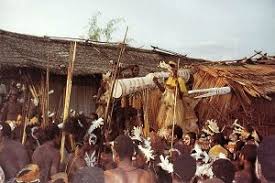
The name “Asmat” most probably comes from the words As
Akat, which according to the Asmat means: “the right man”. Others say
that that the word Asmat derives from the word Osamat meaning “man from
tree”. Asmat’s neighbors to the west, – the Mimika- , however, claim that
the name is derived from their word for the tribe – “manue”, meaning
“man eater”. The approximately 70,000 Asmat
people of the south-central alluvial swamps of Papua Province are of a Papuan
genetic heritage. They are scattered in 100 villages across a 27,000 square
kilometer area in one of the worlds’ largest and most remote alluvial mangrove
swamps— a wet, flat, and marshy place, much of it covered with dense lowland
tropical rain forests. Many of the rivers near the coast rise and fall with the
tides. The Asmat are muscular and tall by New Guinea standards. They average
five feet six inches tall.
Until the
1970s, the Asmat tribe did not have regular contact with the western world.
During this time, they were not living in the Stone Age [yet]. This is because
stone itself was highly unavailable. It wasn’t until the regular visit of the
missionaries [in the 1970s] that they were introduced to knives, axes, and
other metal items.
The area where the Asmat live encompasses some the
last unexplored regions of the world. The land is covered with bog forests and
mangrove and is serrated by many meandering rivers that empty into the Arafura
Sea. The tides submerge an area 100 miles inland. During high tide in the rainy
season, sea water penetrates some two kilometers inland and flows back out to
two kilometers to sea at low tide. During low tide the plains are muddy and
impassable. Here is the habitat of crocodiles, gray nurse sharks, sea snakes,
fresh water dolphins, shrimp, and crabs, while living along the banks are huge
lizards. The forests contain palms, ironwood, merak wood and mangroves and are
home to the crown pigeons, hornbills and cockatoos. There are grass meadows and
orchids. The Asmat have share the region with the Marind-Anim and the Mimika
tribes.
The Asmat have been described as a wood-age culture.
They traditionally have not used stone tools, simply because stones are hard to
find where they live. Up until white missionaries introduced steel fishing
hooks, knives and axes, the only metal or stone items they had were obtained by
trading with highland tribes, and these items were so precious that they were
usually reserved for ceremonial purposes.
The Asmat speak a language that belongs to the
Asmat-Kamoro Family of the Non-Austronesian languages. Bahasa Indonesian is
spoken by many. The population growth rate among the Asmat is estimated at
around 1 percent. There is little migration into and out of the area where the
Asmat live.
ASMAT HISTORY
First
contact with the Asmat was a sighting from the deck of a Dutch trading ship in
1623. Captain Cook later landed in Asmat territory on September 3, 1770, but
the fierce display by the Asmat so frightened the crew that they made a hasty
retreat.
The
Dutch controlled the Asmat territory from 1793-1949, but did not begin
explorations of the area until the early 1900s. The first explorers sent
zoological and artifact specimens back to Europe, where they were received with
curiosity and enthusiasm. The Dutch eventually established a colonial post in
1938. During World War II the post was temporarily closed.
In 1953,
Fr. Zegwaard, a Dutch missionary, reestablished the post at Agats, to serve as
both a government center and a base for missionaries. Agats became the
permanent post of the Catholic Crosier Brothers in 1958. The Crosier
missionaries, who often had anthropology degrees, discouraged the traditional
practices of headhunting and cannibalism, while encouraging the Asmat to retain
many other traditional rituals and festivals. Some of these were eventually
incorporated into the local Catholic practices.
Indonesia received its independence from the Dutch in 1949, but the Dutch
retained control of the western half of New Guinea, including the Asmat region,
until 1962. Then the Asmat area became part of Indonesia. In 1963, to end
headhunting, the Indonesian government burned down all ceremonial houses (jeu),
actively discouraged Asmat ritual and festivals, and severely limited dancing
and drumming. This crackdown lasted until 1968.
The
Crosier Brothers, with Bishop Sowada as their lead spokesperson, intervened to
stop the destructive policy of the Indonesian government. The bishop expressed
the importance of ceremony and ritual in Asmat life, declaring that “without
art and ritual the Asmat culture could not survive”.
To
aid in the resurgence of Asmat art and ritual, the United Nations underwrote a
project from 1968 to 1974 to encourage wood carving. Later, under the combined
efforts of Bishop Sowada, Tobias Schneebaum, Gunter and Ursula Konrad, the
Asmat Museum for Culture and Progress was opened in the early 1980s. Today, the
Museum hosts an annual woodcarving competition and auction that has stimulated
artistic creativity among the Asmat, and has become an economic boon to the
carvers, who are recognized throughout the world for the richness and quality
of their carvings.
In
2000, the Asmat founded the Lembaga Musyawarah Adat Asmat (LMAA) to work with
the Indonesian government on behalf of the interests of the Asmat people. In
2004, the Asmat region became a separate governmental administration, with its
own elected head
ASMAT AND THE DISAPPEARANCE OF
MICHAEL ROCKEFELLER
One of the most famous missing person cases is the
1961 disappearance of Michael Rockefeller, the heir to the Rockefeller oil and
US Steel fortune and the son of Nelson Rockefeller, the American vice president
during the Ford administration. After graduating from Yale with a degree in
ethnology, the twenty-two-year-old Michael went on an expedition to the Asmat
area of New Guinea, where he traded tobacco and steel fishing hooks for carved
Asmat bis-poles to add to the collection at the Metropolitan Museum of Art in
New York.
Rockefeller disappeared on his second expedition to
New Guinea. One of the goals of the expedition to the Asmat region was to
purchase as many woodcarvings as possible. On his first visit Michael had been
deeply impressed by the Asmat sculptures, and planned to display these at an
exhibition in the United States. Today the Metropolitan Museum has an
outstanding collection of Asmat art, the majority of which was collected in
1961 by Michael C. Rockefeller. A group of 17 poles from the village of Otjanep
was delivered to the museum after his disappearance.
Michael Rockefeller was last seen on November 16, 1961
in a jerry-rigged catamaran bound for the village of Otjaneps. He had left the
town of Agats with two mission boys and the Dutch anthropologist Renee Wassing
when the boat’s 18-horsepower motor conked out in the mouth of the Sirets
river. The two boys immediately started swimming for shoreline to get help and
Rockefeller and Davis spent the night on the boat as it drifted out to sea. The
next morning Rockefeller could still see the shore. He tied his steel rimmed
glasses around his neck and attached himself to empty oil cans for buoyancy.
His last words were “I think I can make it.”
Rockefeller was never seen again. The Dutch navy,
various missionary boats, the Australian Air Force and an American aircraft
carrier participated in the search. Nelson Rockefeller and Michael’s twin
sister Mary arrived in a chartered plane and hired 12 Neptune aircraft to
search the sea and paid the Asmat large amounts of black tobacco in return for
participating in search parties. The search lasted for 10 days before it was
abandoned.
The Lawrence and Lorne Blair suggest that Rockefeller
was either eaten by sharks, drowned or was eaten by Asmat headhunters. To back
up the last hypothesis they suggest he might have been killed in revenge for
the murder of four Asmat warleaders by a Dutch government patrol in 1958. They
also point out that seems likely he made it to land because it is possible to
touch the sea bottom three kilometers from shore and wade in from a kilometers
and half out. Locals say there are few sharks in the water and the only thing
they worry about is stepping on a stingray.
An elder war leader in Otjanep told the Blairs that
after returning from fishing some of his friends found Rockefeller laying in
the mud, breathing heavily. Relatives of the friends had been killed by the
Dutch and they speared Rockefeller out of revenge and then dragged his body back
to the village where his head was cut off with a bamboo knife. The cuts were
cleaned out and the body was thrown on a fire. The meat was divided among the
people of the village and the most important men ate the brains.
ASMAT RELIGION
Many Asmat have converted to Christianity, although a
large number continue to practice the religion of their ancestors. For example,
many believe that all deaths—except those of the very old and very young—come
about through acts of malevolence, either by magic or actual physical force.
Ancestral spirits demand vengeance for these deaths. The ancestors to whom they
feel obligated are represented in shields, in large, spectacular wood carvings
of canoes, and in ancestor poles consisting of human figurines. Until the late
1980s, the preferred way for a young man to fulfill his obligations to his kin
and his ancestors and prove his sexual prowess was to take the head of an enemy
and offer the body for cannibalistic consumption by other members of the
village The Asmat have traditionally been animists who believed in a
pantheon of spirits that dwelled in trees, rivers or natural objects or were
spirits of deceased ancestors. The goal of religion was to bring about harmony
and balance with the cosmos. This was achieved through a variety rituals and
practices interwoven with daily life that traditionally included things like
woodcarving, warfare and headhunting. The spirits of ancestors are believed to
be the cause of many illnesses and some rituals are meant to appease them. Asmat
religious practitioners include sorcerers and shaman, whose primary duties are
to mediate between the human and spiritual world, often in the form of healing
and exorcisms. To become a shaman requires a long apprenticeship. Clan leaders
preside over rituals and ceremonies such as adult adoption, initiation and the
construction of men’s houses. Asmat rituals have traditionally been performed
in accordance with a two- or four-year cycle and included dancing, epic poem
singing and woodcarving. Revenge warfare and headhunting raids were often
performed in accordance with the ritual calendar. ~
The Asmat equate a human with a tree. The legs are the
roots, the torso is the trunk, the branches, arms, and the head, fruit. In the
old days in some parts of the Asmat world a freshly severed head—the fruit—was
needed for initiation rites in which a boy became a man by placing the head
between his thighs to draw its power
ASMAT CREATION MYTH
In the beginning, according to the Asmat creation
myth, a corpse of a man floating in the sea was brought to life by a great
bird. In a previous life the man had seduced his brother’s wife and was
banished from his community and drowned when his boat capsized during his
escape. On returning to life he floated to the land where the Asmat live today.
But there was on one there and he grew bored. He tried bring to life some
statues he carved but no luck, finally the spirit told him to go into the
jungle to seek out the “tree woman.”
The man was told to chop off the tree woman’s head and
return it to village where it would bring the statues he made to life. The man
did what he was told. The spirit was right and soon the statues were dancing
around to his delight. Then, one day a crocodile showed up and it and the man
engaged in a horrible battle. The man eventually emerged the winner but he was
so angry he chopped the crocodile in three pieces: one he hurled so far it lost
its color. This produced the white race. Another was tossed a little less hard
so it lost only part of its color. This produced man with brown skin. The third
was left where it was giving rise to black men.
ASMAT IS THE DESCENT OF THE GOD
In ancient times, a God
named Fumeripitsy came down to earth. He explored the earth and started his
adventure from the western horizon of the sunset. In his adventure, the God had
to confront a giant crocodile and defeat him. Despite the victory, the god was
badly wounded and washed up on a river bank.
Although felt hurt, the
God tried to survive until he met a flamingo bird that is noble. He helped the
Gods to recover from the wound. After recovering, the gods lived in that area
and built a house then carved two very beautiful statues. He also made a very
loud drum sound to keep him dancing endlessly. The dance movement of the God
was so powerful that it makes the two sculptures carved into life. Soon after,
the two statues joined in the dance and moved to follow the God. The two
statues were the first human couple to be the ancestors of the Asmat tribe.
THE REASON WHY ASMAT DECLARED THEMSELVES AS THE DESCENDANTS OF GOD
The mythological about
the descents of the God is a trust owned by the Asmat Tribe, one of the largest
tribes in Papua. This myth keeps the Asmat tribe believing that they are gods
until now. It is not excessive, because Asmat does have a culture that is highly
respected. In fact, this tribe has been known to foreign countries. That
is why it’s not surprised if there are many researchers from around the world
often visit the village of the tribe Asmat. They are generally interested in
studying the life of the Asmat, its belief system, and the unique customs of
the Asmat tribe.
ASMAT AND CHRISTIANITY
Many Asmat have converted to Christianity. There has
been a great effort to adapt Christianity to the needs of the Asmat. One
missionary said, “We can stretch our minds as far as possible and still we
can never see the world as the Asmat do.” In an effort to help the Asmat
“find God in the natural world,” Father Vince Cole wears and tooth
necklace and fur headband over his red shirt and cut-off blue jeans.
Attempting to rebuild the Asmat culture, which was nearly
destroyed in the 1960s by the Indonesian government, which tore down men’s
house, outlawed feasts and destroyed sacred objects, the Crosiers incorporated
Asmat rituals into their Catholic services. They also acted as mediators in
clan conflicts and as intermediary between the Asmat and the Indonesian
government. Some Catholic churches have been modeled after the traditional
men’s house with fire pits, ancestor poles and altars made from huge tree
trunks. Christ is depicted with a crown of feathers. Worshipers at one church
are called to prayer with a bell made from an old brake drum. At prayer
meetings held at the traditional men’s house men come with painted bodies,
egret feathers stuck in their headbands, and daggers made from cassowary
shinbones. The worshipers drum, dance, pass around roasted sago as a sign of
sharing, and read passages from a Bible translated into the Asmat language.
The Asmat believe that when they killed and ate a
person, they became that person and absorbed his skills. This is similar, of
course, to the Catholic belief that we eat the body of Christ to become Christ.
So missionaries say, ‘Look you don’t have to go out and kill. You now have
Christ’…What are Catholics after all, but ritualist cannibals?”
The Asmat have also done their bit to adapt to Christian
Western culture. In the village of Agats they are forbidden from appearing
naked. Some worked for several weeks to earn money for shorts.
ASMAT FUNERALS
Asmat funeral ceremonies feature ceremonial shields
which represent the revenge of the dead, ancestor poles (bis) and
ancestor figures (kawa). There is often intense grieving and physical
expressions of loss. To express their grief over the loss of a husband Asmat
women traditionally rolled in patches beside their house. The ritual was
intended not only as an expression of grief but also a way to mask the woman’s
scent from his ghost. Other mourners cover their head with red clay and stab
the earth with bone daggers.
Sometimes the Asmat begin mourning the dead before
they are dead. There was a story of a man who was dying when the villagers
rushed into his house to wail over him and “suffocated the poor
fellow.” Another time a woman collapsed in front of her house. Her family
gather around inside the house expressing their grief and received a terrible
shock when the “dead” woman walked in demanding to know what was
going on. Apparently she only fainted.
The purpose of an Asmat funeral is to placate the
spirits of the dead so they don’t bother the living. Those successfully
placated enter safon; “the other side.” The bodies of Asmat dead
used to be wrapped in pandanus leaves placed on platforms to rot after the head
had been removed and was worn as pendant or used as a pillow.
ASMAT HEADHUNTING AND CANNIBALISM
Until the 1950s, warfare, headhunting, and cannibalism
were constant features of Asmat social life. The people would build their
houses along river bends so that an enemy attack could be seen in advance. Many
Asmat believe that all deaths—except those of the very old and very young—come
about through acts of malevolence, either by magic or actual physical force.
Ancestral spirits demand vengeance for these deaths. The ancestors to whom they
feel obligated are represented in shields, in large, spectacular wood carvings
of canoes, and in ancestor poles consisting of human figurines. Until the late
1980s, the preferred way for a young man to fulfill his obligations to his kin
and his ancestors and prove his sexual prowess was to take the head of an enemy
and offer the body for cannibalistic consumption by other members of the
village.
The Asmat have traditionally practiced headhunting,
cannibalism as part of their ritualized warfare scheme which usually involved
revenge rectification of cosmic or clan imbalances. The heads from captured
enemies were baked and skinned; a hole was cut in the skull and the brain was
scraped out and eaten. The lower jaws were ripped off and worn as a pendant
advertising prowess in war, and the skull was used as a pillow. Asmat believe
they are related to praying mantises which also eat their own kind. Trophy skulls,
bone daggers, stone clubs are all associated with headhunting. As a symbol of their
headhunting skills men often wear bamboo and cassowary-quill pendants decorated
with human vertebrae. Women sometimes borrow the pendants during feasts and
wear them with dog-tooth necklaces and possum fur bonnets.
Officially headhunting ended the Indonesian part of
New Guinea in the 1960s. But it still seemed to be going on in the 1970s and
who knows perhaps it goes on from time to time even now in remote areas. Some
anthropologists have said prohibition of clan warfare and headhunting has left
a huge void in Asmat culture that the modern world has yet to replace.
ASMAT REVENGE WARS
The Asmat have traditionally believed that only the
very young and very old die from natural causes. Everybody else died as a
result of black magic or tribal fighting. Therefore, almost every death needs
to be avenged. In the old days this concept resulted in headhunting raids and
revenge wars. These day the power of the dead is still taken very seriously but
is dealt with ceremonial rituals but “avenging” still may occur.
Asmat warfare was traditionally in the form of raids,
ambushes and skirmishes. Head hunting raids were usually organized to avenge
the killing of a member of the raider’s tribe. Before the raid began the men
painted themselves and decorated their canoes while women prepared a victory
feast and exhorted their men to fight bravely. If you don’t fight, you can be
branded a coward, a traitor. The young people grow up hearing their leaders
talk about the great wars. Then they go out and fight too.
Another way for one tribe to make peace with another
is for a chief in one tribe to give a child to another, often to make amends
for a child killed in a previous raid. To ease tensions sometimes neighboring
villages adopt members of each other’s tribe. During the “adoption”
“children” paint their faces with ocher and cover their heads with
palm leaves. Men of the other tribe lay naked and face down and their women
stand above them. The “children” then climb over the men’s bodies and
through the women’s legs in an act meant to symbolize coming through the womb.
The woman moan as if they are in labor and the “children” keep their
eyes closed until they have emerged. When a child is through the woman’s legs
the “father” announces the successful birth. The “children” continue
playing their roll for several more days, acting childish and learning how to
fish and hunt.
ASMAT RAIDING PARTIES AND REVENGE
WARS
An Asmat raiding party typically took off in canoes
and parked them a couple of river bends before the village they planned to
attack. One of the chiefs got out to scout a good route. The raiding party then
broke into two groups: one heading through the forest and other advancing in
canoes. When groups were in position a handful of lime was thrown into the air
signaling the raid to begin. Surprise was important. The idea was to kill everybody
before they had a chance to get their weapons. As many as forty or fifty people
were killed in some raids, including women and children. While the bodies
of the dead were dragged to trenches for burial the headhunters sang: “We
have killed a man, we have killed a man, we are happy.” Dragging the
bodies through the trenches the warriors shouted, “There’s no need for you
to attack us again. We’ve revenged our dead now, so let’s live in peace.”
The heads were then cut off with bamboo knives and carried home. Once in the
villages the warriors went into their ceremonial house and displayed each head
and related the story of how it was captured.
Journalist Malcolm Kirk landed at a village in the
Asmat area in the 1970s. The atmosphere he said was disturbing. The town was
unnaturally quiet and the men who greeted them were armed with bows and arrows.
His guide told him that they had better get out of there, “I’ll explain
why later.” When they were safely around a bend in their boat the guide
said, “We walked right into a head hunting raid. Everyone we saw was from
another village. The [villagers] heard them coming and fled.” Kirk then went to
another village, called to, and traded some tobacco and fishhooks for some bone
and crocodile jaw daggers. When they went back to their boat their guide told
them that 15 bowmen watched them from the jungle ready to kill on signal. But
why? “The Two people had recently gone head hunting and killed five
people. They thought we might have come to punish them,” the guide said
The Indonesian government no longer allows revenge
killing and the consumption of human brains. To end Asmat clan warfare, the
government banned Asmat festivals and burned their carvings. Attacks, ambushes
and skirmishes still occur from time to time. Missionaries complain that if the
Asmat were left to their own devises they would spend all their time drumming,
dancing and plotting wars.
THE GOVERNMENT STARTED TO PAY ATTENTION TO ASMAT
TRIBE
Although the Dutch
colonial government did not cover the territory of Asmat until 1938, and
Catholic missionaries also just started their mission in 1958, in fact major
changes occurred in the region after the 60s. In the early 90s, Asmat tribes
began to follow education programs from the government and began to embrace
Christianity.
As the wood and oil
processing industries began expanding into this region, fragile environmental
conditions and mangrove forests in their coastal areas are threatened with
destruction due to waste disposal and soil erosion. Although the Asmat have
succeeded in achieving national and international awards for their artwork,
this fame has not provided significant input to the Indonesian government in
making decisions affecting land use in the Asmat territory until the early 90s.
Those are the history of
Asmat Tribe Indonesia. Behind the admiration of Asmat’s art it might embedded
in the minds of the people that Asmat tribe is a primitive tribe and cannibal
humans who like to head enemies. Today Asmat tribe is more famous for its work
art in the field of sculpture and carving. No matter what cultures that Asmat
people have, it is one of the Indonesians culture that must be preserved.
Source: Peter and Kathleen Van
Arsdale, Encyclopedia of World Cultures, Oceania edited by
Terence Hays, (G.K. Hall & Company, 1991)
Source: Malcolm Kirk, National
Geographic, March 1972
Source: “Ring of Fire” by
Lawrence and Lorne Blair, Bantam Books, New York
In Greek mythology, the Amazons were a race of warlike women noted for their courage and pride who lived at the outer limits of the known world, sometimes specifically mentioned as the city of Themiskyra on the Black Sea. Their queen was Hippolyta and although Homer tells us
they were ‘the equal of men’, they fought and lost separate battles against three Greek heroes: Hercules, Theseus and Bellerophon. Scenes from these battles were popular in Greek art, especially on pottery and in
monumental sculpture adorning some of the most important buildings in the Greek
world.
In mythology, the Amazons were daughters of Ares, the god of war. They were a women-only society where men were welcomed only for breeding purposes and all male infants were killed. In legend, the Amazons burnt off their right breast in order to better use a bow and throw a spear, indeed, the word amazon may signify ‘breastless’. Interestingly though, Amazons are not depicted in Greek art with a missing breast. They are most often depicted wearing hoplite armour and frequently ride a horse. The most common weapon is the bow and spear but there are also examples where Amazons carry axes.
IN GREEK ART AMAZONS CAME TO REPRESENT BARBAROUS
FOREIGNERS.
ETYMOLOGY
The origin of the word is uncertain. It may be derived from an Iranian ethnonym *ha-mazan- “warriors”, a word attested indirectly through a derivation, a denominal verb in Hesychius of Alexandria’s gloss. “ἁμαζακάραν· πολεμεῖν. Πέρσαι” (“hamazakaran: ‘to make war’ in Persian”), where it appears together with the Indo Iranian root *kar- “make” (from which Sanskrit karma is also derived).
It may also be derived from *ṇ-mṇ-gw-jon-es “manless, without husbands” (a- privative and a derivation of *man- also found in Slavic muzh) has been proposed, an explanation deemed “unlikely” by Hjalmar Frisk. 19th century scholarship also connected the term to the ethnonym Amazigh. A further explanation proposes Iranian *ama-janah “virility-killing” as source.
The Hittite researcher Friedrich Cornelius assumes that there had been the land Azzi with the capital Chajasa in the area of the Thermodon-Iris Delta on the coast of the Black Sea. He brings its residents in direct relation to the Amazons, namely based on its name (woman of the land Azzi = ‘Am’+ ‘Azzi’ = Amazon) and its customs (matriarchal custom of promiscuous sexual intercourse, even with blood relatives). The location of that land as well as his conclusions are controversial. — Gerhard Pollauer
Among Classical Greeks, amazon was given a folk etymology as originating from a- (ἀ-) and mazos (μαζός), “without breast”, connected with an etiological tradition once claimed
by Marcus Justinus who alleged that Amazons had their right breast cut off or burnt out. There is no indication of such a practice in ancient works of art, in which the Amazons are always represented with both breasts, although one is frequently covered. Adrienne Mayor suggests the origin of this myth was due to the word’s etymology.
Greeks also used some descriptive phrases for them. Herodotus used the Androktones (Greek: Ανδροκτόνες, singular Ανδροκτόνα, Androktonα) (“killers of men”) and Androleteirai (Greek: Ανδρολέτειραι, singular Ανδρολέτειρα, Androleteira)
(“destroyers of men, murderesses”), in the Iliad they are also called Antianeirai (Greek: Αντιάνειραι, singular Αντιάνειρα, Antianeira)
(“those who fight like men”) and Aeschylus in his work, Prometheus Bound, used the styganor (Greek: στυγάνορ) (“those who loathe all men”).
ORIGINS
Herodotus and Strabo placed them on the banks of the Thermodon and Themiscyra. Herodotus also mentions that some Amazons lived at Scythia because after the Greeks
defeated the Amazons in battle, they sailed away carrying in three ships as many Amazons as they had been able to take alive, but out at sea the Amazons attacked the crews and killed them, then these Amazons landed at Scythian lands. Strabo writes that the original home of the Amazons was in Themiscyra and the plains about Thermodon and the mountains that lie above them, but were later driven out of these places, and during his time they were said to live in
the mountains above Caucasian Albania (not to be confused with the modern Albania), but he also states that some others, among them Metrodorus of Scepsis and Hypsicrates, say that after Themiscyra, the Amazons traveled and lived on the borders of the Gargarians, in the northerly foothills of those parts of the Caucasian Mountains which are called Ceraunian. Diodorus giving the account of Dionysius of Mitylene, who, on his part, drew on Thymoetas states that before the Amazons of the Thermodon there were, much earlier in time, the Amazons of Libya. These Amazons started from Libyapassed through Egypt and Syria, and stopped at the Caïcus in Aeolis, near which they founded several
cities. Later, he says, they established Mitylene a little way beyond the
Caïcus. Aeschylus, at Prometheus Bound, places the original home of the Amazons in the country about Lake Maeotis and they later moved to Themiscyra on the Thermodon. According to Pseudo-Plutarch, the Amazons lived in and about the Tanais (Greek: Τάναϊς) river (modern Don river),
formerly called the Amazonian or Amazon (Greek: Ἀμαζόνιος) river, because the
Amazons bathed themselves therein. The Amazons later moved to Themiscyra (modern Terme) on the River Thermodon(the Terme river in northern Turkey). Plutarch, mentions that the campaign(s) of Heracles and Theseus against the Amazons was
at Euxine Sea (modern Black Sea). Homer tells that the Amazons were sought and found somewhere near Lycia.
The Amazons were supposed to have founded many towns, amongst them Smyrna, Ephesus, Cyme, Myrina, Sinope, Paphos, Mitylene. At Patmos there was a place called
Amazonium. Also, on the island of Lemnos, there was another Myrina. The cities of Myrina had this name after the amazon Myrina.
Apollonius Rhodius, at Argonautica, mentions that at Thermodon the Amazons were not gathered together in one city, but scattered over the land, parted into three tribes. In one part dwelt the Themiscyreians (Greek: Θεμισκύρειαι), in another the Lycastians (Greek: Λυκάστιαι), and in another the Chadesians (Greek: Χαδήσιαι).
OTHER NAME
Greeks also used other names for
them. Herodotus used the Androktones (Greek: Ανδροκτόνες, singular Ανδροκτόνα, Androktonα)
(“killers/slayers of men”) and Androleteirai (Greek: Ανδρολέτειραι, singular Ανδρολέτειρα, Androleteira)
(“destroyers of men, murderesses”), in the Iliad they are also called Antianeirai (Greek: Αντιάνειραι, singular Αντιάνειρα, Antianeira)
(“those who fight like men”) and Aeschylus used the Steganor (Greek: Στυγάνορ)
(“those who loathe all men”)
Herodotus stated that in the Scythian
language they were called Oiorpata, oior means “man”, and pata means “to slay”
FIGHTING GREEK HEROES
The first meeting between Greeks and Amazons was when Hercules was sent by Eurystheus, the king of Mycenae, Tiryns and Argos on one of his celebrated twelve labours, this time to fetch the girdle of the Amazon queen Hippolyta. The girdle was given by her father Ares and the task was set
by Eurystheus precisely because it was an impossibly dangerous endeavour. In some versions of the story Hercules goes alone but in other accounts he first assembles an army led by the finest Greek warriors, including Theseus. In some versions, the taking of the girdle turned out to be rather easier than expected when Hippolyta willingly handed it over but in other versions, Hera – always
against Hercules because he was the fruit of her husband’s illicit affair with Alkmene – stirred up the Amazons to give the Greek hero and his army a hot reception. Fine fighters though the Amazons were, they were no match for the invincible Hercules who took the girdle back to Eurystheus. Intriguingly, our earliest depictions of the story in pottery predate the literary sources for the tale by two centuries and they sometimes show Hercules fighting an Amazon named Andromache or Andromeda and in none is a belt ever depicted. This is,
once again, evidence that the oral myths were more complicated and varied than
the literary versions that have survived. A more definite plot element is that during this expedition Theseus fell in love with and abducted (or eloped with) the Amazon Antiope, an action which would lead to a second encounter between Greeks and Amazons. Hercules fighting Amazons was
represented in sculpture on the frieze of the Treasury of the Athenians at Delphi (490 BCE), on the Temple of Apollo at Bassae, on the Hephaisteion of Athens (449 BCE)
and on metopes on the Temple of Zeus at Olympia (470-456 BCE). The throne of the cult statue of Zeus, one of the Seven Wonders of the ancient world, was also decorated with scenes from this famous myth.
Theseus eventually became the ruler of Athens but the Amazons had not forgotten the loss of one of their members and so launched an expedition to rescue Antiope. Theseus defeated the barbarian invaders but during the battle, Antiope was killed. Theseus abducting Antiope is the subject of the pediment from the Temple of Apollo at Eretria (c. 510 BCE) and on the metopes of The Treasury of the Athenians at Delphi.
Bellerophon was involved in a third meeting between Greeks and Amazons. He was another hero who had to perform impossible tasks in service to a king. This time Proitos, king of Argos, outraged at (false) accusations from his wife that Bellerophon had attacked her, the king sent the hero to serve Iobates. It was he who set the hero the task of killing the Chimera – a fantastic creature which was a fire-breathing mix of lion, snake and goat – and when Bellerophon managed that
feat he was told to go off and fight the Amazons. Naturally, the Greek hero won
the day and was even made heir to Iobates’ kingdom in Lycia on his victorious return. A fourth and final meeting with Amazons came towards the end of the Trojan War. In the Epic Cycle we are told that the Amazon Penthesilea aided the Trojans but was
killed in battle by Achilles. In some accounts Achilles fell in love with his victim when he removed her helmet and the scene is captured on a celebrated black-figure vase by Exekias (c. 540 BCE).
MYTHOLOGY
In some versions of the myth, no men were permitted to have sexual encounters or
reside in Amazon country; but once a year, in order to prevent their race from dying out, they visited the Gargareans, a neighbouring tribe.
Strabo, giving credits to Metrodorus of Scepsis and Hypsicrates, mentions that at his time the Amazons were believed to live on the borders of the Gargareans. There were two special months in the spring in which they would go up into the neighboring mountain which separates them and the Gargareans. The Gargareans also, in accordance with an ancient custom, would go there to offer sacrifice with the Amazons and also to have intercourse with them for the sake of begetting children. They did this in secrecy and darkness, any Gargareans at random with any Amazon, and after
making them pregnant they would send them away. Any females that were born are
retained by the Amazons themselves, but the males would be taken to the Gargareans to be brought up; and each Gargarean to whom a child is brought would adopt the child as his own, regarding the child as his son because of his uncertainty. He also stated that the Gargareans went up from Themiscyra into this region with the Amazons, then, in company with some Thracians and Euboeans who had wandered thus far, waged war against them. They later ended the war against the Amazons and made a compact that they should have dealings with one another only in the matter of children, and that each people should
live independent of the other. In addition, he states that the right breasts of all Amazons are seared when they are infants, so that they can easily use their right arm for every needed purpose, and especially that of
throwing the javelin and use the bow.
Herodotus mentions that when Greeks defeated the Amazons at war, they sailed away carrying in three ships as many Amazons as they had been able to take alive,
but out at sea the Amazons attacked the crews and killed them. But the Amazons
knew nothing about ships so they were driven about by waves and winds and they
were disembarked at the land of the Scythians, there they met first with a troop of horses feeding, they seized them and mounted upon these they plundered the property of the Scythians. The Scythians were not able to understand them because they did not know either their speech or their dress or the race to which they belonged, and they thought that they were men. Scythians fought a battle against them, and after the battle the Scythians got possession of the bodies of the dead, and thus they discovered that they were women. After the battle Scythians sent young men and told them to encamp near the Amazons and to
do whatsoever they should do. If the women should come after them, they were not to fight but to retire before them, and when the women stopped, they were to approach near and encamp. This plan was adopted by the Scythians because they desired to have children born from them. When the Amazons perceived that they had not come to do them any harm, they let them alone; and the two camps approached nearer to one another every day: and the young men, like the Amazons, had nothing except their arms and their horses and got their living, as the Amazons did, by hunting and by taking booty. One day a Scythian and an Amazon came close. They could not speak to each other because they were speaking different languages but the Amazon made signs to him with her hand to come. Later the young Scythians and the Amazons joined their camps and lived together, each man having for his wife her with whom he had had dealings at first. The men were not able to learn the language of the Amazons, but the
women learned Scythian.
Apollonius Rhodius, at Argonautica, mentions that Amazons were the daughters of Ares and Harmonia (a nymph of the Akmonian Wood). They were brutal and aggressive, and their main concern in life was war. According to him, the Amazons were not gathered together in one city, but scattered over the land, parted into three tribes. In one part dwelt the Themiscyreians (Greek: Θεμισκύρειαι), in another the Lycastians (Greek: Λυκάστιαι), and in another the Chadesians (Greek: Χαδήσιαι). Also, he mention that on an island, the Queens of the Amazons, Otrere (Greek: Ὀτρηρή) and Antiope (Greek: Ἀντιόπη),
built a marble temple of Ares. On this desert island there were ravening birds, which in countless numbers haunt it. Argonauts passed by Themiscyra on their journey to Colchis. Zeus sent Boreas (the North Wind), and with his help the Argonauts stood out from the shore near Themiscyra where the Themiscyreian Amazons were arming for battle.
The King Iobates sent Bellerophon against Amazons, hoping that they would kill him, but Bellerophon killed them all.
The Amazons appear in Greek art of
the Archaic period and in connection with several Greek legends. The tomb of Myrine is mentioned in the Iliad; later interpretation made of her an Amazon: according to Diodorus, the Amazons under the rule of Queen Myrina, invaded the lands of the Atlantians. Amazons defeated the army of
the Atlantian city of Cerne, treated the captives savagely, killed all the men, led into slavery the children and women, and razed the city. When the terrible fate of the inhabitants of Cerne became known among the other Atlantians, they were struck with terror, surrendered their cities on terms of capitulation and announced that they would do whatever should be commended them. Queen Myrina bearing herself honourably towards the Atlantians, established friendship with them and founded a city to bear her name in place of the city of Cerne which had been razed; and in it she settled both the captives and any native who so
desired. Atlantians presented her with magnificent presents and by public decree voted to her notable honours, and she in return accepted their courtesy and in addition promised that she would show kindness to their nation. Diodorus also mentions that the Amazons of Queen Myrina used the skins of gigantic snakes, from Libya, to protect themselves at battle. Later Queen Myrine led her Amazons to victory against the Gorgons. After the battle against the
Gorgons, Myrina accorded a funeral to her fallen comrades on three pyres and raised up three great heaps of earth as tombs, which are called “Amazon Mounds” (Greek: Ἀμαζόνων σωροὺς).
One of the tasks imposed upon Hercules by Eurystheus was to obtain possession of the girdle of the Amazonian queen Hippolyta. He was accompanied by his friend Theseus, who carried off the princess Antiope, sister of Hippolyta, an incident which led to a retaliatory invasion of Attica, in which Antiope perished fighting by the side of Theseus. In some versions, however, Theseus
marries Hippolyta and in others, he marries Antiope and she does not die; by this marriage with the Amazon Theseus had a son Hippolytus.
In another version of this myth, Theseus made this voyage on his own account, after the time of Heracles. The battle between the Athenians and Amazons is often commemorated in an entire genre of art, amazonomachy, in marble bas-reliefs such as from the Parthenon or the sculptures of
the Mausoleum of Halicarnassus.
Plutarch, in his work Parallel Lives-The Life of Theseus, mentions that Bion said that the Amazons, were naturally friendly to men, and did not fly from Theseus when he touched upon their coasts.
Amazons attacked the Phrygians, who were
assisted by Priam, then a young man. In his later years, however, towards the end of the Trojan War, his old opponents took his side
against the Greeks under their queen Penthesilea “of Thracian birth”, who was slain by Achilles.
The god Dionysus and his entourage fought the amazons at Ephesus, the amazons fled to Samos, but Dionysus pursued them and at Samos he killed a great number of them on a
spot which was, from that occurrence, called Panaema (Greek: Πάναιμα), which means blood-soaked field. In another myth Dionysus united with the Amazons to fight against Cronus and the Titans.
The Amazons are also said to have undertaken an expedition against the island of Leuke, at the mouth of the Danube, where the ashes of Achilles had been deposited by Thetis. The ghost of the dead hero appeared
and so terrified the horses, that they threw and trampled upon the invaders, who were forced to retire. Pompey is said to have found them in the army of Mithridates.
They are heard of in the time of Alexander, when some of the king’s biographers make
mention of Amazon Queen Thalestris visiting
him and becoming a mother by him (the story is known from the Alexander Romance). However, several other biographers of Alexander dispute the claim, including the highly regarded secondary source, Plutarch. In his writing he makes mention of a moment when Alexander’s secondary naval commander, Onesicritus, was reading the Amazon passage of his Alexander history to King Lysimachus of Thrace who was on the original expedition: the king smiled at him and said “And where was I, then?”
The Roman writer Virgil’s characterization of the Volscian warrior maiden Camilla in the Aeneid borrows heavily from the myth of the Amazons.
Jordanes’ Getica (c. 560), purporting to give the earliest history of the Goths, relates that the Goths’ ancestors, descendants of Magog, originally dwelt within Scythia, on the Sea of Azov between the Dnieper and Don Rivers.
After a few centuries, following an incident where the Goths’ women successfully fended off a raid by a neighboring tribe, while the menfolk were off campaigning against Pharaoh Vesosis, the women formed their own army under Marpesia and crossed the Don, invading Asia. Her sister Lampedo remained in Europe to guard the homeland. They procreated with men once a year. These
Amazons conquered Armenia, Syria, and all of Asia Minor, even reaching Ionia and Aeolia, holding this vast territory for 100
years. Jordanes also mentions that they fought with Hercules, and in the Trojan
War, and that a smaller contingent of them endured in the Caucasus Mountains until the time of Alexander. He mentions by name the Queens Menalippe, Hippolyta, and Penthesilea.
In the Grottaferrata Version of Digenes Akritas, the twelfth century medieval epic of Basil, the Greek-Syrian knight of the Byzantine frontier, the hero battles with and kills the female warrior Maximo.
AMAZONOMACHIES
More general Amazonomachies (battles with Amazons) were present on the shield of the cult statue of Athena Parthenos in the Parthenon (438 BCE), on the west pediment of the Temple of Asklepios at Epidaurus (395-375 BCE), on the Temple of Athena Nike on the Athenian Acropolis (c.425-420 BCE), on the Tholos of Delphi (380-370 BCE) and on the Temple of Ares in the Athens agora. The oldest depiction of a warrior fighting an Amazon is on a terracotta votive shield from
700 BCE. Hercules fighting Amazons is the hero’s second most popular labour depicted on Greek black-figure pottery (after the Nemean lion) with almost 400 surviving
examples. Amazons fighting unnamed warriors were common throughout the 6th and 5th centuries both on black and red-figure pottery.
In particular, during the 5th century BCE in Athens, these mythological battles with Amazons came to represent contemporary events, i.e. the battles between Greeks and the invading Persian Armies of Dariusat Marathon (490 BCE), Xerxes at Salamis and the Persian attack on Athens itself in 480 BCE. In this sense, Amazons came to represent barbarous foreigners; indeed depictions of Amazons on pottery in this
period are shown actually dressed in Persian costume. Public buildings and their accompanying sculpture were, without doubt, an important method of mass
communication and depictions of heroes fighting Amazons reminded ordinary
people that the political leaders had successfully defended Greek culture
against the threat of foreign, and in Greek eyes less civilized, invaders.
•••
By Johnson Okunade
About Me
I’m a Writer, Humanitarian, Historian, Computer Scientist, Blogger, Web Developer, Web Content Creator, Culture Activist, A Bowen University graduate (Proudly Bowenian), and a friend-to-all. Feel Free to Contact me on Anything.
During the reign of Oba Ozolua (1481 – 1504), two of his wives, Oloi Idia and Oloi Ohonmi, gave birth on the same day. They both had sons.
Oloi Ohomi gave birth in the morning to the first son and he was named Idubor, who was fondly called Aruanran (sometimes spelt Arhuanran).
On the other hand, Oloi Idia gave birth later in the day. Her son
was given the name Osawe (He later became Oba Esigie).
Here’s where the drama started. When Idubor was born, he did not immediately cry. In that era, it was inappropriate to announce the birth of a mute baby to the monarch.
However, Queen Idia’s baby cried as soon as he was born and thus, his birth was reported to Oba Ozolua, who instantly declared him his first son, automatically moving Idubor to the number two slot.
Idubor, while growing up was very bitter about his predicamentt. He more than on one occasion asked his mother, if the king was his true father and why he callously took away his birthright in
such a mean fashion.
Idubor (Arhuanran) grew up to be a giant. Legend has it that he uprooted palm trees with his bare hands, sweeping the ground with the fronds. He turned out to be a great warrior who had the overwhelming advantage of size and stamina.
I must add here that another version of this story reveals that Idubor and Osawe were not actually the eldest sons of Oba Ozolua. They had an elder brother, Ogidigbo, who was said to have become a cripple following a combat competition between him and his brothers. His disability disqualified him from taking over from his father. Citizens secretly pointed accusing fingers at Oloi Idia as being responsible for Ogidigbo’s calamity, using her mystical powers to ensure that her son, Osawe (Oba Esigie)
clinched the crown.
Before his demise in 1504, of Oba Ozolua had already carved out dukedoms for his sons. This was to avoid anarchy in the next dispensation. As compensation, Arhuanran was therefore made the Duke of Udo; a town not too far from Benin.
Please, note that Idia’s role in the nullification of the first son Ogidogbo was not lost on Arhuanran, whose enmity towards his brother Osawe ( Oba Esigie) intensified that he even tried to assassinate him.
A noted warrior and conqueror of the fierce town of Okhumwu, Arhuanran was bigger and stronger, and could easily have trounced the weaker Esigie, whom Oba Ozolua had sent to attend the Portuguese mission school after his baptism.
Arhuanran’s assassination attempts could have succeeded were it not for Idia who was reputedly skilled in magical arts and whom he knew was a formidable opponent he had to overcome.
Realizing he had to acquire supernatural powers if he wanted to take on Idia who was her son’s spiritual protector, oral tradition recounts that Arhuanran retreated to Uroho village to learn the art of black magic from an old sorceress, Iyenuroho (Okpewho).
That he chose a woman as teacher, is clear recognition that his opponent was a woman and that he had to learn the ways of female mystical powers to be assured of victory.
We should note that Esigie’s possible lack of combat experience, is the result of having to attend the school of Portuguese missionaries, rather than join his father in fighting wars.
Failing to accept the facts on ground, the Duke (Enogie) of Udo, Ahruanran refused to play a subordinate role to his brother, Oba Esigie, and at first, tried to make Udo the capital of Benin kingdom, with himself as king. It did not take too long before the two brothers went to war.
The war was difficult, bitter and long drawn out. It was not until the third campaign that Udo was defeated.
The third campaign was timed to coincide with the planting season, when Udo citizen-soldiers, who were mainly farmers, would be busy on their farms.
Meanwhile, Arhuanran had two sons Kpamabira and Onioni. They were ruling alongside their father, but before the war, Kpamabira died.
Prior to the last battle with his brother, Oba Esigie, Arhuanran told his surviving son, Onioni to stay at home and wait for his return, alerting his household to listen out for the sound of the
magical bell that he placed somewhere in the house. He explained that if it chimed, they will know that his brother, Oba Esigie had won the battle.
Later on, as he fought in the war front, Arhuanran was shocked to see a young man fighting just like himself. Without thinking twice, he used a powerful incantation, commanding the sword to immediately kill the copycat fighter (A GBE VBE NI ME GBE NE UMOZO GBEE RIE YOEWE).
At that moment, the warrior died, only for Arhuanran to discover that the man who possessed his fighting skills, was none other than his beloved son, Onioni. Arhuanran had no idea his son had sneaked along to join in the war. In rage and pain, Arhuanran intensified his onslaught on his brother’s army, until there was no winner in the battlefield.
When victory was not forthcoming, Arhuanran decided to run home on time, but his movements were not swift enough… By this time, the magical bell at home was sounding and therefore, Udo people believed Oba Esigie had conquered their duke. This perceived tragedy caused his wife to jump into a river close to the lake (Odighi). She died.
As soon as Arhuanran got home, he found out that his wife had jumped the river. He was so sad. His sons were gone, now his wife… A depressed Arhuanran also jumped into the lake.
Before jumping into the lake, he left his Ivie (coral bead necklace), the symbol of authority in Benin land, dangling from a tree branch were it could be easily found.
Up until this day, many believe that Arhuanran did not die inside the lake (Odighi). They claim he still comes out at night to parade the town of Udo, providing protection for his people.
Before now, the nights Arhuanran came out of the water, all the babies in Udo town would cry non-stop. This trend forced the people of Udo to appeal to Arhuanran spiritually. After specific rituals, the children no longer cried when he came out of the lake.
Furthermore, the river the wife dived into, is directly opposite the lake. A road separates this river from the lake. Once every year, the river always crosses the road to meet the lake where Arhuanran committed suicide.
Even in 2017, it is forbidden to touch or drink the water from that lake. It is also forbidden to kill or eat any animal from or around the lake. The waters were declared sacred.
It was told that around 1955, a group of Udo people were returning from their farm when they saw a young boy shooting birds close to the lake and the stone dropped into the lake.
Immediately, there was a loud voice from the lake that sounded like thunder and many trees around the place shook, as a heavy wind blew. At that moment, the boy became sick and he was rushed home for treatment.
Udo town used that opportunity to tell the public that Arhuanran did not really die, but still lives in the lake; especially as there was never proof of his death.
This is the story of how the world
was created according to the Yorubas of West Africa.
The entire world was filled with water when God decided to create the world.
God sent his messenger Obatala to perform the task of creating the world.
Obatala brought along his helper, a man named Oduduwa as well as a calabash
full of earth and a chicken. Then they began their descent to earth from a
rope.
Along the way, they stopped over at a feast where Obatala got drunk from
drinking too much palm wine. Oduduwa, finding his master drunk, picked up the
calabash and the chicken and continued on the journey.
When Oduduwa reached the earth, he sprinkled earth from the calabash over the
water and he dropped the chicken on the earth. The chicken then ran around
spreading the earth in every direction he moved until there was land. Oduduwa
had now created earth from what used to be water.
Later when Obatala got out of his drunken haze, he discovered that Oduduwa had
already performed his task and he was very upset. God however gave him another
task to perform ? to create the people that would populate the earth.
And that was how the world was created in a place now called Ile-Ife.