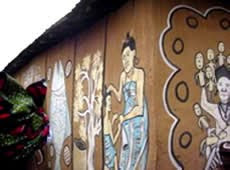
Did you know that there exists a
tribe in Namibian where sex is offered to guests to express honour and foster
relationships?
The people of Ovahimba and Ovazimba tribes in the
Kunene and Omusati regions in Northern Namibia have an upheld culture that has
defied western influence and agitation.
With a population of over 50,000, the women engage in the daily activity of
milking their cows, taking care of the children and other extensive duties
while the men go hunting leaving, sometimes, for an extended period of time.
These nomads’ wealth is determined by the number of cattle one has. A
polygamous people, the Himba girls are married off to male partners selected by
their fathers once they attain puberty.
You cannot ignore the red skin they have. The red colour seen on their skin is
called, the otjize paste (a combination of butterfat, omuzumba scrub and ochre)
and its function is to protect their skin from the sun and insect bites. They
are also guided by the belief that the colour red signifies “Earth and blood”.
Rather than take their baths, the women take a smoke bath and apply aromatic
resins on their skin.
SHORT
HISTORY
They are the original traditional Herero who crossed the Kunene and came from
Angola to Namibia in the middle of the 16th century. They settled in the
Kaokoveld, the north-western part of Namibia and lived a semi-nomadic, pastoral
lifestyle.
The early history of the Herero was fraught with severe droughts and other
disasters. Large groups of the Herero people left the Kaokoveld and looked for
better grazing grounds for their herds in the south-east.
The remaining Herero in the Kaokoveld came under attack from the Swartbooi and
Topnaar Nama in the 19th century. The Nama entered the Kaokoveld from the
south, also looking for better grazing grounds. In 1850 the Nama established a
base in Sesfontein from where they organized raids against the Herero of the
Kaokoveld. Due to the fact that the Herero were widely scattered and the Nama
had much better weapons, large cattle herds were raided from the Herero in the
next 20 years.
As the situation deteriorated and the loss of their material and social wealth
increase the Herero of the Kaokoveld fled over the Kunene River into Angola and
took shelter with the Ngambwe, which granted support to the refugees. They
called the Herero “Ovahimba”, which means “beggar” in the language spoken by
the Ngambwe. Over the years the Herero took over this name still use it until
today.
Most of the Ovahimba followed a popular warrior named Vito back to Namibia in
1920. Ever since and up to the Namibian independence in 1990 the Himba were
able to live their traditional lifestyle. During the recent years the Ovahimba
have been more exposed to the influences of the modern world, although this
mainly refers to the consumption of unhealthy foods, cool drinks and alcohol.
The positive achievements of modern society like a proper health system, modern
schools, pension funds etc. did not yet reach the majority of Ovahimba.
RELIGION
The Ovahimba are a monotheistic people who believe in Mukuru, the creator of
the world, a god who is a vague and distant entity. The belief in ancestral
spirits is much more essential and present. The ancestral spirits are believed
to have received supernatural qualities by Mukuru and thus have the power to
influence the life of the living. The ancestral spirits are the representative
of Mukuru and thus communicate between the Ovahimba (or the human being in
general) and the god.
The place where most of the religious conversation takes place is the holy fire
(okuruwo), a sacred place which is kept by the fire keeper. The holy fire
should always smolder, because it is the sacred connection between the
ancestors and the living. Every family (every homestead) has an own holy fire
which is placed in the middle between the main hut of the homestead and the
kraal.
SOCIAL STRUCTURE AND RITES
The Ovahimba live in large homesteads together with their extended families.
They still practice polygamy; an average Ovahimba husband has two wives. Each
of the wives has her own hut, the main wife resides in the main hut opposite
the entrance of the kraal. Marriages are often arranged by kin. It happens that
even infants are betrothed to adult man in a wedding ceremony. The marriage is
never consummated until the girl reaches menarche and becomes an adult.
The Ovahimba have both, maternal and paternal systems, that means that every
person in the Ovahimba community is a member of both their maternal and
paternal clans. There is a complex inheritance system with mainly material
wealth inherited from the maternal line (often from uncle to nephew) and social
status inherited from the paternal line.
It is a traditional custom to knock out the four lower incisors at the age
between ten and twelve. This has a big social and religious meaning in the life
of an Ovahimba. There are also several initiation rites for boys and girls.
Boys are circumcised, girls undergo a ritual where they have to leave the
homestead during their menarche and are allowed to return back later in company
of experienced older women, followed by a little celebration among friends.
NOMADISM, SUBSISTENCE ECONOMY AND DAILY LIFE
Traditionally the Ovahimba are a so-called “zero-income cultures”. They define
wealth solely based upon the number of cattle the family owns. Besides having
large cattle herds, the Ovahimba breed goats and sheep, grow crops such as
maize and millet. However their main diet is milk and milk products like sour
milk as well as wild herbs, chicken eggs and meat.
During the dry season some members of the extended family leave the homestead
with their herds to find water and grazing grounds in remote areas. Part of the
family stays at the homestead.
The Ovahimba are known as the “red nomads” of Namibia. Especially the women,
but also some men are famous for covering themselves with a perfumed mixture of
ochre pigment and butterfat which has cosmetic characteristics. In fact,
Ovahimba women never wash themselves with water but are very neat when it comes
to personal hygiene. The ochre fat protects the Ovahimba against the sun and
the climate of the extremely hot Kaokoveld and is also an effective mosquito
repellant.
The hair style and the jewelry are very important in the traditions of the
Ovahimba. Hair styles indicate social status and age.
SEX BEING OFFERED TO GUEST
Give honour to whom it is due: This saying is applied differently in this
tribe. When a visitor comes knocking, a man shows his approval and pleasure of
seeing his guest by giving him the Okujepisa Omukazendu treatment. This
practice literally means that his wife is given his guest to spend the night
while the husband sleeps in another room. In a case where there is no available
room, her husband will sleep outside.
This handed down tradition has its “benefits” in the community: it reduces
jealousy and fosters relationships. The woman has little or no opinion in the
decision making. Submission to her husband’s demands come first. She has an
option of refusing to sleep with him but has to sleep in the same room as the
guest.
She is also entitled to give her friends to her husband when they visit but
this rarely happens.
WHAT IS YOUR OPINION ABOUT THIS TRIBE?
Drop your comment below
The BEST way to support us is by providing funding to enable us continue this good work:
Bank: Guarantee Trust Bank (GTBank)
Account Name: Johnson Okunade
Naira Account: 0802091793
Dollar Account: 0802091803
Pounds Account: 0802091810
Euro Account: 0802091827
The bronze work of Igbo-ukuw which can be found in Enugu state remains as the highest of the ancient works of Nigeria art.
It is possible that the inhabitants of Igbo-Ukwu had a metalworking art that flourished as early as the ninth century. Three sites have been excavated, revealing hundreds of ritual vessels and regalia castings of bronze or leaded bronze that are among the most inventive and technically accomplished bronzes ever made. The people of Igbo-Ukwu, ancestors of present-day Igbo, were the earliest smithers of copper and its alloys in West Africa, working the metal through hammering, bending, twisting, and incising.
They are likely among the earliest groups of West Africans to employ the lost-wax casting techniques in the production of bronze sculptures. Oddly, evidence suggests that their metalworking repertory was limited and Igbo smiths were not familiar with techniques such as raising, soldering, riveting, and wire making, though these techniques were used elsewhere on the continent.
Regardless, the talent of these casters was truly astonishing. Many of the castings were made in stages. For instance, in one bronze bowl set on a flat stand found at Igbo-Ukwu, small decorative items including insects and spirals were cast first and placed in the wax model before the main parts of the bowl were made. The vessel itself was then cast in two parts and fitted together by casting a middle band. In addition to a variety of ritual vessels (whose designs appear to reproduce the form of gourd vessels to which metal handles have been attached), many other bronze items have been found at Igbo-Ukwu, including pendants, crowns and breastplates, staff ornaments, swords, and fly-whisk handles. These works were also found with tens of thousands of beads, attained through trade for slaves, ivory, or spices.Igbo-Ukwu bronzeworking was an isolated phenomenon at the time, but bronze casting developed several centuries later in other parts of Nigeria.
Source: Igbo-Ukwu (ca. 9th century) | Thematic Essay | Heilbrunn Timeline of Art History | The Metropolitan Museum of Art
The BEST way to support us is by providing funding to enable us continue this good work:
Bank: Guarantee Trust Bank (GTBank)
Account Name: Johnson Okunade
Naira Account: 0802091793
Dollar Account: 0802091803
Pounds Account: 0802091810
Euro Account: 0802091827
In Greek mythology, the Amazons were a race of warlike women noted for their courage and pride who lived at the outer limits of the known world, sometimes specifically mentioned as the city of Themiskyra on the Black Sea. Their queen was Hippolyta and although Homer tells us
they were ‘the equal of men’, they fought and lost separate battles against three Greek heroes: Hercules, Theseus and Bellerophon. Scenes from these battles were popular in Greek art, especially on pottery and in
monumental sculpture adorning some of the most important buildings in the Greek
world.
In mythology, the Amazons were daughters of Ares, the god of war. They were a women-only society where men were welcomed only for breeding purposes and all male infants were killed. In legend, the Amazons burnt off their right breast in order to better use a bow and throw a spear, indeed, the word amazon may signify ‘breastless’. Interestingly though, Amazons are not depicted in Greek art with a missing breast. They are most often depicted wearing hoplite armour and frequently ride a horse. The most common weapon is the bow and spear but there are also examples where Amazons carry axes.
IN GREEK ART AMAZONS CAME TO REPRESENT BARBAROUS
FOREIGNERS.
ETYMOLOGY
The origin of the word is uncertain. It may be derived from an Iranian ethnonym *ha-mazan- “warriors”, a word attested indirectly through a derivation, a denominal verb in Hesychius of Alexandria’s gloss. “ἁμαζακάραν· πολεμεῖν. Πέρσαι” (“hamazakaran: ‘to make war’ in Persian”), where it appears together with the Indo Iranian root *kar- “make” (from which Sanskrit karma is also derived).
It may also be derived from *ṇ-mṇ-gw-jon-es “manless, without husbands” (a- privative and a derivation of *man- also found in Slavic muzh) has been proposed, an explanation deemed “unlikely” by Hjalmar Frisk. 19th century scholarship also connected the term to the ethnonym Amazigh. A further explanation proposes Iranian *ama-janah “virility-killing” as source.
The Hittite researcher Friedrich Cornelius assumes that there had been the land Azzi with the capital Chajasa in the area of the Thermodon-Iris Delta on the coast of the Black Sea. He brings its residents in direct relation to the Amazons, namely based on its name (woman of the land Azzi = ‘Am’+ ‘Azzi’ = Amazon) and its customs (matriarchal custom of promiscuous sexual intercourse, even with blood relatives). The location of that land as well as his conclusions are controversial. — Gerhard Pollauer
Among Classical Greeks, amazon was given a folk etymology as originating from a- (ἀ-) and mazos (μαζός), “without breast”, connected with an etiological tradition once claimed
by Marcus Justinus who alleged that Amazons had their right breast cut off or burnt out. There is no indication of such a practice in ancient works of art, in which the Amazons are always represented with both breasts, although one is frequently covered. Adrienne Mayor suggests the origin of this myth was due to the word’s etymology.
Greeks also used some descriptive phrases for them. Herodotus used the Androktones (Greek: Ανδροκτόνες, singular Ανδροκτόνα, Androktonα) (“killers of men”) and Androleteirai (Greek: Ανδρολέτειραι, singular Ανδρολέτειρα, Androleteira)
(“destroyers of men, murderesses”), in the Iliad they are also called Antianeirai (Greek: Αντιάνειραι, singular Αντιάνειρα, Antianeira)
(“those who fight like men”) and Aeschylus in his work, Prometheus Bound, used the styganor (Greek: στυγάνορ) (“those who loathe all men”).
ORIGINS
Herodotus and Strabo placed them on the banks of the Thermodon and Themiscyra. Herodotus also mentions that some Amazons lived at Scythia because after the Greeks
defeated the Amazons in battle, they sailed away carrying in three ships as many Amazons as they had been able to take alive, but out at sea the Amazons attacked the crews and killed them, then these Amazons landed at Scythian lands. Strabo writes that the original home of the Amazons was in Themiscyra and the plains about Thermodon and the mountains that lie above them, but were later driven out of these places, and during his time they were said to live in
the mountains above Caucasian Albania (not to be confused with the modern Albania), but he also states that some others, among them Metrodorus of Scepsis and Hypsicrates, say that after Themiscyra, the Amazons traveled and lived on the borders of the Gargarians, in the northerly foothills of those parts of the Caucasian Mountains which are called Ceraunian. Diodorus giving the account of Dionysius of Mitylene, who, on his part, drew on Thymoetas states that before the Amazons of the Thermodon there were, much earlier in time, the Amazons of Libya. These Amazons started from Libyapassed through Egypt and Syria, and stopped at the Caïcus in Aeolis, near which they founded several
cities. Later, he says, they established Mitylene a little way beyond the
Caïcus. Aeschylus, at Prometheus Bound, places the original home of the Amazons in the country about Lake Maeotis and they later moved to Themiscyra on the Thermodon. According to Pseudo-Plutarch, the Amazons lived in and about the Tanais (Greek: Τάναϊς) river (modern Don river),
formerly called the Amazonian or Amazon (Greek: Ἀμαζόνιος) river, because the
Amazons bathed themselves therein. The Amazons later moved to Themiscyra (modern Terme) on the River Thermodon(the Terme river in northern Turkey). Plutarch, mentions that the campaign(s) of Heracles and Theseus against the Amazons was
at Euxine Sea (modern Black Sea). Homer tells that the Amazons were sought and found somewhere near Lycia.
The Amazons were supposed to have founded many towns, amongst them Smyrna, Ephesus, Cyme, Myrina, Sinope, Paphos, Mitylene. At Patmos there was a place called
Amazonium. Also, on the island of Lemnos, there was another Myrina. The cities of Myrina had this name after the amazon Myrina.
Apollonius Rhodius, at Argonautica, mentions that at Thermodon the Amazons were not gathered together in one city, but scattered over the land, parted into three tribes. In one part dwelt the Themiscyreians (Greek: Θεμισκύρειαι), in another the Lycastians (Greek: Λυκάστιαι), and in another the Chadesians (Greek: Χαδήσιαι).
OTHER NAME
Greeks also used other names for
them. Herodotus used the Androktones (Greek: Ανδροκτόνες, singular Ανδροκτόνα, Androktonα)
(“killers/slayers of men”) and Androleteirai (Greek: Ανδρολέτειραι, singular Ανδρολέτειρα, Androleteira)
(“destroyers of men, murderesses”), in the Iliad they are also called Antianeirai (Greek: Αντιάνειραι, singular Αντιάνειρα, Antianeira)
(“those who fight like men”) and Aeschylus used the Steganor (Greek: Στυγάνορ)
(“those who loathe all men”)
Herodotus stated that in the Scythian
language they were called Oiorpata, oior means “man”, and pata means “to slay”
FIGHTING GREEK HEROES
The first meeting between Greeks and Amazons was when Hercules was sent by Eurystheus, the king of Mycenae, Tiryns and Argos on one of his celebrated twelve labours, this time to fetch the girdle of the Amazon queen Hippolyta. The girdle was given by her father Ares and the task was set
by Eurystheus precisely because it was an impossibly dangerous endeavour. In some versions of the story Hercules goes alone but in other accounts he first assembles an army led by the finest Greek warriors, including Theseus. In some versions, the taking of the girdle turned out to be rather easier than expected when Hippolyta willingly handed it over but in other versions, Hera – always
against Hercules because he was the fruit of her husband’s illicit affair with Alkmene – stirred up the Amazons to give the Greek hero and his army a hot reception. Fine fighters though the Amazons were, they were no match for the invincible Hercules who took the girdle back to Eurystheus. Intriguingly, our earliest depictions of the story in pottery predate the literary sources for the tale by two centuries and they sometimes show Hercules fighting an Amazon named Andromache or Andromeda and in none is a belt ever depicted. This is,
once again, evidence that the oral myths were more complicated and varied than
the literary versions that have survived. A more definite plot element is that during this expedition Theseus fell in love with and abducted (or eloped with) the Amazon Antiope, an action which would lead to a second encounter between Greeks and Amazons. Hercules fighting Amazons was
represented in sculpture on the frieze of the Treasury of the Athenians at Delphi (490 BCE), on the Temple of Apollo at Bassae, on the Hephaisteion of Athens (449 BCE)
and on metopes on the Temple of Zeus at Olympia (470-456 BCE). The throne of the cult statue of Zeus, one of the Seven Wonders of the ancient world, was also decorated with scenes from this famous myth.
Theseus eventually became the ruler of Athens but the Amazons had not forgotten the loss of one of their members and so launched an expedition to rescue Antiope. Theseus defeated the barbarian invaders but during the battle, Antiope was killed. Theseus abducting Antiope is the subject of the pediment from the Temple of Apollo at Eretria (c. 510 BCE) and on the metopes of The Treasury of the Athenians at Delphi.
Bellerophon was involved in a third meeting between Greeks and Amazons. He was another hero who had to perform impossible tasks in service to a king. This time Proitos, king of Argos, outraged at (false) accusations from his wife that Bellerophon had attacked her, the king sent the hero to serve Iobates. It was he who set the hero the task of killing the Chimera – a fantastic creature which was a fire-breathing mix of lion, snake and goat – and when Bellerophon managed that
feat he was told to go off and fight the Amazons. Naturally, the Greek hero won
the day and was even made heir to Iobates’ kingdom in Lycia on his victorious return. A fourth and final meeting with Amazons came towards the end of the Trojan War. In the Epic Cycle we are told that the Amazon Penthesilea aided the Trojans but was
killed in battle by Achilles. In some accounts Achilles fell in love with his victim when he removed her helmet and the scene is captured on a celebrated black-figure vase by Exekias (c. 540 BCE).
MYTHOLOGY
In some versions of the myth, no men were permitted to have sexual encounters or
reside in Amazon country; but once a year, in order to prevent their race from dying out, they visited the Gargareans, a neighbouring tribe.
Strabo, giving credits to Metrodorus of Scepsis and Hypsicrates, mentions that at his time the Amazons were believed to live on the borders of the Gargareans. There were two special months in the spring in which they would go up into the neighboring mountain which separates them and the Gargareans. The Gargareans also, in accordance with an ancient custom, would go there to offer sacrifice with the Amazons and also to have intercourse with them for the sake of begetting children. They did this in secrecy and darkness, any Gargareans at random with any Amazon, and after
making them pregnant they would send them away. Any females that were born are
retained by the Amazons themselves, but the males would be taken to the Gargareans to be brought up; and each Gargarean to whom a child is brought would adopt the child as his own, regarding the child as his son because of his uncertainty. He also stated that the Gargareans went up from Themiscyra into this region with the Amazons, then, in company with some Thracians and Euboeans who had wandered thus far, waged war against them. They later ended the war against the Amazons and made a compact that they should have dealings with one another only in the matter of children, and that each people should
live independent of the other. In addition, he states that the right breasts of all Amazons are seared when they are infants, so that they can easily use their right arm for every needed purpose, and especially that of
throwing the javelin and use the bow.
Herodotus mentions that when Greeks defeated the Amazons at war, they sailed away carrying in three ships as many Amazons as they had been able to take alive,
but out at sea the Amazons attacked the crews and killed them. But the Amazons
knew nothing about ships so they were driven about by waves and winds and they
were disembarked at the land of the Scythians, there they met first with a troop of horses feeding, they seized them and mounted upon these they plundered the property of the Scythians. The Scythians were not able to understand them because they did not know either their speech or their dress or the race to which they belonged, and they thought that they were men. Scythians fought a battle against them, and after the battle the Scythians got possession of the bodies of the dead, and thus they discovered that they were women. After the battle Scythians sent young men and told them to encamp near the Amazons and to
do whatsoever they should do. If the women should come after them, they were not to fight but to retire before them, and when the women stopped, they were to approach near and encamp. This plan was adopted by the Scythians because they desired to have children born from them. When the Amazons perceived that they had not come to do them any harm, they let them alone; and the two camps approached nearer to one another every day: and the young men, like the Amazons, had nothing except their arms and their horses and got their living, as the Amazons did, by hunting and by taking booty. One day a Scythian and an Amazon came close. They could not speak to each other because they were speaking different languages but the Amazon made signs to him with her hand to come. Later the young Scythians and the Amazons joined their camps and lived together, each man having for his wife her with whom he had had dealings at first. The men were not able to learn the language of the Amazons, but the
women learned Scythian.
Apollonius Rhodius, at Argonautica, mentions that Amazons were the daughters of Ares and Harmonia (a nymph of the Akmonian Wood). They were brutal and aggressive, and their main concern in life was war. According to him, the Amazons were not gathered together in one city, but scattered over the land, parted into three tribes. In one part dwelt the Themiscyreians (Greek: Θεμισκύρειαι), in another the Lycastians (Greek: Λυκάστιαι), and in another the Chadesians (Greek: Χαδήσιαι). Also, he mention that on an island, the Queens of the Amazons, Otrere (Greek: Ὀτρηρή) and Antiope (Greek: Ἀντιόπη),
built a marble temple of Ares. On this desert island there were ravening birds, which in countless numbers haunt it. Argonauts passed by Themiscyra on their journey to Colchis. Zeus sent Boreas (the North Wind), and with his help the Argonauts stood out from the shore near Themiscyra where the Themiscyreian Amazons were arming for battle.
The King Iobates sent Bellerophon against Amazons, hoping that they would kill him, but Bellerophon killed them all.
The Amazons appear in Greek art of
the Archaic period and in connection with several Greek legends. The tomb of Myrine is mentioned in the Iliad; later interpretation made of her an Amazon: according to Diodorus, the Amazons under the rule of Queen Myrina, invaded the lands of the Atlantians. Amazons defeated the army of
the Atlantian city of Cerne, treated the captives savagely, killed all the men, led into slavery the children and women, and razed the city. When the terrible fate of the inhabitants of Cerne became known among the other Atlantians, they were struck with terror, surrendered their cities on terms of capitulation and announced that they would do whatever should be commended them. Queen Myrina bearing herself honourably towards the Atlantians, established friendship with them and founded a city to bear her name in place of the city of Cerne which had been razed; and in it she settled both the captives and any native who so
desired. Atlantians presented her with magnificent presents and by public decree voted to her notable honours, and she in return accepted their courtesy and in addition promised that she would show kindness to their nation. Diodorus also mentions that the Amazons of Queen Myrina used the skins of gigantic snakes, from Libya, to protect themselves at battle. Later Queen Myrine led her Amazons to victory against the Gorgons. After the battle against the
Gorgons, Myrina accorded a funeral to her fallen comrades on three pyres and raised up three great heaps of earth as tombs, which are called “Amazon Mounds” (Greek: Ἀμαζόνων σωροὺς).
One of the tasks imposed upon Hercules by Eurystheus was to obtain possession of the girdle of the Amazonian queen Hippolyta. He was accompanied by his friend Theseus, who carried off the princess Antiope, sister of Hippolyta, an incident which led to a retaliatory invasion of Attica, in which Antiope perished fighting by the side of Theseus. In some versions, however, Theseus
marries Hippolyta and in others, he marries Antiope and she does not die; by this marriage with the Amazon Theseus had a son Hippolytus.
In another version of this myth, Theseus made this voyage on his own account, after the time of Heracles. The battle between the Athenians and Amazons is often commemorated in an entire genre of art, amazonomachy, in marble bas-reliefs such as from the Parthenon or the sculptures of
the Mausoleum of Halicarnassus.
Plutarch, in his work Parallel Lives-The Life of Theseus, mentions that Bion said that the Amazons, were naturally friendly to men, and did not fly from Theseus when he touched upon their coasts.
Amazons attacked the Phrygians, who were
assisted by Priam, then a young man. In his later years, however, towards the end of the Trojan War, his old opponents took his side
against the Greeks under their queen Penthesilea “of Thracian birth”, who was slain by Achilles.
The god Dionysus and his entourage fought the amazons at Ephesus, the amazons fled to Samos, but Dionysus pursued them and at Samos he killed a great number of them on a
spot which was, from that occurrence, called Panaema (Greek: Πάναιμα), which means blood-soaked field. In another myth Dionysus united with the Amazons to fight against Cronus and the Titans.
The Amazons are also said to have undertaken an expedition against the island of Leuke, at the mouth of the Danube, where the ashes of Achilles had been deposited by Thetis. The ghost of the dead hero appeared
and so terrified the horses, that they threw and trampled upon the invaders, who were forced to retire. Pompey is said to have found them in the army of Mithridates.
They are heard of in the time of Alexander, when some of the king’s biographers make
mention of Amazon Queen Thalestris visiting
him and becoming a mother by him (the story is known from the Alexander Romance). However, several other biographers of Alexander dispute the claim, including the highly regarded secondary source, Plutarch. In his writing he makes mention of a moment when Alexander’s secondary naval commander, Onesicritus, was reading the Amazon passage of his Alexander history to King Lysimachus of Thrace who was on the original expedition: the king smiled at him and said “And where was I, then?”
The Roman writer Virgil’s characterization of the Volscian warrior maiden Camilla in the Aeneid borrows heavily from the myth of the Amazons.
Jordanes’ Getica (c. 560), purporting to give the earliest history of the Goths, relates that the Goths’ ancestors, descendants of Magog, originally dwelt within Scythia, on the Sea of Azov between the Dnieper and Don Rivers.
After a few centuries, following an incident where the Goths’ women successfully fended off a raid by a neighboring tribe, while the menfolk were off campaigning against Pharaoh Vesosis, the women formed their own army under Marpesia and crossed the Don, invading Asia. Her sister Lampedo remained in Europe to guard the homeland. They procreated with men once a year. These
Amazons conquered Armenia, Syria, and all of Asia Minor, even reaching Ionia and Aeolia, holding this vast territory for 100
years. Jordanes also mentions that they fought with Hercules, and in the Trojan
War, and that a smaller contingent of them endured in the Caucasus Mountains until the time of Alexander. He mentions by name the Queens Menalippe, Hippolyta, and Penthesilea.
In the Grottaferrata Version of Digenes Akritas, the twelfth century medieval epic of Basil, the Greek-Syrian knight of the Byzantine frontier, the hero battles with and kills the female warrior Maximo.
AMAZONOMACHIES
More general Amazonomachies (battles with Amazons) were present on the shield of the cult statue of Athena Parthenos in the Parthenon (438 BCE), on the west pediment of the Temple of Asklepios at Epidaurus (395-375 BCE), on the Temple of Athena Nike on the Athenian Acropolis (c.425-420 BCE), on the Tholos of Delphi (380-370 BCE) and on the Temple of Ares in the Athens agora. The oldest depiction of a warrior fighting an Amazon is on a terracotta votive shield from
700 BCE. Hercules fighting Amazons is the hero’s second most popular labour depicted on Greek black-figure pottery (after the Nemean lion) with almost 400 surviving
examples. Amazons fighting unnamed warriors were common throughout the 6th and 5th centuries both on black and red-figure pottery.
In particular, during the 5th century BCE in Athens, these mythological battles with Amazons came to represent contemporary events, i.e. the battles between Greeks and the invading Persian Armies of Dariusat Marathon (490 BCE), Xerxes at Salamis and the Persian attack on Athens itself in 480 BCE. In this sense, Amazons came to represent barbarous foreigners; indeed depictions of Amazons on pottery in this
period are shown actually dressed in Persian costume. Public buildings and their accompanying sculpture were, without doubt, an important method of mass
communication and depictions of heroes fighting Amazons reminded ordinary
people that the political leaders had successfully defended Greek culture
against the threat of foreign, and in Greek eyes less civilized, invaders.
•••
By Johnson Okunade
About Me
I’m a Writer, Humanitarian, Historian, Computer Scientist, Blogger, Web Developer, Web Content Creator, Culture Activist, A Bowen University graduate (Proudly Bowenian), and a friend-to-all. Feel Free to Contact me on Anything.
Welcome To My Woven Words!
You are on your path to discovering how to prepare, a
mouth-licking, palatable recipe… You can and will prepare a groudnut soup also known as Meyan Geda in the Northern part of Nigeria. just follow the simple procedures below…
Ingredients:
Grounded groundnut (fresh)
Palm oil
Crayfish
Dry fish (optional)
Onion, pepper
Tomatoes(fresh) or processed (sachet)
Onion leaf
Spinach
Meat stock
Seasoning (salt, maggi) etc
Goat meat (preferably)
Procedure :
1.Pour moderate amount of oil in a cooking pot.
2.Bleach oil for a few seconds and add salt to taste
3. Pour fresh or sachet tomatoes to fry on low heat.
4.Mix the grounded groundnut with little water or pour directly.
5. Pour the meat stock and add your seasoning (maggi, salt, pepper) to taste.
6. Allow to boil for 15 minutes on low heat.
7. Add Crayfish & dryfish(optional).
8. Put onion leaves when the water is about to start boiling & spinach after the soup is removed to avoid over cooking.
Groundnut soup can be eaten with semovita but mostly with tuwon shinkafa and also called Meyan Geda
By Glory Gandu
About Me
When it comes to Northern traditional recipe, I got you
Today, anyone who has grown around the typical Nigerian displays
of power would have a hard time understanding why a sitting military head of
state would drive through Lagos traffic with no security.
The nation was thrown into turmoil on the
13th of February 1976 after the Head of State and the Chief Commander of the
Armed Forces of Nigeria, General
Murtala Ramat Muhammed, was assassinated in Lagos during an
unsuccessful coup led by Lt.
Col. Buka Suka Dimka. History has it that Gen. Muhammed loved a
low-profile lifestyle, and it was this kind of lifestyle that led to his easy
assassination.
Yet this was only a reflection of the genteel and almost reckless
lack of self-importance with which Murtala, as he was fondly called by most
Nigerians, went about his business.
Born on 9 November 1938 in Kano, one of his
parents’ 11 children, Murtala joined the army at the age of 19.
Within 10 years, on the strength of his work ethic and numerous
degrees and training programs, he was made Colonel, barely 30 at the time.
During this time, Murtala played a role in unseating Aguiyi Ironsi from power, after the latter took
the seat in January 1966.
On 29th July 1975, General Yakubu Gowon was
overthrown while attending the 12th summit of the Organisation of African Unity
(OAU) in Kampala, Uganda.
Muhammed, who had just recently been made Federal Commissioner for
Information (equivalent to the role of Minister for Information and Communication
in today’s administration) took power as the new Military Head of State.
Murtala, with Olusegun Obasanjo as
Chief of Staff, Defence HQ, (a role which was practically the same as being
Vice President), set about changing a lot of the policies and overhauling the
institutions that had made Gowon unpopular in his final days in power.
A popular leader
Within the short span of 201 days, he was able to restore a love
for the nation, a clear sense of patriotism that had been lost when Nigeria’s
first civilian leaders first began to show that having the key to the vault
means that money will begin to vanish and then show up in unexpected places, in
expensive cars and fat bank accounts.
After the rigours of the civil war, Murtala set about to
re-organising and demilitarising a large wing of the Nigerian army, reducing
the total number of active soldiers by 100,000.
As head of state, Muhammed put in place plans to build a new
Federal Capital Territory due to Lagos being overcrowded.
A panel headed by Justice Akinola Aguda chose
the Abuja area as the new capital ahead of other proposed locations.
On February 3, 1976, Muhammed announced that the Federal Capital
would in the future move to a federal territory location of about 8,000 square
kilometres in the central part of the country.
After it was alleged that the 1973 census was heavily weighted in
favour of the North, Murtala cancelled and nullified the results, much to the
pleasure of the other regions who were desperate for equal representation.
These actions reflected the ethos of a man who felt he would treat
everyone as he wished to be treated.
Murtala was seen as very upright and he dealt with his colleagues
and everyone else with a sense of expectation.
Many in that time say he was a natural born leader, charismatic,
direct and ambitious. His decisiveness, especially, won him popular support
among Nigerians.
However, Murtala was a young soldier from the North. Among his
region and other soldiers who felt they deserved a bigger say in the direction
of the country, his changes seemed too abrupt, too radical, too intense even.
Some called him mercurial.
Ultimately, coupled with his belief that his reckless abandon,
this led a group of soldiers to call time on his government and cut him down in
his prime.
Murder in the Capital
On February 13, 1976, General Murtala Ramat Mohammed was on his
way to work in Dodan Barracks. While sitting in his Black Mercedes Saloon Car
along with his Aide-De-Camp (ADC), Lieutenant Akintunde
Akinsehinwa, he was ambushed by a group of soldiers.
Murtala, along with his entourage, was killed in a hail of
bullets, a task that was made all the easier because the only visible sign of
protection was a pistol carried by his orderly.
His assassination was part of a coup attempt led by Lt. Col Buka Suka Dimka, who was the head of the Nigerian Army Physical Training Corps. On killing the
Head of State, the coup plotters swung into action, taking, first, the media.
Murtala had made a meal of nationalising private media, including
the two largest newspapers and strengthening the reach of state-owned media,
particularly the radio network.
Around late afternoon, on that day, Dimka announced on the radio that the Young Revolutionaries had taken
over the government. He went ahead to declare a 12-hour
curfew.
His message was played throughout the day on radio alongside
martial music.
This development heightened an already tense atmosphere. Many knew
that Murtala had been killed and in a country where war was only a recent
memory, there was already a rumour-based list of things to expect.
Dimka’s announcement confirmed that this was an attempt, however
successful, to wrestle power from the government.
It threw everyone and everything into a state of pandemonium. In
Lagos, people were too scared to come out of their homes and go to work, for
fear of reprisal attacks by troops loyal to Murtala or a tussle between both
sides.
The disorder and confusion were not limited to Nigerians alone.
Nigeria in the 70s was enjoying a massive oil boom. The proceeds
of this new found wealth made its way into building infrastructure and making
cities like Lagos a desirable destination for the West and corporate concerns.
The coup happened while the city of Lagos was playing host to the
World Championship Tennis Pro Circuit Series.
Players like Arthur Ashe, Jeff Borowiak and Dick
Stockton were vying for the prize money while enjoying the many
bounties that Lagos has to offer.
Stockton had informed his colleagues at the Federal Palace Hotel
where they were staying, of the coup after Paul Svehlik, the
WCT tour manager had called him to tell him about the assassination.
Further down the hall, the Brazilian football legend, Edson Arantes de Nascimento, or Pele as he is known the world over, was listening
to the radio. He had come to the country as part of a tour sponsored by Pepsi.
From the moment that the first bullets rang out and Dimka’s voice
went on the radio, their lives were suddenly at risk.
Troops loyal to the Federal Military Government made an attempt to
take back the radio station from the coup plotters.
By 3.00 in the afternoon, the Nigerian Broadcasting Corporation
went off the air. In the tussle, Dimka narrowly escaped being shot.
In time, control of the radio was regained and with highlife music
announcing its return, the radio station came back on the air.
By 3 o’clock in the afternoon, the Nigerian
Broadcasting Corporation went off the air. The Federal
Government wanted to take over the radio station from the coup plotters.
Dimka narrowly escaped from the gunfire. After the premises was
recaptured, the radio station came back on the air with highlife music.
By evening, the Federal Government announced that the coup was
successful and a curfew was still in effect.
The silence over Murtala’s death was raised when on February 14,
the Federal Government announced that Murtala had died and Olusegun Obasanjo
was the new Head of State.
The FG also announced a seven-day mourning period for the slain
leader.
The sentiment at the time, and it is one that remains to this day,
was that the American Central Intelligence Agency (CIA) had
murdered Murtala. Nigeria was not the place for any foreigner to be in those
days.
The foreign contingent of the WCT faced some trouble in leaving.
The military disrupted the rest of the games, entering into the courts and
ordering everyone out with automatic rifles and clubs.
Players, support staff and journalists got the brunt of the soldiers’
anger.
One of them, a Daily Mail tennis correspondent John Parsons was hit by a club by a soldier,
leaving an 18-inch scar on his back. Parsons was on his way to the Reuters
office in Lagos to file the breaking story when he was assaulted.
Eventually, after much maneuvering, the Federal Military
Government provided transport for the players and they left the country.
Pele, on the other hand, found refuge in the home of the Brazilian
Ambassador, before flying out of the country.
After Obasanjo was announced President, he set his efforts to
bringing Dimka to justice.
The colonel had not been seen since he fled the premises of Radio Nigeria in Ikoyi after the
coup so he quickly became the focus of a massive manhunt.
Dimka was eventually arrested in the company of a female
companion, at Friendship Hotel in Afikpo, in Eastern Nigeria.
Following a court-martial, Lieutenant Colonel Dimka and another 38
military officers and civilians were executed by firing squad.
Gone, but not forgotten
Looking back today, it says much that Murtala enjoys perhaps the
cleanest legacy of any Nigerian military leader.
His biggest criticisms have come not from that era but from the
civil war. Nigerians may forget but the people of Asaba remember when his
division of the army murdered a majority of the town’s male population,
creating an imbalance that is still evident till this day. That mass murder is
known as the Asaba Massacre and it remains one of the biggest scars from the
civil war.
Our failure to address that part of our history has played in his
favour, as with many of his peers. But that takes nothing away from the work he
did after.
Despite spending just over half a year in power, he left an
imprint of dedication and empathy.
In return, Nigeria’s leaders have shown him love and appreciation.
He was the first Nigerian to have his depiction on Nigerian
currency, specifically the 20 Naira note.
The International Airport in Lagos is also named Murtala Mohammed Airport in his
honour.
In almost every city or state of the country, there are streets,
parks, gardens, buildings and other monuments named after him.
We hope today that the military era of Nigeria’s past is gone, for
good, but while we have the benefit of hindsight, we will look back at days
like that fateful morning in February and think about what it could have been.
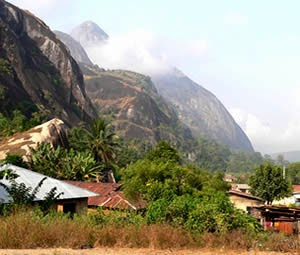
Idanre Hill is one of the most beautiful natural landscapes in Nigeria. Added to Idanre Hill beauty, which fires human curiosity is the fact that the entire people of Idanre lived on these boulders for almost a millennium.
Located in Idanre Town, about 24 kilometres southwest of Akure, Ondo State capital, the ancient Idanre Hills had been a home for the Idanre community for almost 100 years.
IDANRE HILL IS A UNESCO WORLD HERITAGE SITE
As a natural and cultural landscape, Idanre Hills stands out well among all other places that have been listed in UNESCO World Heritage Sites.
It is a cluster of intimidating and imposing hills housing some wonderful things which confound the senses.
The hills surround the town, envelope it and dominate life in the town. From any angle, one sees the hills and virtually every activity revolves round this collection of hills.
IDANRE HILL FLORA AND FAUNA
Apart from that cultural role, the town pulls the wealthy and the commoner, basically due to its perceived mystical aura and the giddy excitement lovers of nature get when they surmount the steep, daunting climb to the top, to witness a spectacular view of the new town and adjoining hills in a breath-taking manner.
The flora and fauna of the place had been under scientific study for several decades. The topography of the place will be of great value to mankind.
Its physical attributes include Owa’s Palace, Shrines, Old Court, Belfry, Agbooogun foot print etc.
PICTURES:
SOME FEATURES ON IDANRE HILL
THE ANCIENT PALACE
The ancient palace which has an intimidating courtyard where the Oba used to hold court is located on top of the hill where the old settlement used to be.
The palace houses some historical monuments about the establishment of Idanre town.
The guides are available to tell visitors rom interesting ancient histories about the community.
BEAUTIFUL LANDSCAPE
Idanre Hill is a cluster of intimidating and imposing hills that surrounds the town of Idanre.
The hills house some wonderful things which confound the senses.
It contains very important bio-physical and landform features whose interaction with the physical features created an enduring cultural landscape.
The panoramic view of the town from atop the Aghagha Hill is a view that takes one’s breath away.
AGHAGHA HILL, OROSUN PEAK AND CULTURAL FESTIVAL
Aghagha Hill emits smoke throughout the year and the Arun river is said to derive its source from the hot confines of the hill. It offers a beautiful scenery for nature lovers.
The famous Orosun festival is one of the major factors for Idanre’s consideration for upgrading to the status of a UNESCO World Heritage Site.
Also, there is an annual Mare Festival (“MARE” meaning “don’t fall”) – an international mountain climbing festival, which celebrates the land, the people and its rich culture.
ARUN RIVER
Arun River is a mysterious river in a serene corner of the hill. It’s said that the river derive its source from the hot confines of Aghagha Hill. The water is so clear, clean and even drinkable.
One can even see the stones and plants inside it. People come here to pray and fetch the water for spiritual cleansing.
Those who venture mid-stream claim that they experience dizziness and the presence of a supernatural being, an eerie feeling which makes the head swell. The experience is definitely not for the lily-livered.
THE OLD TOWN
Idanre old town is a deserted ancient town on top of the hill where abandoned buildings including the palace and courtyard of the Oba can be found.
The old town also has a shrine of the High Chiefs and residential quarters of many inhabitants.
AGBOOGUN FOOTPRINT
The legend of the Idanre Hills is a mosaic of myths and magic, woven around Agboogun, a great hunter with supernatural ability. A popular account asserts that the great hunter asked three of his sidekicks to accompany him on a journey. On their way, he paused to inscribe hieroglyphically on a hillside, and the cryptic inscription became known as the “Unreadable Signs.” A little further, he etched on another hill, this time, broad crisscrossed strokes. This is dubbed the “Wonderful Mat.” Then he climbed the steep Aghagha Hill. At the foot of the hill, Agboogun struck his foot on the rock, leaving an imprint on its surface. The foot shaped-depression is now known as “EseAgboogun” (Agboogun’s Footprint). He left an instruction: “Any person(s) accused of witchcraft should be made to try it for a size; it fits any foot size except those of the malevolent.”
The dense forest of the Osun Sacred Grove is located on the outskirts of Osogbo, the capital city of Osun State. The grove which is one of the last remnants of primary high forest in southern Nigeria, is regarded as the abode of the goddess of fertility – Osun – one of the pantheon of Yoruba gods!
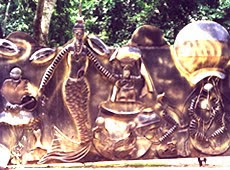
The landscape of the grove and its meandering river is dotted with sanctuaries and shrines, sculptures and artworks in honour of Osun and other deities.
The sacred grove, which is now seen as a symbol of identity for all Yoruba people, is probably the last in Yoruba culture. It testifies to the once widespread practice of establishing sacred groves outside all settlements.
THE NEW SACRED ARTISTS AND SUZANNE WENGER
The development of the movement of New Sacred Artists and the absorption of Suzanne Wenger, an Austrian artist, into the Yoruba community have proved to be a fertile exchange of ideas that revived the sacred Osun Grove.
The grove is the largest and perhaps the only remaining example of a once widespread phenomenon that used to characterise every Yoruba settlement. It now represents Yoruba sacred groves and their reflection of Yoruba cosmology.
OSUN SACRED GROVE AND YORUBA BELIEF
Osun Grove is a tangible expression of Yoruba divinatory and cosmological systems; its annual festival is a living thriving and evolving response to Yoruba beliefs in the bond between people, their ruler and the Osun Goddess.
Osun, also known as Yemoja, is one of Yoruba Orisas and the goddess of all the waters on earth. The orisa Oshun is commemorated annually in an elaborated festival held on the bank of the Osun River.
Osun is also celebrated in other parts of Africa and Brazil where the Orisa is referred to as Yemoja.
PICTURES:
OTHER SPECIAL FEATURES IN OSOGBO INCLUDES:
MUSEUM OF ARTS
Osogbo city has one of the best museum of arts in Nigeria as a result of its position in the Yoruba cultural heritage.
The city of Osogbo is culturally and historically enriched with many artifacts relatively important to the establishment of the city as well as the Yoruba race entirely.
OSOGBO ARTS AND METAL WORKS
This is one of the top holiday destinations in Oshogbo is where metals are artistically crafted and shaped to make valuable items.
Osogbo residents are known to be very artistic and the city has produced very many internationally recognised artists; among them are Nike Arts, Twin Seven Seven, Jimoh Braimoh and others.
OSUN CULTURAL FESTIVAL
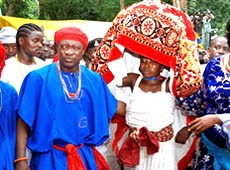
Osun Cultural Festival is an annual event that takes place in Osogbo usually around August. The festival attracts Yoruba culture and belief enthusiasts and other visitors from all over the globe.
The festival offers visitors the opportunity to visit the great Osun Grove, a sacred forest along the banks of the Osun river just outside the city of Osogbo.
ATAOJA ROYAL PALACE
As part of Osun Sacred Grove tour, visitors will be able to visit the Ataoja of Osogbo Palace located in the heart of the city. The palace is an ideal place for tourists to learn more about the city of Osogbo.
The palace has a museum where the historical facts about the establishment of the city are carefully preserved.
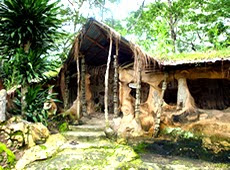
AFRICAN HUTS
There some locally made hut chalets where visitors can relax or get refreshments after exploring the sacred grove and its thick forest as well as the
There are many more features in Osogbo Osun State.. drop the one you know below
Its so destructive when people leave their own history to tell other people’s without proof. Just like white man came to Africa parted the lands, reduced our history to few centuries claiming Greek was the start of creation of 4,000 years. They called us monkeys but now with their own DNA research found out that all people except Africans are Neandathals. what a beautiful name to give caravan, ape and gorilla people. DNA proof white people have 4-5% of animals mixed with their DNA, means they were not created in the image of Ehyeh Asher Ehyeh (lye Ashe Iye) The Creator but Annunakis who created them in the labouratory .
Some Yoruban knew there history and those Yoruban saying ill things about themselves need to thoroughly do their research. Firstly, We are not related to Nimrod though he is Oduduwa but Kushite and we are Shem descendants. Oduduwa is only a royal title passed down from Noah to his descendants and is kingship, war hero title. Noah is Nuah in Egyptian children of ham, it is Oduduwa in Yoruba and a Yemen Hebrew lsraelite king in Hymya in Yemen by the name Dhu Nuwa in 500AD fled to lle ife to create more states. He escaped from the enemies who slaughtered the royal family. He did not commit suicide or drown in the sea as narrated in the Arabia history. OduNoah, OduNuah, Oduduwa, Dhu Nuwa, Noah or Nuah is only title, even the Benin people have their own version. Other Oduduwas are Abraham, King David and so on.
Origin of Yoruba
According to chronological Historb of Yoruba Dynasty in the Alafin palace, We migrated from lsrael to captivity in Assyria and Babylon 700-600BC . After the collapse of the Assyria and Babylonia empire we fled to West Africa land of Shem because Nebukanezer brought foreigners to occupied lsrael. Yoruba left lsrael around the time king Jeroboam (Olugbogi) and king Joash (Oluasho) were kings in Israel. Not all lsraelites returned with prophet Ezra because of civil in Israel. Final batch joined their people in 70AD when Israel was finally destroyed. The 1747 map of West Africa showed the Kingdom of Judah which later became slave coast in Badagry, Lagos Nigeria. Judah was part of old Ile ife Owodaiye means Whdah or Odaiye means Judah or Ouidah (Portuges) or Fidah in French. During the Antlantic Slave trade Judah was the target by the Romans and that is why they came to West Africa to finish Creator’s own people. Oyo empire fought with the Fon king of Dahomey who was capturing the Odaiye/judaites to the Europeans and prisonals of war from the enemies side too were enslaved by Yoruban. DNA proof all negroes (people with afro kinky hair) migrated to Africa while the Ethiopians, Somalians and Sudaness people with straight and coily hair texture are Africans but migrated to Arabia. Ancient Ethiopia was Africa, West Asia including India and Arabia and Israel, and Greek and Spain. They were called Ethiopians, jet black and brown people afro kinki people while those in india have straight or coily hair texture. Light skin were minority and were said to be of deferent race by the Arabs. Modern day Ethiopia was later called West Ethiopia and now the only Ethiopia nation.
DNA Proof
DNA is the Creator’s wonders even the scientist believe there is a Creator of the beautiful heavens and earth. DNA links Luyah of Kenya who are Descendants of biblical Joseph (Yuya) and Gabon descendants of Orugu or Orungun (biblical Reuben). Yoruba land occupied from Nigeria to Benin Republic, Togo, Ivory Coast and Ghana. Yoruba use to call themselves Aku meaning Akuibe or Akusibe as the biblical Jacob. When Yoruba have twins that is why they always make the last of the twins the elder, other Aku are in Senegambia and the Creols in Sierra leone. Yoruba was never the name the people but the language and was later changed by Samuel Ajayi Crowther from Aku to Yoruba to please the Europeans so we can forget our origin. Yoruba thus means Yerubbal meaning “Ati she eruba bale” that is the people cause baal terrible fear when they destroyed his evil alter. Yoruban also linked with King Yeroboam “great people), to remind them of the time they left Israel. West Africa language including the Zulus in South Africa is Shemetic pure Hebrew, ancient Aramic and Egyptian. Yoruba is pure Hebrew and Egyptian, its becomes Hebrew when English version of Hebrew word is removed, e.g the word shibboleth in not pure Hebrew its English version, correct word is Shibbole and is the same in Yoruba and in meaning. Rishon in Hebrew is Greek version, it is Risha but when fully written is orisha means ancestors. Aaron is not Hebrew word but Greek, Aare is Yoruba and Hebrew word for a leader. Dan in Hebrew have same meaning in Yoruba meaning Danilare or Damilare (judge or judge me). Hebrew deal with 3 letter root words, E .r. i. could mean Jerimaiah.
The foreigners could not accurately translate our book that is why there were errors in the bible. Eri is not the true name but English version, Eri means my awake one or to arouse one self or to suddenly stir up like excel. It would be Ori or Ari, just like Arieli is Greek version not Hebrew word. There is Aro in Yoruba word as in Arodi in the bible but to conveinced anyone as the same word will have to have same meaning. The modern day Ashenaz jews only occupied lsraeli in 1948 by balfor declearation between Britain and America. They converted to Judaism in 700AD by their king Bulan . Ancient lsraelites were black and still are today never light skin. Yoruba language is close to Egyptian becauses most of the pharaoh kings were Hebrew, king David or Daud is Pharaoh Pseuenes of Egypt (Ipesinuola), Abraham (Amenemhat I of Egypt) means Oba Ashiwaju king in front not Amen in front because Mene is the title of Oba in Egypt not Pharaoh, pharaoh means big house like ile ife. Moses or Moshe is Tutmose lll in Egypt (Moshetutu), that is sacrifice to God Amen or Thot. Ehyeh Asher Ehyeh (Iye Ashe Iye). the Ashe is also same meaning in Egyptian word to say it is borrowed word in Hebrew. Egyptian say Amen to the god Amen Ra, Yoruba say Ashe, Amin is Roman catholic corruption to make them say amin when Yoruba bible was translated from latin.
Yoruba and Ifa religion
Ifa religion which l myself have condemned in the past because of ignorant of knowledge of our history is infact biblical. Ifa is the oldest religion in the world and is proven to be 8,000 years old. It was passed down from Noah or Odunoah or odunuwa or Dhu Nuwa to Shem and Ham and Kush to their descendants. Ifa is the Ephod in the bible and the verses are the true Torah not the one called five books of moses because it is not accurate and Moses never wrote it but 500 years after his death. Ephod is not only the garment for priests but also the tray and the object to consult the Creator. The true Levi are Oluwo or Luwo and the Rabbis are Araba. Europeans called it vodu but is Odu and Odu is the father of Noah not Lamech (Odu ni baba Iwa). Before 1848, Yoruba places Yah as the suffix of their names like Tobiyah now Oluwatobi using (Odonuwa or Oluiwa). When Yoruba children started to attend Christian and muslim schools, they dropped Yoruba names as evil and Ifa as juju. Europeans forced Yoruba to abbreviate lfa to Indeginious Faith of Africa before registerd as a religion. Ifa is Ephad and Ifadida is Ephadida not Ephod (Greek version).
Yoruba Hebrew Israelites
Yoruba Hebrew Israelites heritage is not for every Yoruba to claim even the anthropologists and researchers are waiting for us to come forward. it is for Yoruban that are ready to accept their heritage and the Creator himself will return his people as prophesised. Some Yoruban say they are muslim, it cannot be true unless they are convert because the original muslim are the children of ham including Egyptians who spread lslam to Arabia slaughtering the true Arabs and drove them out. They themselves were driven out of Arabia by the light skin Persians. Original Christians were the descendants of Kush and they wrote the book of Enoch, Ethiopia language is original greek and latin as they once ruled Europe and built castles. Negroes are the true Arabs and pure black and still black.
Yoruba are the people of Yah, Eriwo or Ariwo or Alariwo Yah lo wodi lsrael, That is AlleluYah made the wall of Jericho collapsed, Eriwo Yah is Shout of Yah. Selah Shalom (Ashela Ashalafia)
During the reign of Oba Ozolua (1481 – 1504), two of his wives, Oloi Idia and Oloi Ohonmi, gave birth on the same day. They both had sons.
Oloi Ohomi gave birth in the morning to the first son and he was named Idubor, who was fondly called Aruanran (sometimes spelt Arhuanran).
On the other hand, Oloi Idia gave birth later in the day. Her son
was given the name Osawe (He later became Oba Esigie).
Here’s where the drama started. When Idubor was born, he did not immediately cry. In that era, it was inappropriate to announce the birth of a mute baby to the monarch.
However, Queen Idia’s baby cried as soon as he was born and thus, his birth was reported to Oba Ozolua, who instantly declared him his first son, automatically moving Idubor to the number two slot.
Idubor, while growing up was very bitter about his predicamentt. He more than on one occasion asked his mother, if the king was his true father and why he callously took away his birthright in
such a mean fashion.
Idubor (Arhuanran) grew up to be a giant. Legend has it that he uprooted palm trees with his bare hands, sweeping the ground with the fronds. He turned out to be a great warrior who had the overwhelming advantage of size and stamina.
I must add here that another version of this story reveals that Idubor and Osawe were not actually the eldest sons of Oba Ozolua. They had an elder brother, Ogidigbo, who was said to have become a cripple following a combat competition between him and his brothers. His disability disqualified him from taking over from his father. Citizens secretly pointed accusing fingers at Oloi Idia as being responsible for Ogidigbo’s calamity, using her mystical powers to ensure that her son, Osawe (Oba Esigie)
clinched the crown.
Before his demise in 1504, of Oba Ozolua had already carved out dukedoms for his sons. This was to avoid anarchy in the next dispensation. As compensation, Arhuanran was therefore made the Duke of Udo; a town not too far from Benin.
Please, note that Idia’s role in the nullification of the first son Ogidogbo was not lost on Arhuanran, whose enmity towards his brother Osawe ( Oba Esigie) intensified that he even tried to assassinate him.
A noted warrior and conqueror of the fierce town of Okhumwu, Arhuanran was bigger and stronger, and could easily have trounced the weaker Esigie, whom Oba Ozolua had sent to attend the Portuguese mission school after his baptism.
Arhuanran’s assassination attempts could have succeeded were it not for Idia who was reputedly skilled in magical arts and whom he knew was a formidable opponent he had to overcome.
Realizing he had to acquire supernatural powers if he wanted to take on Idia who was her son’s spiritual protector, oral tradition recounts that Arhuanran retreated to Uroho village to learn the art of black magic from an old sorceress, Iyenuroho (Okpewho).
That he chose a woman as teacher, is clear recognition that his opponent was a woman and that he had to learn the ways of female mystical powers to be assured of victory.
We should note that Esigie’s possible lack of combat experience, is the result of having to attend the school of Portuguese missionaries, rather than join his father in fighting wars.
Failing to accept the facts on ground, the Duke (Enogie) of Udo, Ahruanran refused to play a subordinate role to his brother, Oba Esigie, and at first, tried to make Udo the capital of Benin kingdom, with himself as king. It did not take too long before the two brothers went to war.
The war was difficult, bitter and long drawn out. It was not until the third campaign that Udo was defeated.
The third campaign was timed to coincide with the planting season, when Udo citizen-soldiers, who were mainly farmers, would be busy on their farms.
Meanwhile, Arhuanran had two sons Kpamabira and Onioni. They were ruling alongside their father, but before the war, Kpamabira died.
Prior to the last battle with his brother, Oba Esigie, Arhuanran told his surviving son, Onioni to stay at home and wait for his return, alerting his household to listen out for the sound of the
magical bell that he placed somewhere in the house. He explained that if it chimed, they will know that his brother, Oba Esigie had won the battle.
Later on, as he fought in the war front, Arhuanran was shocked to see a young man fighting just like himself. Without thinking twice, he used a powerful incantation, commanding the sword to immediately kill the copycat fighter (A GBE VBE NI ME GBE NE UMOZO GBEE RIE YOEWE).
At that moment, the warrior died, only for Arhuanran to discover that the man who possessed his fighting skills, was none other than his beloved son, Onioni. Arhuanran had no idea his son had sneaked along to join in the war. In rage and pain, Arhuanran intensified his onslaught on his brother’s army, until there was no winner in the battlefield.
When victory was not forthcoming, Arhuanran decided to run home on time, but his movements were not swift enough… By this time, the magical bell at home was sounding and therefore, Udo people believed Oba Esigie had conquered their duke. This perceived tragedy caused his wife to jump into a river close to the lake (Odighi). She died.
As soon as Arhuanran got home, he found out that his wife had jumped the river. He was so sad. His sons were gone, now his wife… A depressed Arhuanran also jumped into the lake.
Before jumping into the lake, he left his Ivie (coral bead necklace), the symbol of authority in Benin land, dangling from a tree branch were it could be easily found.
Up until this day, many believe that Arhuanran did not die inside the lake (Odighi). They claim he still comes out at night to parade the town of Udo, providing protection for his people.
Before now, the nights Arhuanran came out of the water, all the babies in Udo town would cry non-stop. This trend forced the people of Udo to appeal to Arhuanran spiritually. After specific rituals, the children no longer cried when he came out of the lake.
Furthermore, the river the wife dived into, is directly opposite the lake. A road separates this river from the lake. Once every year, the river always crosses the road to meet the lake where Arhuanran committed suicide.
Even in 2017, it is forbidden to touch or drink the water from that lake. It is also forbidden to kill or eat any animal from or around the lake. The waters were declared sacred.
It was told that around 1955, a group of Udo people were returning from their farm when they saw a young boy shooting birds close to the lake and the stone dropped into the lake.
Immediately, there was a loud voice from the lake that sounded like thunder and many trees around the place shook, as a heavy wind blew. At that moment, the boy became sick and he was rushed home for treatment.
Udo town used that opportunity to tell the public that Arhuanran did not really die, but still lives in the lake; especially as there was never proof of his death.
Across the world, there are people who have not been swayed by the technological advancement but have rather maintained their traditional way of life.
Some of this kind of people are found around Lake Turkana and the Lower Omo Valley in Southern Ethiopia.
The Surma people is made up of three ethnic groups:
The Mursi People
The Suri People
The Mekan people
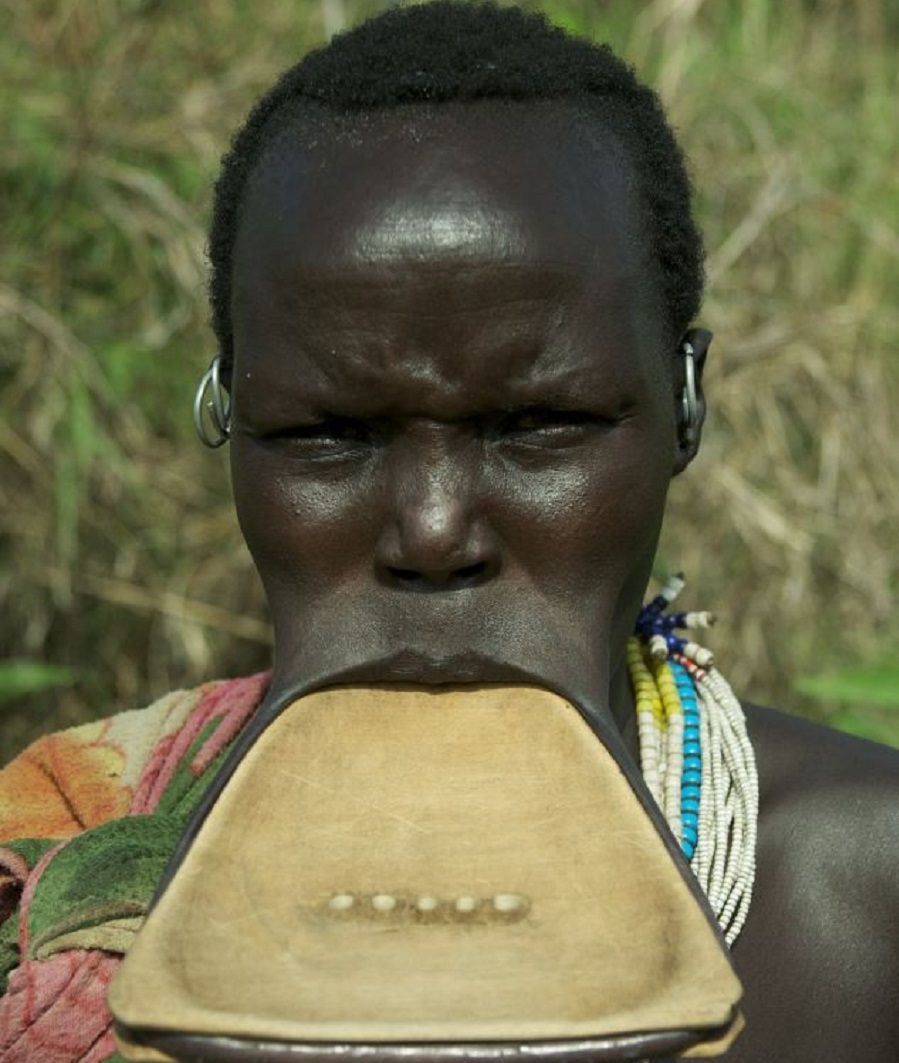
The Suri and the Mursi share a similar culture. Their women’s beauty is determined by how large their lip plate is.
Lip plates are usually made of clay or wood and range between 4 and 25 centimeters. To be placed on the lip, two or four teeth are removed before the lower lip is cut to fit the lip plate.
This lip plate process is usually done by their mother when they attain puberty. To stretch the lip, a ceramic disc is placed after the cut and will remain until the initial cut has healed before it is placed with another slightly larger disc.
The process is repeated so that the lip will become large enough to accommodate the first lip plate which is about 4 centimeters. Beauty is in the eye of the beholder.
Apart from designing their skin with incisions and patterns which are sometimes painted, the lip plate is seen as a boost of one’s self -esteem.
The lip plate tradition is valued by both parents because it indirectly means that the father ’s number of cows will increase when he is paid her dowry. Any man who must marry a Suri or Mursi lady has to be wealthy because her dowry usually falls between 40 cattle (for the small plate) and 60 for the large plate).
Because of the self -worth and importance attached to it, some girls increase their lip plate. To their delight, they are often allowed to design her lip plate.
Most times, the women don the lip plate when their intention is to look more appealing . An example is when they want to serve the meal of their male counterpart; as part of their beauty regime or during special ceremonies.
However, their men only have to undergo body painting as their form of ritual. Each scar on the man tells a story: He has fought and killed an enemy .