Author: Johnson Okùnadé

  • MYTHICAL CREATION OF THE YORUBA TRIBE

    MYTHICAL CREATION OF THE YORUBA TRIBE

    The Yoruba tribe were
    believed to have emerged from Oduduwa (one of the servants of Olodumare- the
    Supreme Being) who was sent down to the world to create the earth. It was
    believed that he descended with a long chain from heaven and carried a calabash
    full of sand and also brought a five- toed fowl along with him. The whole earth
    was covered with water, not a single dry place could be found, then he (Oduduwa) poured the sand on the water and
    placed the fowl on it, and the fowl started to sprinkle the sand with its
    legs. Everywhere the sand touched turned into a solid ground and the chameleon
    was sent to judge if it was dry and solid enough. The other places that were
    not touched by the sand remained as water till today. Then, Olodumare sent
    Obatala (god of divination) to create and mould human beings the way it pleases
    him and he (Olodumare) would put life into them and would also design their
    various destinies.

    According to some accounts, it was Obatala that Olodumare sent to create the
    earth, but on his way, he joined a group of gods feasting and he drank wine
    till he was drunk then fell asleep. Oduduwa then carried the calabash and the
    fowl beside him and carry out the mission that was meant for Obatala. When Obatala
    woke up, he discovered Oduduwa had created the earth and he became furious, but
    Olodumare calmed him with another mission of creating human beings.
    It was also believed that Oduduwa had a son named Okanbi also called
    Idekoseroake, and Okanbi also begat seven children who can now be referred to
    as the fathers of the seven main Yoruba tribes, as follows ( Owu, Alaketu,
    Benin, Orangun, Onisabe, Olupopo and Oranyan).

    The Yoruba people, who
    can be found in the Southwestern part of Nigeria, believe so much in the
    traditional accounts of their creation.


    The BEST way to support us is by providing funding to enable us continue this good work:

    Bank: Guarantee Trust Bank (GTBank)
    Account Name: Johnson Okunade
    Naira Account: 0802091793
    Dollar Account: 0802091803
    Pounds Account: 0802091810
    Euro Account: 0802091827

    Business Email — hello@johnsonokunade.com

  • The History Of Ibadan- The City Of Heroes

    The History Of Ibadan- The City Of Heroes

    Ibadan, the present capital of Oyo State, is the third most populous state in Nigeria after Lagos and Kano with 3.5 million dwellers.
    In the 1960s, Ibadan was known to be the largest city in Africa after Cairo (Egypt) and Johannesburg in South Africa.
    The Yoruba people are the main inhabitant of this popular city, Ibadan, which was formally called Eba Odan (the city at the edge of a Savannah) at the point of its creation.
    Ibadan, located in the south-western part of Nigeria served as the home for trade, commerce and fashion in the 60s and 70s making Lagos a perfect rival.
    Ibadan was also the centre for administration of the Western region during the colonial era.
    The origin of this great city, Ibadan, was traced to the reign of the great old Oyo empire (Oyo-Ile).
    It was said that the Alaafin (king) of the Oyo empire ordered Lagelu who was then the commander of armed forces (Are-Ona-Kakanfo) in Oyo, and some of his best men in Oyo, Ilesa and Ogbomosho to build a war camp for warriors coming from the Ijebu, Ife and Egba kingdoms.
    Jagun Lagelu and his men settled in Àwótán, in Apete (presently located in the Ido local government area) and established a peaceful city named Eba Odan.
    Later, the city was destroyed by the Oyo armies for violating the customs of Yorubaland.
    The people of Eba Odan (Ibadanland) were said to have humiliated an Egungun at the market place. The Egungun was accidentally disrobed which resulted into an abominable mockery from Eba Odan women and children.
    When the news of the incident reached the Alafin of Oyo, he ordered his men to turn Eba Odan into complete rubble for committing such disrespectful and abominable offence.
    Origin of Ibadan
    Those who survived the attack, including Lagelu who had become old and weak, ran to a near-by hill for safety.
    On the hill, there was no food except for the Oro fruit and roasted snails the people fed on.
    After a long period, normality returned and the people founded another settlement. This was about 1829.
    Shortly afterwards, Lagelu died leaving behind swarms of strong and political people.
    History has it in profile that Ibadan was later attacked three different times, but survived them all (1840 Osogbo war, Ibadan-Ijaye war; 1861-62, Kiriji war; 1877-93).
    After the destruction of Oyo-Ile by the Fulani raiders in 1835/1836, refugees from several yoruba towns and villages fled down to Ibadan, Ijaye and the new Oyo-Atiba, but Ibadan received the highest number of refugees who later settled in the city.
    After sometime, the new Ibadan had grown extensively into a popular hub of trade and commerce.
    Ibadan also dominated the political and military scene in Yorubaland filling the vacuum created by the fallen Oyo empire.
    People displaced by war now saw Ibadan as a sanctuary because of its location, economy and military power.
    In 1840, the marauding fulanis tried to expand their caliphate deeper into the southern part of Yorubaland, but was defeated by the strong armies of the Yoruba kingdom led by Ibadan. This war was later known as the 1840 Oshogbo war.
    By the end of 1850, the population of Ibadan had grown over 265,000, making Ibadan the largest town in Yorubaland.
    Later in the year 1893 (immediately after the Kiriji war), Ibadan became a British protectorate after the Baale of Ibadan, Fijabi, signed a treaty with George C. Denton, the British acting Governor of Lagos, on the 15th of August that same year.
    Further Reading:
    * The Political Economy of a Pre-colonial African State: Ibadan, 1830-1900. byToyin Falola
    * Sir Isaac Babalola Akinyele: Iwe Itan Ibadan (1911)
    * The City of Ibadan- P. C. Lloyd, A. L. Mabogunje, B. Awe
    SOURCE: OLD NAIJA

    The BEST way to support us is by providing funding to enable us continue this good work:

    Bank: Guarantee Trust Bank (GTBank)
    Account Name: Johnson Okunade
    Naira Account: 0802091793
    Dollar Account: 0802091803
    Pounds Account: 0802091810
    Euro Account: 0802091827

    Business Email — hello@johnsonokunade.com

  • OLURONBI

    A very long time ago, there was a
    village where many of the women were barren. They desperately wanted children
    and decided to ask the spirit that lived inside the big Iroko tree for
    help. 

    One by one, they went to visit the Iroko tree to beg the Iroko tree spirit for
    help. The Iroko tree asked each of the women who showed up what she would give
    in return for bearing a child. And woman after woman promised the Iroko tree
    spirit goats, yams, handwoven cloth or whatever it was she sold for a living as
    many of these women were traders who sold their wares at a weekly market in an
    open field.

    One of the women who was named Oluronbi also approached the Iroko tree for
    help. She was so desperate for a child that when the Iroko tree spirit asked
    her what she would give in return for a child, she eagerly offered her first
    born child.

    Before a year ran out, many of the women had given birth to children and
    returned to the Iroko tree to fulfill their various promises. When it was time
    for Oluronbi to fulfill her promise, she went to the Iroko tree to plead her
    case. She could offer the Iroko tree everything, anything else but not her
    child. But the tree spirit would not be swayed and took the child despite
    Oluronbi?s cries and pleas.

    Since then villagers have sang this song as a reminder of the event.

    Oníkálukú jèjé ewúré
    Others offered sheep
    Oníkálukú jèjé àgùtàn, àgùtàn bòlòjò
    Others offered goats
    Olúrónbí èjé omo re
    Oluronbi offered her child
    Omo re a pón bí epo
    Her beautiful child
    Olúrónbí ò jo jo
    Ìrókò jo jo
    [The last two lines are just chorus]


    The BEST way to support us is by providing funding to enable us continue this good work:

    Bank: Guarantee Trust Bank (GTBank)
    Account Name: Johnson Okunade
    Naira Account: 0802091793
    Dollar Account: 0802091803
    Pounds Account: 0802091810
    Euro Account: 0802091827

    Business Email — hello@johnsonokunade.com

  • Idanre Hill- Heights of Natural Wonders

    Idanre hill, also known as Oke-Idanre, is one of the leading natural tourist destinations in Nigeria. The Idanre hill is located in Idanre town which is about 24 kilometers southwest of Akure, the capital city of Ondo State, Nigeria. The beautiful and wonderful Idanre hill has been a home to the people of Idanre for over 150 years. History of Idanre has it that the early settlers of the Idanre people lived high up in the hill in a place now known as Old Oke-Idanre.
    The Idanre hill is a collection of inslebergs (hills with steep sides and round top) that tower to the clouds and enclose the idyllic and rustic town of Idanre which covers a land area of about 900km2. Idanre town is laden with breath-taking attractions which include the colourful Orosun festival which draws the natives of Idanre to the Idanre hill to have fun and pray to their ancestors.
    The idanre hill is listed among UNESCO World Heritage Sites. Its physical features include shrines, palace, old court, Agboogun footprint etc. The Agboogun footprint was mystically engraved on the hill and it is said that the footprint will size any foot except that of witches and wizards. Tourists willing to reach the top of the Idanre hill will have to ascend 660 steps with five resting posts. The entry fee to the Idanre hill is N1000.
    The 660 steps of Idanre hill
    Another mystery of the Idanre hill is the unreadable writings scribbled in an unknown language on a steep rock in Old Oke-Idanre. This writing is called “The unreadable letters of the flood”, and ingeniously known as “Adiye kowe, Oyinbo kaati” which is translated as “a white man cannot read the writings of a hen”.
    The Idanre hill is a wonderful and spell-bounding site nature lovers and tourists of all ramifications should visit in a lifetime.
    Idanre Hills
    Source: Old Naija
  • Oruko Amutorunwa (Pre-Destined Names) In Yorubaland

    Oruko Amutorunwa (Pre-Destined Names) In Yorubaland

    In Yoruba land, one of the most important things done when a child is born is to give the child a name. This comes after the child’s ritual birth, massage of specific body parts, and other rites as well.
    Names are given to the child by the father, mother, grandparents (paternal and maternal), and some close relatives also.
    But sometimes, the circumstance of a child’s birth will automatically give the child a name. This name is known as ‘orúko àmútọ̀runwá’ (pre-destined or generic name) in Yorubaland.
    The most common generic names (orúko àmútọ̀runwá) in Yoruba land are ‘Taiwo‘ and ‘Kehinde‘ (altogether known as Ìbejì) which are given to twins. The firstborn of the twins is called Táíwò, a shortened form of Tò-aiyé-wò (taste the world) while the last born of the twins is called Kéhìndé which literally means “the last to come”.
    Contrary to the popular belief that Taiwo, being the firstborn of the twins, is older than Kehinde, it is said by Yoruba elders that Kehinde is older than Taiwo because Taiwo was sent by Kehinde to have a taste of the world and announce his coming as well.
    The child, whether male or female, born after the twins is called Idowu. The Idowu is known to be stubborn and troublesome and is therefore regarded as “Eshu lehin Ibeji” (the devil after twins). The Yoruba people believe, though not strongly, that if the mother of twins should fail to give birth to another child after the twins i.e. Idowu, she is likely to run mad because the spirit of the stubborn Idowu will fly into her head and make her go insane.
    The child born after Idowu is called Idogbe (if male) and Alaba (if female). In some cases where triplets are born, they are named TaiwoKehinde, and Èta ọkọ̀ respectively.

    Dada child

    Dada Awuru

    Apart from the twins series, other children born in Yoruba land in peculiar circumstances or ways are given pre-destined names (oruko amutorunwa) too. They are as follows:
    •  Ilori– This is a child born during the absence of menstruation;
    •  Ojo and Aina– This is a child born with the umbilical cord twisted around his/her neck. If this kind of child is male, he is named Ojo, and if female, Aina;
    • Dada– This is a child born with long, thick, and curly hair which is not to be cut at any time. Dada is also called Dada awuru or olowo ori. They are known to be strong and stubborn;
    • Oke– This is a child born with unruptured membranes all over his/her body;
    • Olugbodi– This is a child born with supernumerary digits (six fingers);
    • Ige– This is a child born with breech or footing presentation i.e. the child came out of the womb with the legs first;
    • Omope– This is a child born later than the normal period of utero-gestation;
    • Ajayi– This is a child born with his face downward. This child is also called Ogidi olu;
    • Salako (male) or Talabi (female) – This is a child born with his/her body covered in ruptured membranes;
    • Abiona– This is a child born on a pathway usually when the mother is away from home or on a journey;
    • Abiodun– This is a child born in festive periods;
    • Johojo– This is a child whose mother died during labour;
    • Babatunde– This is a male child born shortly after the death of his grandfather. It is believed the grandfather reincarnated. Babatunde literally means ‘father has come again’;
    • Yetunde– This is a female child born shortly after the death of her grandmother. Yetunde means ‘mother has come again;
    • Babarimisa– This is a child whose father fled at his/her birth.
    • Oni– This is a neurotic child who at his/her birth cries all day and night

    It is important to note that having a pre-destined (oruko amutorunwa) name does not mean that a child cannot have other names. A child can be given as many names as possible, but in most Yoruba families, the pre-destined (oruko amutorunwa) stands as the first name of the child.

    Reference
    Samuel Johnson; The history of the Yorubas, Lagos, CSS Limited; 1921; pg. 80-81

    COPYRIGHT

    Copyright © 2020 by My Woven Words: No part of this published blogpost and all of its contents may be reproduced, on another platform or webpage without a prior permission from My Woven Words except in the case of brief quotations cited to reference the source of the blogpost and all its content and certain other uses permitted by copyright law.

    For permission requests, contact the admin on admin@johnsonokunade.com, or WhatsApp/Text him on +2347036065752

  • Obitun: Initiation of girls into womanhood in Ondo Town

    The people of Ondo inhabit the south western region of Nigeria and are one of the largest subgroups of the Yoruba ethnic group. Ondo people live as one big family because they are bounded by the same historical background, traditions and cultural heritage which defines who they are. The culture and traditions of Ondo people are very rich, fascinating and exciting as well.
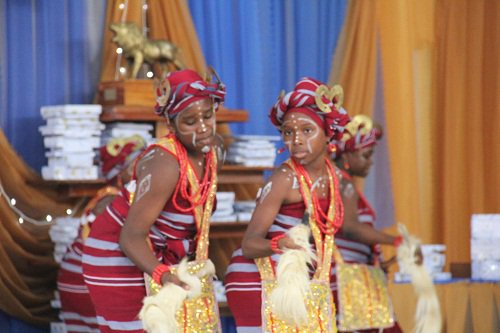
    In the heart of Ondo town, the Ekimoguns, as the Ondo people are called, celebrate the transition of their girls into womanhood through a festival-like rite known as ‘Obitun’which means ‘new woman’. The Obitun festival performed in the olden days of the Ondo people is a way different from the modern Obitun cultural dance now performed as a mere entertainment during public functions. It is only the dancing aspect of the old Obitun that was retained by modern sons and daughters of Ondo, the initial rite and intention of Obitun has gone into extinction. In the olden days of Ondo people, Obitun was believed to be a sacred rite, and a very important milestone in the lives of young but matured girls. They believed that for a girl to become a woman, she must go through Obitun, otherwise, bad lucks and problems such as barrenness and broken marriage would befall her.
    Obitun festival in Ondo town
    But today, owing to Western education, christainity and some other religious beliefs, most families in Ondo do not consider Obitun important for their daughters before being acknowledged as a woman and getting married. But nevertheless, the Obitun tradition still thrive among some set of the Ondo people even though it is being threatened by extinction.
    Back in the early days, Obitun festival was usually held for a week. The girls initiated during the festival were treated with extra care and love. They were beautifully dressed and decorated with exquisite beads and camwood face paintings. Part of Obitun costume are horsetails, fans and beaded wallets which is worn across the shoulders.
    Obitun festival in Ondo state
    Throughout the Obitun festival, the initiated girls were not called by their names, instead, they were called ‘Obitun’ which means new woman. There were usually plenty of foods at Obitun festival; the most common of all is pounded yam and okra soup. These foods were offered as sacrifice to the spirits of the newly initiated girls (Obitun) to guide them in their journey to womanhood. On the last day of the festival, the newly initiated girls would all together dance round the town stopping at some important places such as the houses of their relatives where they would be praised and lavished with gifts. They would also stop at some shrines such as Ogun lei, and Ogun Aisero in Ododibo and Odojomu to give final thanks to their creator.
    Obitun cultural dance
    In recent times, all these aspects of Obitun has been scrapped out leaving only the dance session. The Obitun cultural dance of Ondo people is now performed by cultural dance troops just to entertain people at ceremonies.
  • The History And Mystery of Bilikisu Sungbo Shrine In Ijebu Ode, Ogun State

    The burial place of the legendary and biblical Queen of Sheba, locally known among Yoruba people as Bilikisu Sungbo, has turned a place of worship and tourism in Nigeria.
    Millions of people visit annually from different parts of the world to share the mystery surrounding Bilikisu Sungbo grave-turned-shrine located in Oke-Eri, Ijebu-Ode, Ogun State, Nigeria.
    The historical queen, Bilikisu Sungbo, was said to have traveled all the way from Ethiopia down to Ijebu-Ode where she died and was buried. The natives of Ijebu-Ode hold strong and popular claims about the identity of the controversial Bilikisu Sungbo. They claimed that she was the Queen of Sheba mentioned in the bible to have visited the wise king Solomon at height of his powers.
    They also claimed that Bilikisu Sungbo was the Quranic Queen Baliqs of Ethopia (from which the name Bilikisu was derived) who visited king Sulaiman. Another source has it that Bilikisu Sungbo was a wealthy woman and the leader of a group of women potters who traveled to far away places.
    Also, she was believed to possess supernatural powers with which she dug ditches around villages in Ijebu-Ode.

    Queen Bilikisu Sungbo                      Queen Bilikisu Sungbo

    Howbeit, the tradition of the Ijebu people forbid women and dogs to visit the spot where Bilikisu Sungbo was buried. At the shrine, there is a small open ground with no grass growing on it. This place is said to be the place where the ancient queen was washed before being buried, and because of her supernatural powers, no plant or grass can ever grow on the spot.
    In 1995, Bilikisu Sungbo’s shrine was added to the cultural category of UNESCO World Heritage Site. The Bilikisu Sungbo ‘grave-shrine’ will forever remain a pride of Ijebu-Ode people.
  • THE CREATION OF THE WORLD: A YORUBA MYTH

    This is the story of how the world
    was created according to the Yorubas of West Africa.

    The entire world was filled with water when God decided to create the world.
    God sent his messenger Obatala to perform the task of creating the world.
    Obatala brought along his helper, a man named Oduduwa as well as a calabash
    full of earth and a chicken. Then they began their descent to earth from a
    rope.

    Along the way, they stopped over at a feast where Obatala got drunk from
    drinking too much palm wine. Oduduwa, finding his master drunk, picked up the
    calabash and the chicken and continued on the journey.

    When Oduduwa reached the earth, he sprinkled earth from the calabash over the
    water and he dropped the chicken on the earth. The chicken then ran around
    spreading the earth in every direction he moved until there was land. Oduduwa
    had now created earth from what used to be water.

    Later when Obatala got out of his drunken haze, he discovered that Oduduwa had
    already performed his task and he was very upset. God however gave him another
    task to perform ? to create the people that would populate the earth.

    And that was how the world was created in a place now called Ile-Ife.

  • Yoruba Culture and the Left Hand

    Yoruba Culture and the Left Hand

    The Yoruba people are one of the three major ethnic groups in Nigeria. They inhabit the south western part of the country and are the second most populated of the three major Nigerian ethnic groups, followed by the Igbos of eastern Nigeria. The Yoruba people are well known for their strong desire for peace and unity at home and in diaspora. They are also known for their rich cultures and traditions which include: lifestyle, religions, dressings, beliefs and so on. The Yorubas, also called Omo Odua (offspring of Oduduwa- the progenitor of the Yoruba tribe), cherish every aspect of their cultures and traditions; none is being overlooked or handled with less importance and care because they practice them daily.
    Ethics is a vital aspect of the Yoruba culture. The Yoruba attach great importance to ethical significance because they believe that this aspect of their culture is highly essential to every individual’s life. They also believe that it will be easy for someone with good ethics to succeed in life and the other way round for the one who lacks it. Therefore, the Yoruba people use all means to teach their children good manners and morals and how to use them in the society. Some of the means they use are: storytelling, songs, poetry, oral lecturing and so on.
    However, the use of left hand falls under this aspect. In Yoruba land, it is considered immoral, disrespectful and unhealthy to do certain things with the left hand, such as, eating, giving directions, greeting, giving and collecting, etc. This has no reason other than the belief attached to the left hand that it is meant for unsanitary purposes like: picking or removing dirt from a place, cleaning of oneself after using the toilet, picking of the nose and so on. Yoruba elders take all chances to correct their younger ones when found using the left hand for what it is not meant for.  Older Yoruba people will never with their left hand give or collect from their younger ones because they don’t want them to cultivate or perpetuate the so called uncultured act. The Yoruba people even go to the extent that they dubbed any child who gives directions to his/her father’s house as ‘omo ale’ which means bastard; they will say, “omo ale lo ma fi owo osi juwe ile baba re”; which means “only a bastard will give directions to his or her father’s house with the left hand”. This shows the extent at which the Yoruba people esteems ethics in their culture.
    Also, learning institutions (primary schools in particular) in Yoruba communities take part in the quest to kick down the wrong use of left hand, particularly in writing, among their students. Mrs Olufunke Esuruoso share her experience with johnsonokunade.com on how her primary school teacher knocked the back of her left fingers for writing with her left hand- “Personally I do not consider being left-handed a stigma. We all have two hands. I don’t know anyone who would choose to be without their left hand. Some cultures and religions frown on the use of the left hand. For me, I do not even notice the difference. I can understand why the left hand was considered “dirty”. Most are said to use their left hands to clean themselves up after using the toilet. Hence the reference to uncleanliness. However with decent hygiene habits this should not be a problem. Your last question: My parents let me be natural with my left hand. This was not so at school. In Primary One, my teacher would rap my knuckles each time I tried to write with my left hand. So I switched to the right hand for writing. Not at home though. This affected my writing for a long time. However, there were other ways I had to adjust to using my right hand. When I was growing up there were no left-handed knives or scissors. I will peel yams with my right hand but sew clothes with my left.
    However, this unhealthy belief the Yoruba people attach to the left hand does not affect the whole aspect of their indigenous religions. The left hand is not much condemned in this aspect because it serves important purposes. For instance, the religion of Ifa consider the left hand sacred as it is mostly used for important purposes and rites such as looking into someone’s future by looking into his/her left palm; holding of sacred religious items and so on.
    More importantly, what gave birth to this belief? Why was this belief attached to the left hand in the first place? The answer appears mysterious like many other beliefs in Yoruba land. But if scrupulously examined, it can be scientifically said to be the natural weakness of the left hand compared to the right that led to the much preference of the latter and the condemnation of the former. But today, the condemnation of the left hand in Yoruba land has begun to fade, but at a very low rate, and consequently, some Yorubas have preferred to call the left hand ‘owo alaafia’ which literally means ‘hand of peace’ instead of ‘owo osi’, the original Yoruba word for the left hand.
    It must be brought under discussion that other ethnic groups in Nigeria and the world outside also share this belief attached to the left hand, but in distinct ways.
    Dear readers, feel free to share your experiences or/and views on the usage of left hand in your society by using the comment box below.

Sorry, cannot copy or rightclick.