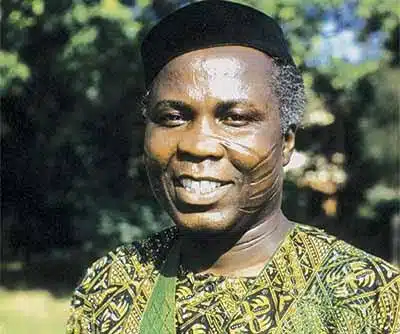
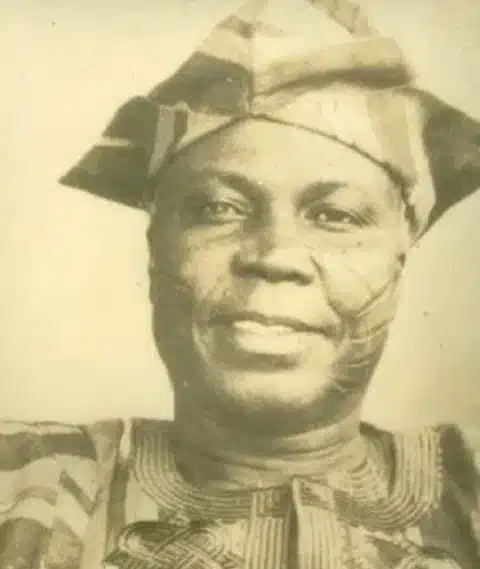
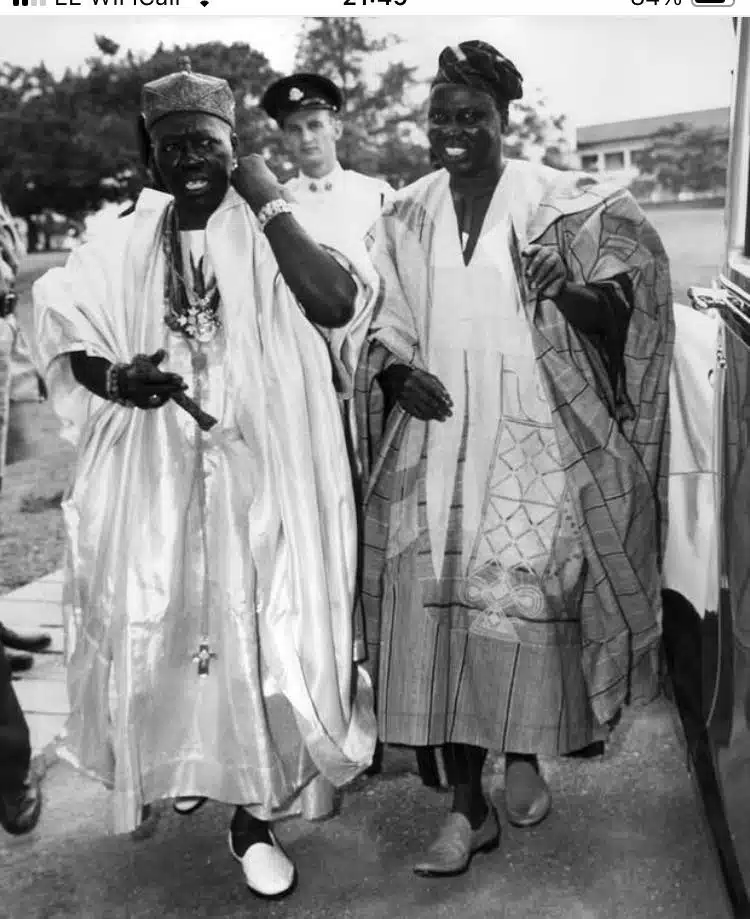
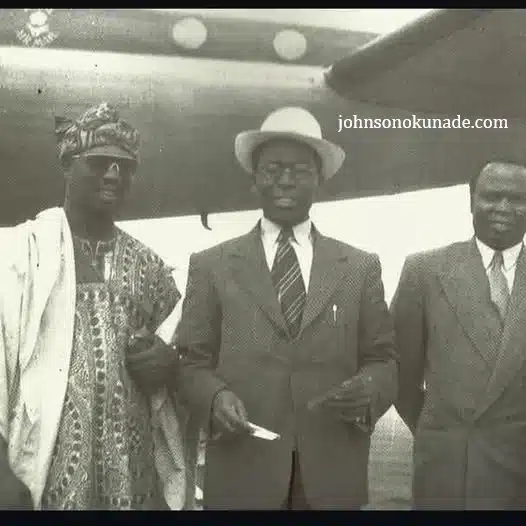
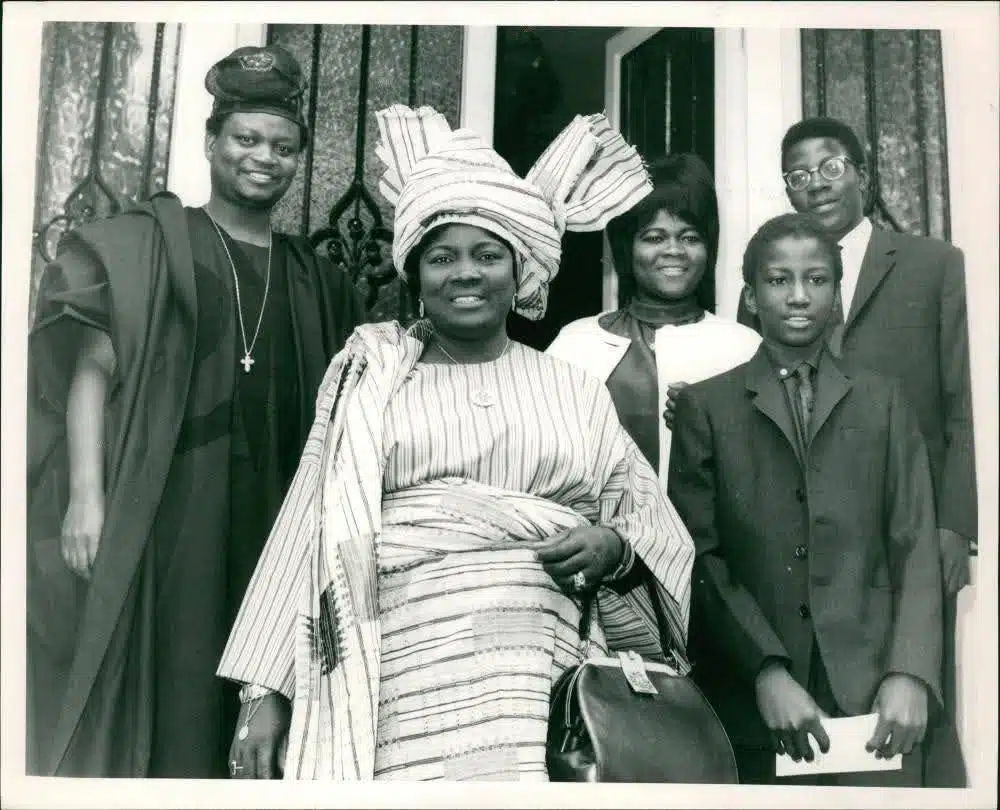
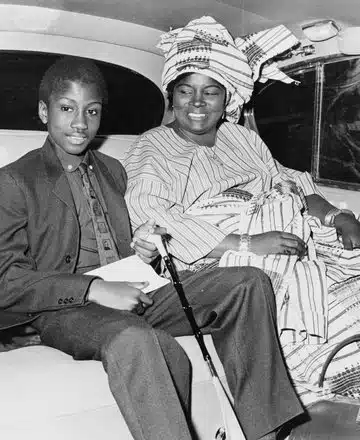
With sons and fathers bears an inexplicable connection and imprint of a father that will forever remain on the son. A son will always replicate the greatness that has been instilled in him by his father; this is the case of Dele Paimo.
Chief Lere Paimo MFR remains a titan who has distinguished himself as a remarkably talented actor for the last 60years. Eda Onile Ola is indisputably a fulfilled man that has successfully instilled greatness in his first son, Dele Paimo.
Unknown to many, Dele Paimo is a sublimely gifted international gospel singer. His voice is beautiful and sonorous, sounds like sun birds and bees. It’s rare to find a male with a soprano voice like his.
Growing up in Ibadan, the capital city of Oyo State, Dele Paimo started singing as a small boy. He eventually joined the choir in his church at a very tender age and never stopped singing since then. Singing became his passion and it propelled him to become a professional singer.
He created his first gospel album, “Fullness of Joy” in 2008 and he kept the flag flying by spreading his tentacles and also improving in his passionate profession of gospel songs. No doubt, he is focused and determined to make a great a great name in his chosen career.
By the time he decided to release his second gospel album in 2015, he decided to take it a step further by going as far as South Africa and Ghana to shoot the album titled “End Time”.
Talking about his relationship with his father, Dele Paimo mentioned that his father is the most supportive and understanding man anyone could ask for. He said Chief Lere Paimo MFR always encourage him to be optimistic and be of good repute by telling him to remember the son of whom he is in all his endeavours.
By default, many people just assume that his life would be a smooth one as the first son of a veteran actor but contrary to that opinion, he had his silent battles which made it impossible for him to proceed to the university after graduating from Loyola College, Ibadan.
He disclosed that what inspired him to pursue his passion was the positively inclined people in his life who kept advising him not to give up, especially his lovely wife, Mrs. Grace Paimo. Asides the kind words of encouragement from people, he mentioned that his voice also gives him confidence that he’ll make it in his chosen profession.
Dele Paimo decided to face music professionally at the completion of his secondary school education. As mentioned earlier, In 2008 he released his first album titled “Fullness of Joy” featuring his dad, Chief Lere Paimo MFR. The Album which was released and marketed by S.T Omoola Records has three tracks namely:
Praise
Jesu mi
Aleselewi, Alewilese
In 2015, he raised the bar higher by recording his second album; which was shot in South Africa 🇿🇦 and Ghana 🇬🇭. The album titled “End Time” has six tracks namely:
Opin Aye
On the last day
The lord has set the task before me
God’s will
Igbeyin Aye de
Source of my life.
Dele Paimo is currently working on his third album titled “Glory” and it promises to be the apex of apexes, the best of the best and the primus inter pares (first among equals).
Dele Paimo is a great dancer like his father. When he isn’t singing he can be found in the kitchen preparing tantalizing recipes or reading books. Asides cooking and reading, he has a sagittarius personality which explains why he loves to travel and having adventurous experiences. He visits beach to relax, reflect and enjoy the cool breeze of the sea.
Before I conclude, let me also ask you all if you are ready for Chief Lere Paimo’s first son on your television screens. Dele Paimo intends to step in his father’s shoes by carving a niche for himself in the movie industry the way his father, Eda Onile Ola did. As you wait in anticipation for his third album, Glory; also anticipate for his first movie titled, “Irinajo Eda”. The movie is going to be epic, trust me.
Evang Dele Paimo with his wife, Mrs. Grace Paimo
Evang Dele Paimo got married to his sweetheart and fellow indigene of Ogbomoso, Mrs. Grace Paimo in 2016. They are both living happily in Ghana with their kids.
COMPUTER PROGRAMMING, AN EXTENSION OF YORUBA’S IFA CORPUS
In the second year (200 Level) of my undergraduate days, there was Engr. Dr Alamu, the lecturer taking Logic Gates (CIT 219) at Alma Rohm every Wednesday morning. In one of his classes, he said the whole programming concept in computer science is similar to Ifa. He said the whole concept of programming was invented based on Ifa Corpus.
He was the strictest lecturer in our department as at that time so when he said those words I even hated him more. In my mind I was thinking the statement is a good explanation of his wickedness, maybe he is a ritualist; I used to think anything related to Ifa is evil.
But now, I understand what he was saying. Engr. Dr Alamu was right!
There is a thin line between Ifa Corpus and Coding, programmers are copycats of Babaláwos. Programmers write instructions/command (incantations) on Computers(Iyere-osun [powder from camwood]). Programmers write code to give instructions, Babaláwos recite odu ifa to give instructions.
Àfọ̀ṣẹ (oun tí a fọ̀ tí ó sì ṣẹ) means command/code. You write codes to give commands and make things happen. The whole concept of programming imitates Yorùbás’ Ifa Corpus.
Incantation (computer codes) can animate the entities in the computer/system and make them become whatever we want: A Signature Verification System, Traffic Controller Systems, Computer Games, and any computer/mobile application you can think of.
Opele Ifa
Computer programming is logic, see the image of opele above. The Opele (Irere) consists of eight half-nuts of the Opele tree.
Most people just assume that Babalawos invoke evil spirit to make divinations (kudos to Yorùbá actors that keeps confusing people by looking into black pots or looking into some clothes on the wall for the cause of a problem), what they don’t know is that Babalawos rely on “Ifa dida” before addressing issues brought to them.
After the “Ifa dida” the result they get from the opele which is similar to logic is then used to predict.
When a Babaláwo cast opele (ifa dida) to make divinations the half-nuts of the opele will divide side by side into two rows, four on each side. If the half-nut opens, it’s the same as “1” if it closes, “0”.
The result of the opele is what determines the odu ifa the Babalawo will recite and use in making his predictions.
That is binary or logic; the only language Computer understands.
On 27 October 2011, Pope Benedict XVI travelled to the town of Assisi to start off the inter-religious meeting. Once there, leaders from the world’s major religions gathered to pray for world peace including Prof. Wande Abimbola (Spokesman IFA and Yoruba Religion), Acharya Goswami Shri Shrivatsa (Representative of the Hindu Religion), Ja-Fri Seung (President of “Jogye Order,” Korean Buddhism), Mr Kyai Haji Hasyim Muzadi (Secretary-General of the International Conference of Islamic Schools), Professor Julia Kristeva (Representative Non-Believers), Rev. Dr. Olav Fykse intervention Tveit (General Secretary World Council of Churches), Rabbi David Rosen (Representative of the Chief Rabbinate of Israel, etc. They all gave various speeches at the event.
Prof Wande Abimbola
According to the former vice-chancellor of Obafemi Awolowo University (OAU), Prof Wande Abimbola:
Ifa is one of the orisa (divinity) of Yoruba people. It started in Ile-Ife since the beginning of the Yoruba race. We know of Obatala, Ogun, Oya, Osun and so on. Ifa is one of them but it is different because it has more extensive literature than any other divinity. All the chants of Ogun can be rendered in two volumes; like the size of a Bible.
But Ifa is versed. There are 256 odus (books) of Ifa. Each odu contains 800 stories. The first book is Ejiogbe and it has 800 stories. In all, we have a total of 204,800 stories.
That will fill the size of a large library. There is no other literature in the world that has such a volume. Ifa is the greatest heritage of Africa. It talks about everything. It is our own encyclopaedia which is held orally. It is a testimony to the fact that the human brain can retain a lot of information without having to write anything.
When Orunmila or Ifa was alive, he had two eyes in the front and two at the back. A Babalawo will cast and see everything that will happen to the client. It is completely scientific.
It is different from being possessed by orisas like a Sango or Osun priest. After feeding and dancing to those orisa, they can possess you and you will start saying what they ask you to say. Babalawo does not function like that. He uses verses of the odu that he casts.
Ifa is the greatest African gift to the whole world. Unfortunately, while Ifa has travelled all over the world, Yoruba people, who are the real owners are ignorant about it because somebody changed our minds. There are white people who are now Babalawo and some of them have private jets from the practice.
Prof Wande Abimbola and other world spiritual leaders praying for world peace
We Africans believe everything from our culture is evil and unprogressive. This society condemns our indigenous culture and exalts foreign culture. Babalawos are portrayed as evil most especially in our movies.
Yes, I believe there should be reorientation and some evil traditions should be jettisoned but that doesn’t mean the totality of the Yorùbá culture is evil.
The Bible has Old and New Testament for a reason, we can also decide to focus on the positive and progressive sides of our culture, I believe it’ll go a long way in propelling us towards the greatness we crave in Africa, and in truth the greatness we deserve.
REFERENCES
Ifa – A Computer Programmer’s Perspective by Olobe Yonyo
What is Ifa in the real sense by Prof Wande Abimbola
Thanks so much for your time.
Please drop your opinion in the comment session below.
Written by Johnson Adé OKÙNADÉ, an enthusiast of Indigenous Culture
BIOGRAPHY OF CHIEF LERE PAIMO (MFR); A RARE BREED CALLED EDA ONILE OLA
WRITTEN BY JOHNSON ADE OKUNADE
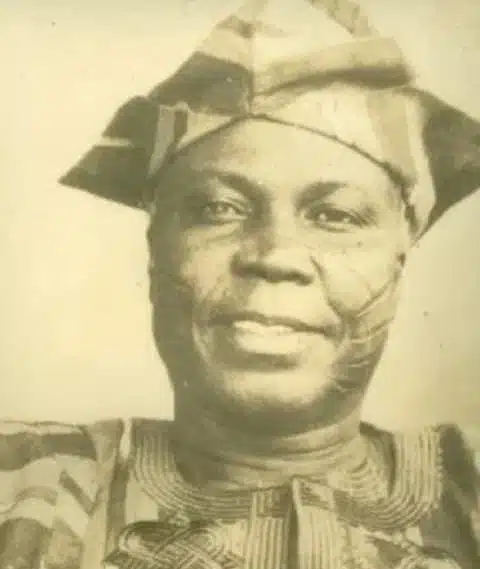
Chief Lere Paimo MFR (Eda Onile Ola) is one of the most modern dramatists, theatre arts performer, filmmaker, dancer, and singer from Ogbomoso who has distinguished himself on stage for the last few 60years.
Chief Lere Paimo, MFR was born on September 19, 1939 in Ile Ikoyi Odan, Osupa Ogbomoso. His father was a tobacco and yam farmer, and the leader of the local farmers’ organization. His mother was a trader. Lere was sent to primary school in Ogbomoso but then left for the Gold Coast (now Ghana).
He continued his education in the Gold Coast (Ghana) up to teacher training college where he obtained a Teacher’s Grade two certificate. He eventually returned back to Nigeria and decided to stay in Osogbo where he worked as a classroom teacher in a Baptist Missionary School, Newton Memorial School.
In the 1950s, Osogbo was the seabed of Yorùbá indigenous culture Osogbo. Osogbo continued to serve as a beacon for arts, culture, and dramatics between the 1950s and 1970s; cultural flowering took place during this place majorly in Osogbo. No wonder ace artists, musician dramatists, and actors started their careers in Osogbo.
The likes of Duro Ladipo, Oyin Adejobi, Kola Ogunmola who were the three greatest and most talented actor-managers in the history of Yoruba theatre, established their careers in Osogbo. Lere Paimo, like every other actor of the time, joined the theatre through his experience of acting at school, asides from his experience he was passionate about acting.
In around 1960, while working as a teacher in Osogbo, he decided to join the Oyin Adejobi theatre group, a theatre group founded by Pa Oyinade Adejobi which was an organization performing plays for churches, schools, and cultural and social clubs. A year later in about 1961, Duro Ladipo invited him to Mbari Club – the cultural centre founded by Ulli Beier- to take part in art production. He was interested in painting as well as in theatre, so he accepted the invitation.
From the beginning, Lere Paimo’s talent as an actor was recognized and he was given leading roles. In Eda, a Yoruba version of Everyman, he played Everyman himself, so memorably that up till today his nickname has remained Eda Onile ola. While with Duro Ladipo, he featured in a stage play titled Obamoro with the role of “Chief Basa”. For twelve solid years, he was an apprentice tutelage of the renowned international artist, Late Duro Ladipo before establishing his own Lere Paimo Theatre Group.
Duro Ladipo died in 1978 5yrs after Chief Lere Paimo started his own Theatre group. Lere Paimo regards the years he spent with Late Duro Ladipo as a formative influence on his career, and up to this day refers to him as his boss. He stayed with Late Duro Ladipo for Twelve years and eventually became Ladipo’s manager and right-hand man before starting his own Theatre group.
Chief Lere Paimo, MFR had set up his own Theatre group by 1973. In the 1970s, the theatre group was at its peak. Numerous theatre groups started in this particular decade, old theatre groups also “up” their games by becoming professional and commercial so as to catch up with the trends.
By this time, Chief Lere Paimo, MFR was already well known and celebrated due to his well-approved works with the renowned Late Duro Ladipo. This gave him an edge over others as many aspiring actors already had their eyes on the veteran actor. Chief Lere Paimo is unapologetically passionate and proud of his heritage as a Yoruba man.
After setting up his theatre group, he went ahead to produce most of the first well-accepted movies. As a proud indigene of Ogbomoso, he produced an epic Yoruba movie titled Ogbori Elemoso where he played the lead role of Soun Ogunlana, the first king (Soun) of Ogbomoso and the founder of Soun dynasty; a movie depicting the history of his beloved hometown.
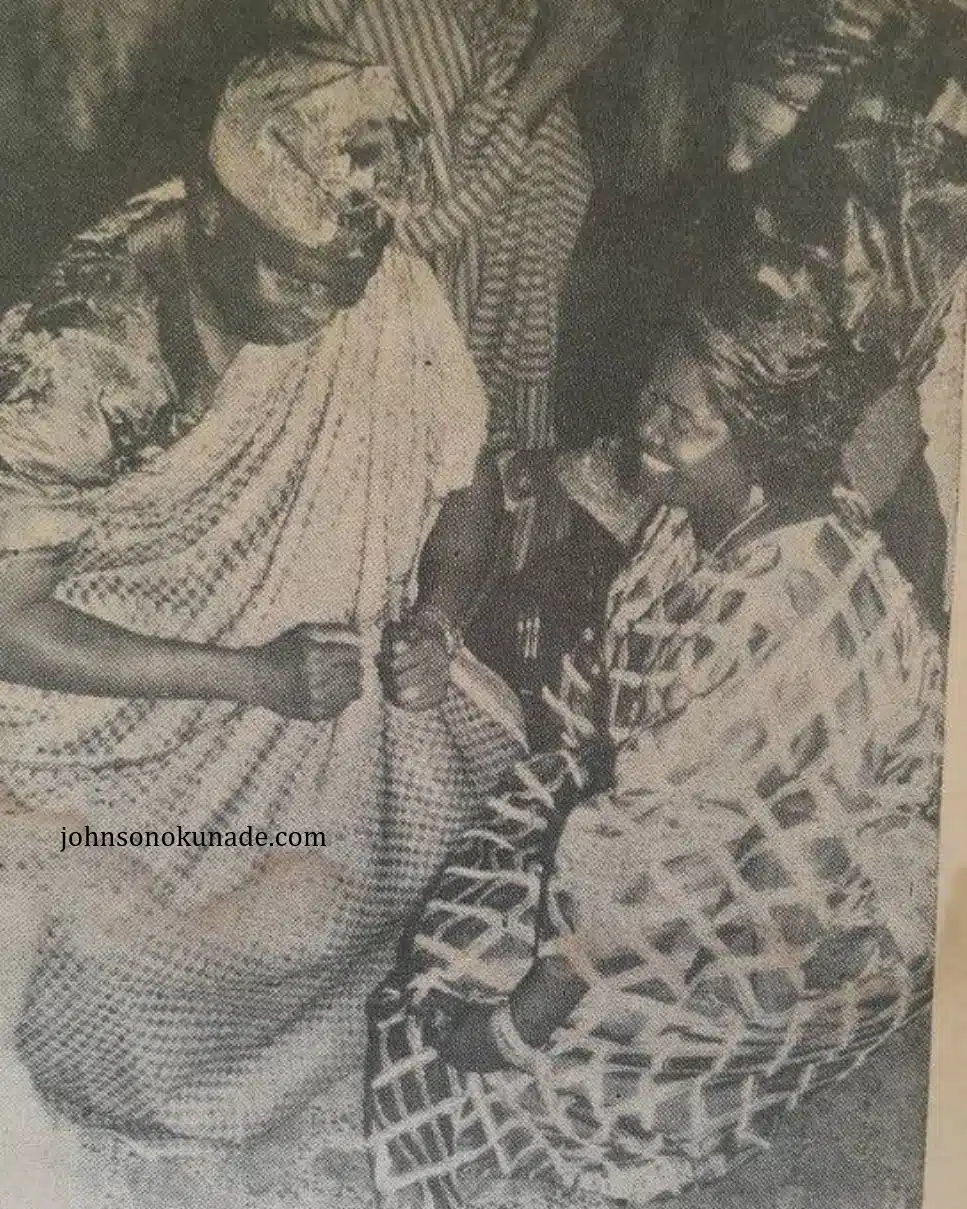
Chief Lere Paimo as Onikoyi in his Epic Onikoyi Movie in the 1980sChief Lere Paimo as Soun Ogunlola and Elemoso (Lalude) in Ogbori ElemosoSoun Ogunlola placed his leg on Elemoso’s head he severed-off in Ogbori Elemoso
Other repertoires of plays he produced include; Onikoyi, Aye n yi, Gbangba Dekun, Irinajo Eda, Idajo, Aye Gbege, Akukuu-bi, Gba die, Ago Alaago and Ere Ogun.
All the aforementioned movies promote indigenous Yorùbá culture. Also, some of the movies were derived directly from the traditionalist style of play, being based on traditional oral narratives and making extensive use of indigenous art such as drumming, singing, and dancing. Chief Lere Paimo is no doubt, a rare breed.
Eda Onile ola participated fully in the extraordinary creativity and innovativeness of the Yoruba popular theatre. Like all the first-rate theatre of the 1970s and early 1980s, he introduced not only new themes and styles but also new theoretical techniques. He also used colourful backcloths which were changed from scene to scene and more elaborate lighting effects; he was a creative genius.
Chief Lere Paimo will forever be remembered in the history of theatre arts for his innovations and creativity. He remains the sceptre of the old and contemporary theatre industry and has done the nation proud both locally and internationally. He has contributed immensely to the socio-cultural and tourism development of Nigeria through his unbeatable records in the theatre and movie industry.
Ever since on the stage performing, Chief Lere Paimo, MFR has won several awards, Laurels in performing theatre arts and Films. He won from the then Governor-General of Nigeria the then Governor-General of Nigeria, Dr. Nnamdi Azikwe, Trophy for participating in World Berlin Arts Festival 1964; First position in Drama at the Common Wealth Art Festival 1965; Best Actor Award in the first National Film Festival, Best Yorùbá Actor Theme Award 1999 and so many others.
For recognition of his career’s worth, he bagged the chieftaincy title of “Aare Arobajo of Ogbomosoland” from his royal majesty Oba Oladunni Oyewumi Ajagungbade III, the Soun of Ogbomosoland in 2004.
Equally, in 2005, former President Olusegun Obasanjo bestowed him with a National award of Member of the Federal Republic (MFR) alongside Zeb Ejiro in recognition of his immense contributions to the Nigerian film industry.
In May 2013, it was reported that he had a partial stroke, an attack he survived. In April 2014, he won an N1 million cash prize in a Nigerian game show, Who Wants To Be A Millionaire.
On Saturday, September 28, 2019, the Ogbomoso Community Foundation (OCF), a social-cultural organization founded in 2001 under the leadership of late IGP, Chief Sunday Adewusi, organized an event tagged, Night with Stars which was dedicated to honouring Ogbomoso indigenes who have positively impacted the Country, state and the Ogbomoso community.
Outstanding indigenes were giving like Chief Lere Paimo (Eda Onileola) we’re giving Exemplary Award/Outstanding Recognition. Other beneficiaries of the awards/recognition are; Dr. Samson Adegoke (Maigida), Late Chief Ogundare Foyanmu (Posthumous Award), Special Award (Entertainment) Mr. Abolore Akande (9ice), Alhaji Wale Akorede (Okunnu), Prince Femi Oyewumi, Alhaji Ramoni Akanni, Mr.Ayodeji Adegoke, Benedict Ayoola and others.
Chief Lere Paimo MFR is happily married to Olusola, Mojirade, Abiola and Bolanle Paimo. His first son, Dele Paimo is a great gospel singer. Chief Lere Paimo’s hobbies cannot be less than acting and dancing.
REFERENCE
Chief Oyebisi Okewuyi (JP.) 2013, Ogbomoso in the Early Times, Modern Era and in Today’s Contemporary World, Published and printed by Johnny Printing Works, Beside Okelerin Court Area, Ogbomoso, Nigeria
Thanks so much for your time.
Please drop your opinion in the comment session below.
Written by Johnson Adé OKÙNADÉ, an enthusiast of Indigenous Culture
PROFESSOR (CHIEF) HON. NATHANIEL DUROJAYE (N.D) OYERINDE (OBE): THE FIRST NIGERIAN PROFESSOR
Introduction
The life and times of our beloved who was the first Ògbómòsó man to be well educated and rose to become the first professor in Nigeria, perhaps also among the earliest educationalists in Black Africa to have a PhD and become professor.
Chief Nathaniel David Oyerinde came from a strong Christian family and inherited an enduring tenacity in the Christian faith. Born around 1875, he belonged to the second generation of Christian converts in Ogbomoso.
He died in 1977 at the age of 102. He belonged to the tiny group of Nigerians educated in the USA early this century. He had a distinguished public career and was respected by his contemporaries and even British officials. He contributed immensely to Nigeria’s development through his membership to the Nigerian Legislative Council from 1935 to 1944, of the former Western House of Chiefs from 1944 to 1950 and of various Government boards and committees until 1957.
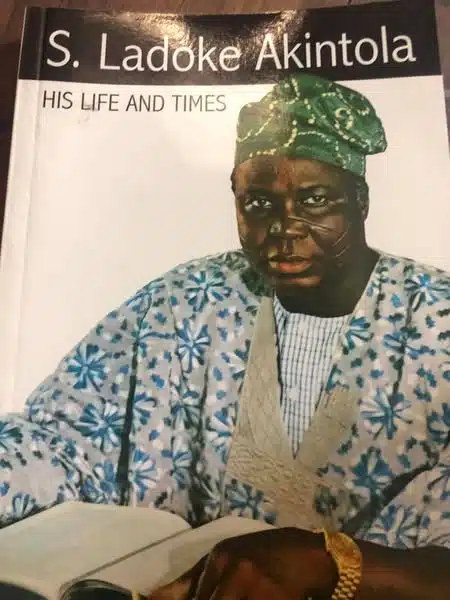
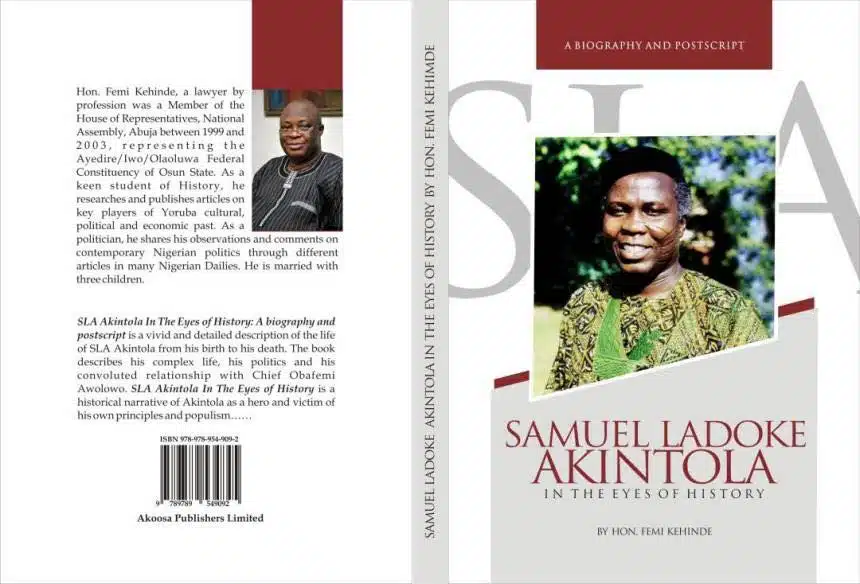
He was publicity-shy but believed in action. He concentrated his activities in Ogbomoso, his hometown where he lived and died. Samuel Ladoke Akintola (SLA) and Nathaniel David Oyerinde had a lot in common asides from the fact that they were both from Ogbomoso.
Both of them were also progressive members of the Nigerian Baptist Convention, they went ahead to serve the convention in different capacities. Professor Nathaniel David Oyerinde’s extraordinary career as a politician and academician of note was between 1931 and 1966, the year Samuel Ladoke Akintola (SLA) was killed.
Professor N.D Oyerinde
Early Life
Nathaniel Durojaye Oyerinde hailed from Ile-Igbagbo in Isale Afon, the root of Christianity in Ògbómòsó which produced early educationists. The family house became the forerunner of who is who in pursuit of Western education.
Master Nathaniel Durojaye Oyerinde was born into the family of Pa. David Aworinde in October 1897. His Father, Pa. David Aworinde and Madam Adeyemi Aworinde were one of the earliest trained pastors by the Baptist missionary to Nigeria, Thomas Bowen in 1855.
Reverend Charles Edwin Smith was of great influence on the Young Master Durojaye Aworinde, he received his early education directly under him. While attending Baptist Day School, Osupa, Ogbomoso, it was clear that a promising future awaits him.
Reverend Charles Edwin Smith recommended him for training as a teacher at Iwo Baptist College in 1898. He was the first student to be enrolled in the college. By 1900, Young Oyerinde was back at the Baptist Training School, Ogbomoso, teaching in the elementary session.
Studying Abroad
By December 1902, Nathaniel Durojaye (N.D) Oyerinde had begun to think of further education in America. It was said that he was influenced by one Miss Moloto Osodi in Ogbomoso that year seeking a teaching appointment in the school. However, he understood very well that he could not expect any sponsor for his education abroad unless he worked hard for it.
He wrote Reverend Smith requesting that he save £15 out of his annual salary of £18 in the bank to enable him to study abroad after saving enough. Reverend Smith was impressed, so he recommended the young Oyerinde to the Foreign Mission Board of the Baptist Mission in Richmond, Virginia. In the letter, he mentioned that Oyerinde should be encouraged since he hoped to return to teach in the Baptist Training school in Ogbomoso.
N. D. Oyerinde left Nigeria for further studies in the United States of America in 1906, on the same boat with the Reverend C. E. Smith who was returning home on health grounds preparatory to his retirement in 1909. On arrival in the United States, Oyerinde was admitted to the Wayland Academy, a preparatory secondary school attached to Virginia Union University in Richmond, Virginia.
After three years, he gained admission into the university and obtained a Bachelor of Arts degree in 1914. It is worth mentioning that while in the United States, Oyerinde demonstrated his love for liberal rather than religious education. This informed his decision to take a Bachelor of Arts degree before “he took the Bachelor of Divinity degree in 1915 and spent the next academic year widening and deepening his education in both the liberal arts and social sciences by reading Greek, Mathematics, and Economics at the University of Chicago.”
He finally returned to Nigeria in 1916 after successfully completing his education in the United States. From available records, it can be deduced that on a comparative level, Professor N.D Oyerinde remains one of the earliest Nigerians to be so educated even on the Continent of Africa.
His Return to Nigeria
On his return to Nigeria, Professor Nathaniel Durojaye (N.D) Oyerinde realised that he had no choice but to accept and function within the system in which he had found himself. He described his experience at the Virginia Union University, as Booker T. Washington once said of Hampton Institute, that he found the opportunities to learn thrift and push, and that he was surrounded by an atmosphere of business, Christian influences, and the spirit of self-help.
With a solid academic background and an experience of the United States environment and educational system, Professor Nathaniel Durojaye (N.D) Oyerinde was well equipped to put his newly acquired ideas and experience into practice in Nigeria. It is necessary to recall at this point that the British educational policy in Nigeria was not dynamic because aside from other inherent shortcomings there were no guidelines on the curriculum to be followed.
Hence, the Baptist Mission, whose sphere of influence was Ogbomoso, continued to emphasize what seemed to it the best option for the Nigerian people in educational matters. With his newly acquired ideas and experience in the United States, it is natural to expect that Professor Nathaniel Durojaye (N.D) Oyerinde’s activities in the educational development of Nigeria in general and Ogbomoso, in particular, were a reaction to the educational policies of the Baptist Mission and that of the British Colonial Government.
It is against this background that Professor Nathaniel Durojaye (N.D) Oyerinde’s contributions to the educational development in colonial southern Nigeria in general and his quest for the introduction of the American educational model, in particular, will be discussed. To a very great extent, Professor Nathaniel Durojaye (N.D) Oyerinde’s ideas of education were encouraged and adapted from the ideas of Booker T. Washington. Based on this, he chastised the Baptist Mission’s educational enterprise because they did not recognise education as a tool of “social regeneration”.
While he was the Headmaster of Baptist Academy in Ogbomoso, he tried to introduce some of his ideas in the curriculum and administration of the school. “He strongly believed that the minimum success he achieved in creating awareness about the wider world in his pupils beyond the narrow goals set by the Baptist Mission was the immediate reason for the merger that produced the Baptist College and Theological Seminary.”
As an academic person, Professor Nathaniel Durojaye (N.D) Oyerinde did not hide his dislike for ministry (church) work, hence he taught only English and Mathematics throughout his career as a teacher. His refusal to be ordained as a pastor of the Baptist Mission “robbed him of a higher post than that of a teacher till he left the Baptist College in 1935.” This should not be taken to mean that Professor Nathaniel Durojaye (N.D) Oyerinde was not a religious man. It can be argued that his refusal to be ordained as a pastor of the Baptist Mission was a direct and open protest against the policies of the Baptist Mission in Nigeria at that time.
The Ogbomoso Progressive Union (OPU)
To achieve some of his goals, together with some elites in his Ogbomoso society they formed the Ogbomoso Progressive Union (OPU) in 1933 with the aim of fostering rapid socio-economic and political development of the town. Professor Nathaniel Durojaye (N.D) Oyerinde was its first president. The newly formed OPU comprised both militant, moderate, and conservative associations and individuals. However, the Ogbomoso Progressive Union provided Professor Nathaniel Durojaye (N.D) Oyerinde with the pedestal from which he launched his educational ideas.
In 1934, shortly after the birth of the OPU, some members of the associations presented a proposal for the establishment of a grammar school in Ogbomoso. This idea was however modified to that of a comprehensive school named Ogbomoso People’s Institute, (O.P.I.). It is important to note that the name, operational, and instructional model of the Ogbomosho People’s Institute was patterned after the Hampton and Tuskegee Institutes founded by Booker T. Washington in the United States of America.
The newly established Ogbomoso People’s Institute was essentially an institution where Professor Nathaniel Durojaye (N.D) Oyerinde tried as much as he could to fully implement his educational thoughts, which he acquired in the United States during his studies in that country.
With the moral, financial and manual assistance of his fellow Ogbomoso kinsmen, a building was erected for the Ogbomosho People’s Institute between 1934 and 1938. Professor Nathaniel Durojaye (N.D) Oyerinde also received the encouragement and assistance of Eyo Ita, who was a colleague at the Baptist College in 1929 and had returned to Ogbomoso in 1934 after his education in the United States of America.
Both men had similar views and shared aspirations about the system and content of the type of education, the Nigerian child should receive. Without mincing words, both men had inherent belief in the operations of the American system and curriculum of education in Nigeria.
Ogbomoso People’s Institute
In October 1938, the Ogbomoso People’s Institute was formally opened with Professor Eyo Ita as its first Principal. Ladipo Babatunde, an ex-student of Professor Nathaniel Durojaye (N.D) Oyerinde at the Baptist College, was the headmaster of the primary section, while Oyerinde served as the school manager and proprietor. Subjects taught in the school included Carpentry and Woodwork, Weaving, Smithing, Agriculture, and Literary subjects.
A major problem that the Ogbomoso People’s Institute had to contend with was that of qualified personnel. The school was never lucky to have qualified and specialist teachers to teach vocational and industrial subjects. The reason for this is not far-fetched. First, salaries paid to clerks were higher than those paid to technicians and artisans.
As such, the zeal to acquire vocational and industrial education at higher schools of learning by Nigerians was disappointingly low. Again, only the Hope Waddel Institute in Calabar was a standard school where industrial and technical education could be acquired by the few interested Nigerians, thus, there was a dearth in the supply of this category of teachers.
Furthermore, the official policy of the colonial British Administration did not encourage the acquisition of vocational and industrial education because it catered for its need for such personnel “through the workshops of the Nigeria Railways, Public Works Department, Marines, Surveys, Posts and Telegraphs.” What is more, the establishment of the Yaba Higher College in 1934 did not improve the situation as intakes for technical education and engineering were continuously tailored to meet government needs.
Indeed, “before 1940, only about 300 Nigerians had had an opportunity to receive formal instruction and training for technical occupations.” In light of the above problem of recruiting qualified and adequate personnel for the school, the authorities of the Ogbomoso People’s Institute had no choice but to embark on a training scheme for the production of its own crafts teachers.
Thus in 1944, the school could only “send a teacher to Maiduguri and Jos (in Northern Nigeria) to learn leather works including shoemaking”. It is important to mention that the course was undertaken not in a formal school of learning but with established local craftsmen. Again, the sole beneficiary of the course was sponsored with funds provided by the Ogbomoso community resident in Jos.
Another major problem that the Ogbomoso People’s Institute had to contend with was that of inadequate finance. Since it was a community project, the Ogbomosho People’s Institute from inception relied on community funds for survival. The continuous flow of funds depended on the willingness to give and the unanimous support of all sections of the town.
However, it was only the Baptist section that was forthcoming on a continuous basis in its financial obligation towards the upkeep of the school. The Church Missionary Society, other Christian missions, and the colonial administration were lukewarm towards the provision of finance for the school to be placed on a sound and proper footing.
The Muslim population were engrossed with contributions towards the construction of a central mosque in Ogbomoso; consequently, the financial upkeep of the school was not a priority to them. Therefore, distressing and discouraging was the financial situation of the Ogbomosho People’s Institute that Professor Nathaniel Durojaye (N.D) Oyerinde wrote in August 1940, “In my deep consideration, Ogbomoso is not prepared for such big work.”
As a result, a move was made to close down the school. This, however, could be said to be the beginning of the end for the Ogbomoso People’s Institute as classes were drastically reduced. Furthermore, the departure of Professor Eyo Ita to Calabar in 1940 to assume full control of the West African People’s Institute led to the closing down of the secondary section of the Ogbomoso People’s Institute in 1942.
Eyo Ita’s relocation to Calabar was facilitated by the fact that the colonial administration had refused to approve the Ogbomosho People’s Institute as long as Professor Eyo Ita remained its principal and also that of the West African People’s Institute.
In 1943, a year after Professor Eyo Ita’s exit, the Department of Education approved the Ogbomoso People’s Institute for the issue of the First School Leaving Certificate and in the next year, a grant of £100 from the funds of the Ogbomoso Native Authority was given to it. It will not be wrong to argue at this point that the approval of the Ogbomoso People’s Institute as a First School Leaving Certificate awarding institution was a tacit approval by the colonial British Administration of the American system of education in Nigeria.
When Professor N.D Oyerinde was being congratulated for the award of the Order of the British Empire (OBE) at a meeting of the Native Authority Councillors from Ibadan Northern District on 9 July 1947, Professor Nathaniel Durojaye (N.D) Oyerinde emphasised that he wished his school, the People’s Institute, had been helped instead of the honour done him.
In accordance with the desires of the local populace, the tacit rejection of Professor Nathaniel Durojaye (N.D) Oyerinde’s school by the Ogbomoso people showed their preference for a school, which was completely devoted to literary education. However, in 1943, a woman instructor was employed to teach weaving in the school, and, by 1945, the demand for a secondary grammar school was at its peak again in Ogbomoso.
Furthermore, by 1952 with the help of Samuel Ladoke Akintola was the last premier of the western region, 13th Aare-Ona Kakanfo and proud son of the soil, the new Ogbomoso High School was inaugurated and housed within the buildings of the Ogbomoso People’s Institute which was finally phased out in 1954. Thus, the attempt to transfer the Tuskegee and Hampton Institutes’ ideas and models to Nigeria by Prof N. D. Oyerinde suffered a major setback.
With Professor Nathaniel Durojaye (N.D) Oyerinde’s Ordeal with Ogbomoso People’s Institute, we can describe him as a man with lofty ideas who lived before his time. As an illustrious son of Nigeria, his contribution to the growth and development of education in colonial southern Nigeria is second to none.
Career And Politics
On his arrival home, Professor Nathaniel Durojaye (N.D) Oyerinde taught at Baptist Academy, Ogbomoso from late 1916 to 1921 and at Baptist College and Seminary, Ogbomoso 1922 to 1935. On his other multi-facets and multifarious assignments, he remains a colossus of his era. He was Recording Secretary of the Nigerian Baptist Convention in 1923 and 1924 and was the president of the Nigerian Baptist Convention between 1926 and 1937.
Professor Nathaniel Durojaye (N.D) Oyerinde was nominated to be a member of the legislative council of Nigeria, Lagos, representing Oyo province from 1935 to 1944. As president of the Ogbomoso Progressive Union (OPU), he was made a full-time council member of the Ògbómòsó District Council in 1935.
As a patriotic citizen fighting for the advancement and progress of his fatherland, Professor Oyerinde was solidly the brain behind the establishment of earlier Ogbomoso continuation classes and the People’s Institute founded in 1938 for which he invited his young friend, Professor Eyo Ita as the headmaster of the Institute.
Professor N.D Oyerinde
Professor N.D Oyerinde, Indisputably The First Nigerian Professor
Edward Wilmot Blyden was born in 1832 to Igbo parents who were enslaved and sold to the new world. His place of birth, St. Thomas [now US Virgin Islands] did not stop him from holding on to his African roots. He relocated to Liberia, lived in Nigeria as one of the founders of Archbishop Vining Church, Ikeja and died in Sierra Leone on December 12, 1912.
Blyden was a professor of Greek and Latin at Liberia College. He also rose to the position of President of the college between 1880 and 1884. It is safe to regard him as the first recorded Igbo professor as there was no country called Nigeria until 1914.
There are also claims that Eyo Ita was the first professor to emerge from our shores. With degrees from University of London and Columbia University, he once served as headmaster of Baptist Academy, Lagos before setting up the West African Peoples Institute[WAPI] in Calabar,1938.
Nsukka admitted its first set of undergraduates and they began classes in October 1960. There was a Vice Chancellor, George Marion Johnson, and he signed certificates for the first graduates in 1963, the year Prof. Dike began to settle down in Ibadan. Little wonder Lions hail Nsukka as the first independent Nigerian university. But before UNN, there were NBTS, Ogbomosho degrees.
Prof K.O. Dike, the first Nigerian Vice Chancellor and first Nigerian to earn a PhD in History, became a professor in 1956. Four years later, 1960, he became VC at Ibadan and lasted until 1966.
Dr. Taslim Olawale Elias, the only Chief Justice of Nigeria appointed from the bar, was also a professor in 1956. With a 1949 doctorate in Law, he was a visiting professor of Political Science at the University of Delhi.
While we continue debate on the first Nigerian professor, we need not worry ourselves about the first female professor. Adetowun Felicia Ogunseye achieved this feat in Library Science in 1973. The duo of Alele -Williams and Bolanle Awe joined her in 1976. The former is the first female VC, the later, first female professor of History.
Prof. Ogunseye comes from a family of firsts. Her younger brother, Brigadier Victor Adebukunola Banjo, was the first Director of the Nigeria Army Electrical and Mechanical Engineers[NAEME].He was born in Benin City and he led Biafra’s 101 Division that operated in Benin.
There is Dr. Ademola Banjo, who in 1954, became first Nigerian PhD holder in Metallurgical Engineering. Prof. Adesegun Banjo is first Nigerian to bag a doctorate in Ultra Structure and Electro Microscopy. One of Victor Banjo’s children, Olayinka Omigbodun, is a professor of Child and Adolescent Psychiatry.
Prof. Ogunseye and her brother, Dr. Banjo, made everyone proud when they graduated from the University of Ibadan same day. While she came out as the best female graduating student, with a scholarship to Newham College, Cambridge, he was best graduating male student, with scholarship to Manchester University. The young man made a first class in Mechanical Engineering, 1952.
Prof Chike Obi received his Ph.D at a very young age of 29 making him the first Nigerian to receive a Doctorate degree but he didn’t become a professor until when he was in his fifties in 1970s. By this time the First Nigerian Professor, Prof N.D Oyerinde was in his old age, he died at the age of 102 in 1977.
Prof. Ita lived in Ogbomosho to help Prof N.D Oyerinde at the then Ogbomoso People’s Institute and has a house named after him at Ogbomosho Grammar School. Prof. Eyo Ita begat more professors. His first son, Lawrence, was a professor at the University of Las Vegas. He holds doctorate degrees in Mechanical and Civil Engineering and also went for a degree in Law. Grandson, another Eyo Ita, is a professor of Physics at the United States Naval Academy, Annapolis, Maryland.
In other words, when Professors Wole Soyinka and Chinua Achebe, Emeka Anyaoku, Bola Ige, Chris Okigbo, Gamaliel Onosode, Emma Ifeajuna, and Grace Alele-Williams studied there, they were under Principals, beginning from Kenneth Mellanby in 1947, not Vice Chancellors. The first Vice-Chancellor, Keneth Onwuka Dike, came in 1963.
From 1901 to 1906, Professor Nathaniel Durojaye (N.D) Oyerinde, the first Nigerian Professor was a teacher at The Baptist Day School, Ogbomoso, and The Nigerian Baptist Theological Seminary [NBTS], Ogbomosho. He later left for the United States Of America to study.
He was at Wayland Academy and Virginia Union University, Richmond Virginia, and obtained B.A. Degree in Mathematics and classics in 1914 and B.D. Degree in 1915.
For his postgraduate study, he was at the University of Chicago, Illinois, majoring in Hebrew before returning to Nigeria in 1916. From available records, it can be deduced that on a comparative level, Professor Nathaniel Durojaye (N.D) Oyerinde, the first Nigerian Professor remains one of the earliest Nigerians to be so educated even on the Continent of Africa.
The NBTS, Ogbomosho was established in 1898 and by 1948 was affiliated with the Baptist Theological Seminary, Louisville in the United States. There is no disputing the fact that by 1950, NBTS had turned out its first set of graduates. Historically that should be the first Nigerian institution to award degrees. Professor Nathaniel Durojaye (N.D) Oyerinde earned his professorship there. Ibadan began as University College in 1948, something like a campus of London University. It only became autonomous in 1962.
First Nigerian Professors in some Fields/Academic Discipline
First Female Professor of Agriculture in Nigeria and First Female Professor of Agricultural Economics in Africa – Professor (Mrs) Tomilayo O. Adekanye.
First Female Professor of Yoruba Studies in the world – Prof. (Mrs). Omotayo Olutoye
First Nigerian Female Professor of Animal Science – Prof Mrs Oyebiodun Longe
First Nigerian Female Professor of Urban and Regional Planning – Prof. (Mrs).Ogbazi Joy Ukamaka
First female Nigerian Professor of Accounting – Prof. Jane Ande
First female Physics Professor in Africa – Prof. (Mrs) Deborah Ajakaye
First female Professor of Animal Breeding & Genetics in Nigeria – Prof. Adebambo Ayoka.O
First female professor of Chemical Engineering in Nigeria – Professor (Mrs) P.K. Igbokwe
First Female Professor of Chemistry in Nigeria – Prof. (Mrs) Modupe Ogunlesi
First Female Professor of Computer Science – Prof Adenike Osofisan
First Female professor of physiotherapy in Africa – Prof. Arinola O. Sanya
First Nigeria Professor of Forestry – Professor Kolade Adeyoju (Ekiti State)
First Nigerian Female Professor ever – Prof. (Mrs) Felicia Adetoun Ogunsheye
First Nigerian Female Professor of History – Prof. (Mrs) Bolanle Awe
First Nigerian Female Professor of Law – Prof (Mrs) Jadesola Olayinka Akande
First Nigerian Female Professor of Mass Communication – Prof. (Mrs) Chinyere Stella Okunna
First Nigerian Female Professor of Mathematics Education – Prof. (Mrs). Grace Allele-Williams.
First Nigerian Female Professor of Pharmacy – Prof. (Mrs) Babalola Chinedum Peace
First Nigerian Female Professor of Psychiatry – Prof. (Mrs) Olayinka Omigbodun
First Nigerian Female Professor of Quantity Surveying in Africa – Prof Olubola Babalola
First Nigerian Professor of Accounting – Prof. Micheal A. Adeyemo
First Nigerian Professor of Agriculture – Prof. Victor Adenuga Oyenuga
First Nigerian Professor of Anatomy – Prof. Thomas Adesanya Grillo
First Nigerian Professor of Animal Science – Prof. Gabriel. M. Babatunde
First Nigerian Professor of Arabic and Islamic Language – Prof M.O.A Abdul
First Nigerian Professor Of Architecture – Prof. Ekundayo Adeyemi
First Nigerian Professor of Botany – Prof. Eni Njoku
First Nigerian Professor of Chemical Engineering – Prof. Sikiru A. Sanni
First Nigerian Professor of Chemistry – Prof. Stephen Oluwole Awokoya
First Nigerian Professor of Civil Engineering – Prof. Ifedayo O. Oladapo
First Nigerian professor of Clinical Pharmacy – Prof. Nzebunwa Aguwa
First Nigerian Professor of Computer Science – Prof. Olu Longe
First Nigerian Professor of Education – Prof. Aliu Babs Fafunwa
First Nigerian Professor of Estate Management – Prof. John. A. Umeh
First Nigerian Professor of French Language – Prof Evans
First Nigerian Professor of Geography – Prof. Akin Mobogunje
First Nigerian Professor of Geology – Prof. Mosobolaje O. Oyawoye
First Nigerian Professor of History – Prof Kenneth Dike
First Nigerian Professor of Industrial Engineering – Prof. David. E. Osifo
First Nigerian Professor of Insurance – Prof. Joseph. O. Irukwu
First Nigerian Professor of Law – Prof Teslim Olawale Elias
First Nigerian Professor of Library and Information Science – Prof Mrs Adetoun Ogunsheye
First Nigerian Professor of Linguistic – Prof Ayo Bamgbose
First Nigerian Professor of Marketing – Prof. Julius Onuorah Onah
First Nigerian Professor of Mathematics – Prof. Chike Obi
First Nigerian Professor of Medicine – Prof. Theophilus Ogunlesi
First Nigerian Professor of Mining Engineering – Prof. Zacheus Opafunso
First Nigerian Professor of Music – Prof. Lazarus Ekwueme
First Nigerian Professor of Nursing – Prof (Mrs). Elfrida. O. Adebo
First Nigerian Professor of Nutrition – Prof Babatunde Oguntona
First Nigerian Professor of Paediatrics – Prof Olikoye Ransome-Kuti
First Nigerian Professor of Petroleum Engineering – Prof. Gabriel Kayode Falade
First Nigerian Professor of Philosophy – Prof Olubi Sodipo
First Nigerian Professor of Physical Education – Prof. M. Oluwafemi Ajisafe
First Nigerian Professor of Physics – Prof. Muyiwa Awe
First Nigerian Professor of Physiology – HRH Prof. Joseph Chike Edozien
First Nigerian Professor of Physiotherapy – Prof. Vincent C. B. Nwuga
First Nigerian Professor of psychiatry – Prof. Thomas Adeoye Lambo
First Nigerian Professor of Psychology – Prof. Dennis Ugwuegbu
First Nigerian Professor of public health – Prof. Oladele Ajose (Lagos state)
First Nigerian Professor of Public Health Engineering – Prof. Paul Aibinuola Oluwande
First Nigerian Professor of statistics – Prof. Nwoue Adichie
First Nigerian Professor of Tests and Measurement – Prof. Dibu Ojerinde
First Nigerian Professor of Theatre and Arts – Prof Joel Adeyinka Adedeji
First Nigerian Professor of Urban and Regional Planning – Prof. Adepoju Onibokun
First Nigerian Professor of Yoruba and African Literature – Prof Wande Abimbola
First Professor of Mass Communication in Nigeria – Prof Alfred Opubor
First Professor of Marine Engineering – Prof Kelvin Datonye Bob-Manuel (From Abonnema, Rivers State)
Impacts And Legacy
Professor Nathaniel Durojaye (N.D) Oyerinde was among the founders of Ogbomoso Grammar School and Ogbomoso Girls High School. For many years he was the chairman Board of Governors for Ogbomoso Grammar School, similarly, he was the founder and First President of Ogbomoso Progressive Union (OPU) in 1912.
He was conferred with OBE on Queen Elizabeth II’s birthday honour in 1947. Similarly, he was made a member of the Federal Republic of Nigeria (MFR) by the Head of State of Nigeria and in 1950 he was appointed a Justice of the Peace (JP). Equally, for many years, he was Chairman of the Education Committee of Ogbomoso District Council and Chairman of the Board of the Nigeria Training Centre for the Blind, Ogbomoso.
It was also Professor (Chief) N.D. Oyerinde, the first Nigerian Professor wrote and submitted a memorandum on “Economic Development of Ogbomoso in 1948”. Professor N.D Oyerinde’s Economic thesis was based on the premise that since Ogbomoso is largely cocoa, rubber, and mahogany which could advance the fortunes of his teeming population.
It was obvious that the tilling of land is not sufficient for the growing youth population as a result of the cessation of hostility after the Yoruba civil strife, in order to check Ogbomoso dispersal or drift to other towns and regions, and similarly to reduce economic hardship being experienced at home, the learned Professor thought and felt there was a need for reawakening and discovery to bail his people out of the doldrums.
Thus, the growing of cotton and the planting of tobacco was accepted as an alternative, profitable enterprise by the Oba of Ogbomoso and his high chiefs, the resident district officer of Ogbomoso, and by Dr. J.C Pool of the American Baptist Mission.
On top of all his contributions, Late Pa. (Hon) N.D. Oyerinde a Professor Emeritus, sat down and chronicled into a book; THE HISTORY OF OGBOMOSO; TITLED, “IWE ITAN OGBOMOSO” Published as far back as 1934, without which not much could have been known on Ogbomoso early or ancient history.
Professor (Chief) Hon. Nathaniel Durojaye Oyerinde, the first Nigerian Professor died on 18th April 1977 at the ripe age of 102.
Conclusion
Without any iota of doubt, Professor (Chief) Hon. Nathaniel Durojaye Oyerinde (OBE) was a patriot. His efforts to transfer the educational model of Tuskegee and Hampton Institutes to Ogbomoso may be rational considering the reality of the economic situation in the town but the demand of the people for the encouragement given by the British to literary education spelled the doom of his efforts.
It is for this reason that he is criticised by some elements today in Ogbomoso for not encouraging education in the town along the right lines. It is significant, however, that Oyerinde was not against higher education; he readily cooperated with the people in their demand for a secondary grammar school after 1944. The Ogbomoso People’s Institute was the antecedent for the Ogbomoso Grammar School.
His role in politics was also bound to be misunderstood by many sectors in the town. To the Muslims, he was the leader of the Christian group that tried to dominate the town’s government. This apprehension was shared by many of the Chiefs and successive Baale before Baale Oke Lanipekun Laoye. The more militant among the OPU were impatient with his methods. Only the British Officers realised his great contributions to the administrative progress of the town.
In spite of reproaches from his opponents, all agree as to his strength of character, his sense of probity, and fair play. Had Professor N.D Oyerinde joined the Nigerian Public Service, he would have been a most successful civil servant. But as a politician, his moderate approach to many issues seems to portray him as a weakling.
Notwithstanding, Professor (Chief) Hon. Nathaniel Durojaye Oyerinde (MFR, JP, OBE) contributed immensely to the development of his beloved hometown, Ogbomoso, he should be well celebrated and commended for his great feats.
Reference
CHIEF OYEBISI OKEWUYI, OGBOMOSO IN THE EARLY TIMES MODERN ERA AND IN TODAY’S CONTEMPORARY WORLD Published by Johnny Printing Works, pp. 107
EMEKA OBASI, SEARCHING FOR FIRST NIGERIAN PROFESSOR Published on Vanguard on May 5, 2018.
MICHEAL M. OGBEIDI, NIGERIAN RETURNEES FROM THE UNITED STATES AND EDUCATIONAL DEVELOPMENT IN COLONIAL SOUTHERN NIGERIA
B. AGIRI, CHIEF N.D. OYERINDE AND THE POLITICAL SOCIAL AND ECONOMIC DEVELOPMENT OF OGBOMOSO Published on Journal of the Historical Society of Nigeria, Vol. 10, No. 1 (DECEMBER 1979), pp. 86-112
THE UNTOLD UNIQUENESS OF YORÙBÁ’S INDIGENOUS ALCOHOLIC BEVERAGES (OTÍ)
WRITTEN BY JOHNSON ADE OKUNADE
As a developing country, Nigeria is at the crossroads of indigenous and foreign cultures.
A culture that has been in existence for centuries is being replaced with a culture we didn’t know until about a century ago.
When we were colonized, British called Ogogoro illicit drink so they can sell and promote their own gin.
We were also so eager to throw away our naturally-made and highly medicinal Alcoholic Beverages (Oti)
British have Gin
Scots are known for Scotch Vodka
The Caribbeans of West Indies part of North Americans are proud of Rum
Scotland, Ireland, America still have Whiskey
Generically, the Yoruba refer to alcoholic beverages as “Oti” long before we were colonized.
Palm Wine is of two varieties; emu made from the oil palm, and Oguro, from the raffia palm. Palm Wine may be distilled producing a drink called Ogogoro.
Guinea corn is malted and fermented to produce oti baba or oti ‘ka, with baba or oka being local names for the corn.
We also have Agadangidi, a fermented beverage made from mashed ripe plantain, fresh red chilli peppers and water.
Those four types of Alcoholic beverages (Oti) served as a major component of of local herbal medicines and an integral part of social life. Up till date, it remains an element of indigenous worship and sacrifice.
Needless to say that our indigenous Alcoholic beverages (Oti) is an untapped source of income for both male and female in the society.
Women are the only producers of guinea corn beer, and they also sell their produce in small shops near their homes or brewing sites. Although men are responsible for tapping the palm wine, women provide the commercial outlets.
Also, Indigenous Yorùbá herbal medicine comes in five forms:
ÀGÚŃMU: Powders of ground roots and leaves.
ÀGBO: A liquid concoction where the ingredients are either boiled or soaked.
Cooked in the form of stew
Made into ointment, or
In powder form, rubbed into incisions
Powdered herbs are frequently mixed with fresh palm wine to create a medicinal portion. These liquids medicines often use Ogogoro as a base for soaking roots and barks.
With the use of herbs and some of Yorùbáindigenous alcoholic beverages (Otí), a number of indigenous healers specialize in making such medicines for what they term women’s diseases.
These medicines focus on menstrual problems, worms that are believed to prevent pregnancy, swollen breast, pelvic inflammation, displaced uterus, and sexually-transmitted infections.
Asides the medicinal applications as mentioned above, lots of revenue could be generated from these of Yorùbá indigenous alcoholic beverages (Otí) provided we improve on them and package it to meet modern standards.
In conclusion, let me leave you with this shocking fact I recently discovered from Statista;
Revenue in the Gin segment amounts to US$12,938m in 2020. Not only that, the market is expected to grow annually by 8.7% (CAGR 2020-2023).
Revenue in the Rum segment amounts to US$14,989m in 2020. Yet still, the market is expected to grow annually by 8.1% (CAGR 2020-2023).
Revenue in the Vodka segment amounts to US$42,057m in 2020. Also, the market is expected to grow annually by 8.0% (CAGR 2020-2023).
Revenue in the Whisky segment amounts to US$80,586m in 2020. Albeit, the market is expected to grow annually by 7.6% (CAGR 2020-2023).
The statistics above shows how much each of the above mentioned foreign alcoholic drinks generate in just one year, so you can imagine how much it worths.
Revenue in the Gin segment amounts to US$12,938m in 2020.
Revenue in the Rum segment amounts to US$14,989m in 2020.
Revenue in the Vodka segment amounts to US$42,057m in 2020.
Revenue in the Whisky segment amounts to US$80,586m in 2020.
I’m not saying we should promote drunkenness, but we should stop closing our eyes to the fact that appreciating foreign products means putting more money in their coffers. It’s time we cherish what we have!
While Russia is the leading country and region in terms of alcohol consumption per capita, Nigeria remains the giant of Africa even in alcohol consumption.
Our indigenous alcoholic beverages has become roadside drink; tagged illicit. We could have upgraded it to compete among well known alcoholic drinks in the world.
REFERENCES
The healing powers of herbs with special Reference to Obstetrics and Gynecology by Lambo J.J
Health Implications of Alcohol Production and Trade by Walsh B
The Origin Of Herbal Cure and Its Spread by Ogunyemi A.O
Alcohol consumption pattern among women in a rural Yoruba community in Nigeria by Mamman, Brieger and Oshiname
Chief Moshood Kashimawo Olawale Abiola,GCFR (24 August 1937 – 7 July 1998) was a Nigerian Yoruba businessman, publisher, politician and aristocrat of the Yoruba Egba clan, he was the Aare Ona Kankafo of the Yoruba land. MKO Abiola ran for the presidency in 1993, for which the election results were annulled by the preceding military president Ibrahim Babangida because of allegations that they were corrupt and unfair.
Abiola was awarded the GCFR posthumously on 6 June 2018 by President Muhammadu Buhari and Nigeria’s democracy day was changed to June 12.
Abiola was a personal friend of Babangida and he is believed to have supported Babangida’s coming to power. Abiola’s support in the June 1993 presidential election cut across geo-political zones and religious divisions, among a few politicians to accomplish such a spread during his time. By the time of his death, he had become an unexpected symbol of democracy.
EARLY LIFE
M. K. O. Abiola was born in Abeokuta, Ogun State to the family of Salawu and Suliat Wuraola Abiola, his father was a produce trader who primarily traded cocoa and his mom traded in Kola Nuts. His name, Kashimawo, means “Let us wait and see”.
Moshood Abiola was his father’s 23rd child but the first of his father’s children to survive infancy, hence the name ‘Kashimawo’. It was not until he was 15 years old that he was properly named Moshood, by his parents. Abiola attended African Central School, Abeokuta for his primary education.
As a young boy, he assisted his father in the cocoa trade, but by the end of 1946, his father’s business venture was failing precipitated by the destruction of a cocoa consignment declared by a produce inspector to be of poor quality grade and unworthy for export and to be destroyed immediately.
At the age of nine he started his first business selling firewood gathered in the forest at dawn before school, to support his father and siblings. Abiola founded a band at the age of fifteen and would perform at various ceremonies in exchange for food. Abiola was eventually able to require payment for his performances, and used the money to support his family and his secondary education at the Baptist Boys High School Abeokuta.
Abiola was the editor of the school magazine The Trumpeter, Olusegun Obasanjo was deputy editor. At the age of 19 he joined the National Council of Nigeria and the Cameroons ostensibly because of its stronger pan-Nigerian origin compared with the Obafemi Awolowo-led Action Group.
In 1960, he obtained a government scholarship to study at University of Glasgow where he later earned a degree in accountancy and qualified as a chartered accountant.
BUSINESS CAREER AND POLITICS
In 1956 Moshood Abiola started his professional life as a bank clerk with Barclays Bank in Ibadan, South-West Nigeria.
After two years he joined the Western Region Finance Corporation as an executive accounts officer, before leaving for Glasgow, Scotland, to pursue his higher education.
From Glasgow University he received a first class degree in accountancy, and he also gained a distinction from the Institute of Chartered Accountants of Scotland.
On his return to Nigeria, Abiola worked as a senior accountant at the University of Lagos Teaching Hospital, then went on to US firm Pfizer, before joining the ITT Corporation, where he later rose to the position of Vice-President, Africa and Middle-East.
Abiola spent a lot of his time, and made most of his money, in the United States, while retaining the post of chairman of the corporation’s Nigerian subsidiary.
Otunba MKO Abiola, General Ibrahim Babangida and Asiwaju Bola Tinubu (behind)
Abiola’s involvement in politics started early on in life when he joined the National Council of Nigeria and the Cameroons (NCNC) at age 19. In 1979, the military government kept its word and handed over power to the civilian.
As Abiola was already involved in politics, he joined the ruling National Party of Nigeria(NPN) in 1980 and was elected the state chairman of his party.
Re-election was done in 1983 and everything looked promising since the re-elected president was from Abiola’s party and based on the true transition to power in 1979; Abiola was eligible to go for the post of presidential candidate after the tenure of the re-elected president.
However, his hope to become the president was shortly dashed away for the first time in 1983 when a military coup d’état swept away the re-elected president of his party and ended civilian rule in the country.
Abiola announced his candidacy for president in February 1993, this was after a previous round of presidential primaries had been cancelled by military President Babangida.
His party of choice was SDP, though he was an outsider who was new to the partisan politics within the party which at the time was dominated by two major factions, People’s Front(PF) and PSP. Both SDP and its opposition, NRC held presidential primaries in March 1993.
SDP’s primaries was held in Jos and was largely a three way contest between Abiola, Kingibe and Atiku even though there were more aspirants. Abiola was heavily supported by the People’s Solidarity faction (PSP) within SDP while Atiku was supported by PF faction led by Yar’Adua and Kingibe was supported by a loose coalition of party members.
During the first ballot, Abiola was able to score a slim majority vote of 3,617 to Kingibe’s 3,225. A second round was contested two days later and Abiola again emerged victorious with a slim margin and he became the party’s presidential candidate for the June 12 election.
Abiola’s political message was an optimistic future for Nigeria with slogans such as “Farewell to poverty”, ” At last! Our rays of Hope” and the “Burden of Schooling”.
His economic policy included negotiations with foreign creditors and better management of the country’s international debts, in addition, increased cooperation with the foreign community while presenting himself as someone the international community can trust.
BASHORUN MOSHOOD KASHIMAWO OLAWALE ABIOLA INSTALLED AS THE ARE ONA KAKANFO
In 1987, Oba Yesufu Oloyede Asanike, Olubadan of Ibadan made history. Olubadan installed Moshood Kashimawo Olawale Abiola as the Bashorun of Ibadan. It was a prestigious title befitting of a distinguished personality in the mould of MKO Abiola.
That was the title of the legendary Bashorun Oluyole who was the paramount chief of Ibadan in 1850. It was also the title of Bashorun Ogunmola who reigned between 1865 and 1867.
It was therefore historic that exactly 120 years after the death of Ogunmola, MKO Abiola became the fourth person to be conferred with the prestigious title.
It was indeed a befitting honour for someone who had amassed chieftaincy titles from almost every town in Nigeria. As of the time of his installation in 1987, MKO Abiola was reputed to have over 150 chieftaincy titles.
He was the Bobajiro of Ode-Remo. He was the Bada Musulumi of Gbagura Egba. He was just settling down in his Ikeja home when he was informed that he had a call. Who was on the line? He asked before collecting the phone.
It was the Alaafin of Oyo, Oba Lamidi Olayiwola Adeyemi III. MKO snatched the phone. “Iku Baba Yeye, Igbakeji Orisa! Kabiyesi!” The newly installed Bashorun paid his homage to the foremost traditional ruler.
Alaafin must be calling to congratulate me, MKO thought. Kabiyesi was however not calling to congratulate the business magnate. “We have decided that you are to be conferred with the title of Aare Ona Kakanfo!” Kabiyesi informed him.
The phone nearly dropped from the hand of Bashorun. Aare Ona Kakanfo! The Generalissimo of Yoruba race! The Field Marshall for all descendants of Oduduwa! The portfolio held by Afonja, the founder of Ilorin! The title of Aare Obadoke Latosa of Ibadan – the scourge of Efunsetan Aniwura! The position held by the last premier of Western Region, Ladoke Akintola of Ogbomoso!
Ha!
Alaafin and MKO Abiola
For a single person to be Bashorun and Aare was unheard of. It was the ultimate! Traditionally, Bashorun is the Prime Minister. Aare is the Field Marshall.
When Bashorun Gaa moved against Alaafin Abiodun around 1770, it was Oyalabi from Ajase (now Republic of Benin), the Aare Ona Kakanfo that came to the powerful monarch’s rescue.
Now, Abiola was going to be both the Prime Minister and the Field Marshall! Alaafin had spoken. MKO Abiola had no choice. The news spread like wildfire.
Congratulatory messages poured in from all over the globe. Aare Ona Kakanfo was not just another title. It was the title. It was the father of all traditional titles. Father ke? No, it was the Grandfather of All Titles.
If it were to be a national honour, it would be the equivalent of the Grand Commander of the Federal Republic! Everybody in and outside Yorubaland was ecstatic at the choice of Abiola as the 14th Aare Ona Kakanfo. Well, almost everybody.
It happened that the Ashipa of Oyo, Chief Amuda Olorunosebi was not pleased with the choice of Bashorun MKO Abiola as the Aare. Ashipa was one of the prominent chiefs of Alaafin. He objected to the choice of the flamboyant publisher, an Egba man, as Aare Ona Kakanfo.
He went to Kabiyesi to protest. Iku Baba Yeye was adamant that MKO was eminently qualified to be the Aare Ona Kakanfo. Despite all the efforts of Chief Amuda Olorunosebi, Alaafin installed MKO Abiola as the Are Ona Kakanfo.
On Saturday, January 14, 1988, Oba Lamidi Olayiwola Adeyemi III installed Bashorun Moshood Kashimawo Abiola as the 14th Aare Ona Kakanfo.
The famous Yoruba Poet, Lanrewaju Moshood Adepoju was then called to the podium. In his deep and flawless Yoruba, Adepoju movingly rendered traditional poetry tracing the history of the title and the qualities of the new Aare Ona Kakanfo.
Abiola smiled.
It was indeed a glorious day for the husband of Simbiat Atinuke. Ashipa Amuda Olorunosebi tried jeopardizing the intention of Alaafin to install MKO Abiola as Are Ona kakanfo but Chief Afe Babalola was available to give Alaafin legal support.
In recognition of his service to the Crown and the Law, Alaafin later conferred Chief Afe Babalola with the prestigious title of Aare Bamofin of Oyo Empire.
(Adapted from Impossibility Made Possible by Chief Afe Babalola, with additional materials researched from publicly available sources.)
IMPRISONMENT AND DEATH
In 1994 Moshood Abiola declared himself the lawful president of Nigeria in the Epetedo area of Lagos island, an area mainly populated by (Yoruba) Lagos Indigenes.
He had recently returned from a trip to win the support of the international community for his mandate. After declaring himself president he was declared wanted and was accused of treason and arrested on the orders of military President General Sani Abacha, who sent 200 police vehicles to bring him into custody.
MKO Abiola has been referred to as Nigeria’s greatest statesman. His second wife Alhaja Kudirat Abiola was assassinated in Lagos in 1996 after declaring public support for her husband.
Moshood Abiola was detained for four years, largely in solitary confinement with a Bible, Qur’an, and fourteen guards as companions. During that time, Pope John Paul II, Archbishop Desmond Tutu and human rights activists from all over the world lobbied the Nigerian government for his release.
The sole condition attached to the release of Chief Abiola was that he renounce his mandate, something that he refused to do, although the military government offered to compensate him and refund his extensive election expenses.
For this reason Chief Abiola became extremely troubled when Kofi Annan and Emeka Anyaoku reported to the world that he had agreed to renounce his mandate after they met with him to tell him that the world would not recognise a five-year-old election.
Abiola died in suspicious circumstances shortly after the death of General Abacha, on the day that he was due to be released, 7 July 1998.
While the official autopsy stated that Abiola died of natural causes, Abacha’s Chief Security Officer, al-Mustapha has alleged that Moshood Abiola was in fact beaten to death. Al-Mustapha, who was detained by the Nigerian government, but later released, claims to have video and audio tapes showing how Abiola was beaten to death.
The final autopsy report, which was produced by a group of international coroners has never been publicly released. Regardless of the exact circumstances of his death, it is clear that Chief Abiola received insufficient medical attention for his existing health conditions.
As recounted at the time in a BBC interview with special envoy Thomas R. Pickering, an American delegation which included Susan Rice visited Abiola; during their meeting with him, Abiola fell ill, with what was presumed to be a heart attack which caused his death.
A clause in Abiola’s will required that his heirs prove that he was their father. Over seventy people were able to show that Abiola was their father using DNA tests. Seven children were descended from his second wife, Alhaja Kudirat Abiola.
Although Africa is regarded as the poorest continent in the world, we can’t but identify numerous business magnates and self-made richest billionaires who rose against all odds and imprinted their footsteps on the sands of time.
The list of African richest people below and how they have amassed great wealth in a continent regarded as the poorest in the world arrests the misconception that all Africans are subjected to poverty.
Some of the richest people in Africa are self-made, some of them have built on their influence and power to gather their wealth, and some of these billionaires have leveraged inheritances to become one of the richest people in Africa.
One of the richest people in the world, and also the richest black man in the world, Aliko Dangote Of Northern Nigeria is also a world-class Businessman and a public figure that indicates Africa is blessed.
Listed below are the top 20 richest people in Africa (Africa Richest), their pictures, Age and Net Worth according to the data “My Woven Words” could gather.
1. ALIKO DANGOTE – NIGERIA 🇳🇬
NET WORTH: $10.1 BILLION
AGE: 63
ALIKO DANGOTE – NIGERIA 🇳🇬
Dangote is the richest person in Africa and the only African on the list of the top 100 richest in the world. His primary businesses include cement, sugar and flour.
His company Dangote Group is currently on an expansion drive to many other African countries. Dangote refineries are expected to come online very soon.
Dangote, Africa’s richest man, founded and chairs Dangote Cement, the continent’s largest cement producer. He owns about 90% of publicly traded Dangote Cement through a holding company.
Dangote Cement produces 45.6 million metric tons annually. Dangote also owns stakes in publicly traded salt, sugar and flour manufacturing companies.
Aliko Dangote, an ethnic Hausa Muslimrom Kano State, was born on 10 April 1957 into a wealthy Muslim family. He is the great-grandson of Alhaji Alhassan Dantata, the richest African at the time of his death in 1955. Alhaji Alhassan Dantata was a successful trader of rice and oats.
Dangote has said, “I can remember when I was in primary school, I would go and buy cartons of sweets [candy] and I would start selling them just to make money. I was so interested in business, even at that time.”
Dangote was educated at the Sheikh Ali Kumasi Madrasa, followed by Capital High School, Kano. He has a bachelor’s degree in business studies and administration from Al-Azhar University, Cairo.
2. NASSEF SAWIRIS – EGYPT 🇪🇬
NET WORTH: $8 BILLION
AGE: 59
NASSEF SAWIRIS – EGYPT 🇪🇬
Nassef Sawiris is a scion of Egypt’s wealthiest family. His brother Naguib is also wealthy.
Sawiris split Orascom Construction Industries into two entities in 2015: OCI and Orascom Construction.
He runs OCI, one of the world’s largest nitrogen fertilizer producers, with plants in Texas and Iowa; it trades on the Euronext Amsterdam exchange. Orascom Construction, an engineering and building firm, trades on the Cairo exchange and Nasdaq Dubai.
His holdings include stakes in cement giant Lafarge Holcim and Adidas; he sits on the supervisory board of Adidas. A University of Chicago graduate, he donated $24.1 million to the school in 2019 to aid Egyptian students and fund an executive education program.
Nassef Sawiris, one of Africa’s richest teamed up with Fortress Investment Group’s Wes Edens to purchase a majority stake in Aston Villa Football Club.
3. MIKE ADENUGA – NIGERIA 🇳🇬
NET WORTH: $7.7 BILLION
AGE: 67
MIKE ADENUGA – NIGERIA 🇳🇬
This Nigerian billionaire is an investor in the telecommunications and oil production industries.
He is the founder of Globacom Limited, which is the second-largest phone network in Nigeria.
Dr Mike Adenuga, one of Africa’s richest is the chairperson of ConOil PLC, a lucrative oil exploration company in Nigeria.
3. NICKY OPPENHEIMER – SOUTH AFRICA 🇿🇦
NET WORTH: $7.7 BILLION
AGE: 75
NICKY OPPENHEIMER – SOUTH AFRICA 🇿🇦
Based in South Africa, Nicky Oppenheimer made the bulk of his fortune from the diamond trade.
He owns shares in several corporate companies such as Anglo-American. Nicky Oppenheimer is one of the wealthiest people in Africa.
The DeBeers diamond heir sold his 40% stake in DeBeers to Anglo American for $5.1 billion in cash in 2012. Anglo-American, which Nicky’s grandfather founded, controls 85% of De Beers.
He served on Anglo American’s board for 37 years until 2011 and retains an estimated 1% stake in the company.
5. JOHANN RUPERT – SOUTH AFRICA 🇿🇦
NET WORTH: $6.5BILLION
AGE: 70
JOHANN RUPERT – SOUTH AFRICA 🇿🇦
Rupert is chairman of Swiss luxury goods firm Compagnie Financiere Richemont. The company is best known for the brands Cartier and Montblanc.
It was formed in 1998 through a spinoff of assets owned by Rembrandt Group Limited (now Remgro Limited), which his father Anton formed in the 1940s.
He owns a 7% stake in diversified investment firm Remgro, which he chairs, as well as 25% of Reinet, an investment holding co. based in Luxembourg.
In recent years, Rupert has been a vocal opponent of plans to allow fracking in the Karoo, a region of South Africa where he owns land.
He also owns part of the Saracens English rugby team and Anthonij Rupert Wines, named after his deceased brother.
When the British design magazine Wallpaper* described the Afrikaans language as “one of the ugliest languages in the world” in its September 2005 edition (in reference to the Afrikaans Language Monument), Rupert responded by withdrawing advertising for his companies’ brands such as Cartier, Van Cleef & Arpels, Montblanc and Alfred Dunhill from the magazine.
Rupert, one of Africa’s richest says his biggest regret was not buying half of Gucci when he had the opportunity to do so for just $175 million.
6. ISAAD REBRAB – ALGERIA 🇩🇿
NET WORTH: $4.4 BILLION
AGE: 76
ISAAD REBRAB – ALGERIA 🇩🇿
This Algerian businessman gained well through his investments in the food industry.
He is the founder of the largest private conglomerate in Algeria – Cevital. This organization owns the biggest sugar refineries in the world with the capacity to produce 2 million tons a year.
It is also involved in the production of vegetable oil and margarine. Cevital owns European companies, including French home appliances maker Groupe Brandt, an Italian steel mill and a German water purification company.
After serving eight months in jail on charges of corruption, Rebrab was released on January 1, 2020. He denies any wrongdoing.
Rebrab is the son of militants who fought for Algeria’s independence from France.
Cevital helped finance a biopic on Algerian resistance hero Larbi Ben M’hidi, who was executed by the French in 1957.
7. MOHAMED MANSOUR – EGYPT 🇪🇬
NET WORTH: $3.3 BILLION
AGE: 72
MOHAMED MANSOUR – EGYPT 🇪🇬
Mansour oversees the family conglomerate Mansour Group, which was founded by his father Loutfy (D.1976) in 1952 and has 60,000 employees.
Mansour established General Motors dealerships in Egypt in 1975, later becoming one of GM’s biggest distributors worldwide. Mansour Group also has exclusive distribution rights for Caterpillar equipment in Egypt and seven other African countries.
He served as Egypt’s Minister of Transportation from 2006 to 2009 under the Hosni Mubarak regime. Mohamed Mansour is a billionaire and businessman with diverse investments across different industries in Egypt.
He oversees and manages the growth and functioning of Mansour Group and General Motors simultaneously.
He has stakes in the telecom education industry and real estate industry in different overseas countries. His brothers Yasseen and Youssef, who share ownership in the family group, are also wealthy; his son Loutfy heads the private equity arm Man Capital.
8. ABDULSAMAD RABIU – NIGERIA 🇳🇬
NET WORTH: $3.1 BILLION
AGE: 59
ABDULSAMAD RABIU – NIGERIA 🇳🇬
His company BUA Group specializes in commodities such as flour and sugar. It is also a large-scale distributor of cement in Nigeria. Furthermore, the organization manages ports and terminals within the industry as well.
In early January 2020, Rabiu, one of the African richest men merged his privately-owned Obu Cement company with the listed firm Cement Co. of Northern Nigeria, which he controlled. The combined firm, called BUA Cement Plc, trades on the Nigerian stock exchange; Rabiu owns 98.5% of it.
Rabiu, the son of a businessman, inherited land from his father. He set up his own business in 1988 importing iron, steel and chemicals.
9. NAGUIB SAWIRIS – EGYPT 🇪🇬
NET WORTH: $3 BILLION
AGE: 65
NAGUIB SAWIRIS – EGYPT 🇪🇬
Naguib Sawiris, one of Africa’s richest men is a scion of Egypt’s wealthiest family. His brother Nassef Sawiris is also wealthy.
He built a fortune in telecom, selling Orascom Telecom in 2011 to Russian telecom firm VimpelCom (now Veon) in a multibillion-dollar transaction.
He’s chairman of Orascom TMT Investments, which has stakes in a major asset manager in Egypt and an Italian internet company, among others. Family-holding La Mancha has stakes in Evolution Mining, Endeavour Mining and Golden Star Resources, which operate gold mines in Africa and Australia.
Naguib Sawiris is a majority owner in Euronews. He’s also developed a luxury resort called Silversands in Grenada.
Naguib Sawiris helped found The Free Egyptians, a liberal political party, at the onset of Egypt’s uprisings in 2011.
In 2015, he offered to buy a Greek or Italian island to house Syrian refugees, but Greece and Italy turned him down.
10. PATRICE MOTSEPE – SOUTH AFRICA 🇿🇦
NET WORTH: $2.6 BILLION
AGE: 58
PATRICE MOTSEPE – SOUTH AFRICA 🇿🇦
Motsepe, the founder and chairman of African Rainbow Minerals, became a billionaire in 2008 – the first black African on the Forbes list.
In 2016, he launched a new private equity firm, African Rainbow Capital, focused on investing in Africa. Motsepe, one of Africa’s richest men also has a stake in Sanlam, a listed financial services firm, and is the president and owner of the Mamelodi Sundowns Football Club.
He became the first black partner at the law firm Bowman Gilfillan in Johannesburg and then started a contracting business doing mine scut work.
In 1994, he bought low-producing gold mine shafts and later turned them profitable.
11. KOOS BEKKER – SOUTH AFRICA 🇿🇦
NET WORTH: $2.5 BILLION
AGE: 67
KOOS BEKKER – SOUTH AFRICA 🇿🇦
Bekker, one of Africa’s richest men is revered for transforming South African newspaper publisher Naspers into an ecommerce investor and cable TV powerhouse.
He led Naspers to invest in Chinese Internet and media firm Tencent in 2001 – by far the most profitable of the bets he made on companies elsewhere.
In 2019, Naspers put some assets into two publicly traded companies, entertainment firm MultiChoice Group and Prosus, which contains the Tencent stake.
It sold a 2% stake in Tencent in March 2018, its first time reducing its holding, but stated at the time it would not sell again for three years. Bekker, who retired as the CEO of Naspers in March 2014, returned as chairman in April 2015.
His Babylonstoren estate, nearly 600 acres in South Africa’s Western Cape region, features architecture dating back to 1690, a farm, orchard vineyard and more.
Over the summer of 2015, he sold more than 70% of his Naspers shares.
12. YASSEEN MANSOUR – EGYPT 🇪🇬
NET WORTH: $2.3 BILLION
AGE: 58
YASSEEN MANSOUR – EGYPT 🇪🇬
He runs the Mansour Group along with his brothers in Egypt. The company specializes in Caterpillar dealerships.
The company also has diversified interests in other industries. For instance, it is the distributor of L’Oreal in Egypt.
Yassen, one of the African richest men also is the founder of a big-time real estate development company – Palm Hills Development. Mansour Group is the sole franchisee of McDonald’s in Egypt, as well as the distributor of Gauloises cigarettes.
13. ISABEL DOS SANTOS – ANGOLA 🇦🇴
NET WORTH: $2.2 BILLION
AGE: 47
ISABEL DOS SANTOS – ANGOLA 🇦🇴
Dos Santos is the oldest daughter of Angola’s longtime former president, Jose Eduardo dos Santos, who stepped down in fall 2017.
Isabel Dos Santos, the richest woman in Africa has made significant investments in Angola’s telecommunication company Unitel as well as in the Banco BIC bank.
Her father made her head of Sonangol, Angola’s state oil firm, in June 2016, but Angola’s new president removed her from that role in November 2017.
While Isabel’s father was president, she ended up with stakes in Angolan companies including banks and a telecom firm. She owns shares in Portuguese companies, including telecom and cable TV firm Nos SGPS.
She is an independent businesswoman and a private investor representing solely her own interests. In December 2019, an Angolan court issued an order freezing her stakes in Angolan companies, part of a suit about funds she owes to the state oil firm.
Isabel dos Santos is nicknamed “the princess” in Angola.
Santos’ mother, Tatiana Kukanova, met her father while he was a student in Azerbaijan. The couple later divorced.
14. YOUSSEF MANSOUR – EGYPT 🇪🇬
NET WORTH: $1.9 BILLION
AGE: 75
YOUSSEF MANSOUR – EGYPT 🇪🇬
Youssef Mansour, one of the African richest men is chairman of the family-owned conglomerate Mansour Group, which was founded by his father Loutfy (d.1976) in 1952.
Compared to his Egyptian wealthy Mansour brothers, Youseff maintains a very low profile. Apart from being a major stakeholder of Mansour Group, he is also interested in the field of consumer goods. Mansour Group is the exclusive distributor of GM vehicles and Caterpillar equipment in Egypt and several other countries.
He oversees the consumer goods division, which includes supermarket chain Metro, and sole distribution rights for L’Oreal in Egypt.
Younger brothers Mohamed and Yasseen are also wealthy and part owners of Mansour Group.
Former Egypt President Gamal Abdel Nasser nationalized his father’s original cotton trading business.
Mansour is a founding member of the American-Egyptian Chamber of Commerce.
15. AZIZ AKHANNOUCH – MOROCCO 🇲🇦
NET WORTH: $1.7BILLION
AGE: 59
AZIZ AKHANNOUCH – MOROCCO 🇲🇦
Aziz Akhannouch is the majority owner of Akwa Group, a multibillion-dollar conglomerate founded by his father and a partner, Ahmed Wakrim, in 1932.
It has interests in petroleum, gas and chemicals through publicly traded Afriquia Gaz and Maghreb Oxygene.
Akhannouch, one of African richest men is Morocco’s Minister of Agriculture and Fisheries and the president of a royalist political party.
His wife Salwa Idrissi runs her own company, which has franchises for Gap, Gucci and Ralph Lauren in Morocco.
16. MOHAMMED DEWJI – TANZANIA 🇹🇿
NET WORTH: $1.6 BILLION
AGE: 45
MOHAMMED DEWJI – TANZANIA 🇹🇿
Mohammed Dewji, one of Africa’s richest men is the CEO of MeTL, a Tanzanian conglomerate founded by his father in the 1970s.
MeTL is active in textile manufacturing, flour milling, beverages and edible oils in eastern, southern and central Africa.
MeTL operates in at least six African countries and has ambitions to expand to several more. Dewji, Tanzania’s only billionaire, signed the Giving Pledge in 2016, promising to donate at least half his fortune to philanthropic causes.
Dewji was reportedly kidnapped at gunpoint in Dar es Salaam, Tanzania, in October 2018 and released after nine days.
Dewji retired from Tanzania’s parliament in early 2015 after completing two terms.
Dewji, who is known as Mo (short for Mohammed), launched Mo-Cola several years ago to compete with Coca-Cola.
17. OTHMAN BENJELLOUN – MOROCCO 🇲🇦
NET WORTH: $1.4 BILLION
AGE: 87
OTHMAN BENJELLOUN – MOROCCO 🇲🇦
Benjelloun, one of African richest men is CEO of BMCE Bank of Africa, which has a presence in more than 20 African countries.
His father was a shareholder in RMA Watanya, a Moroccan insurance company; Benjelloun built it into a leading insurer.
Through his holding company FinanceCom, he has a stake in the Moroccan arm of French telecom firm Orange.
He inaugurated in 2014 a $500 million plan to build the 55-story Mohammed VI Tower in Rabat. It will be one of the tallest buildings in Africa.
FinanceCom is part of a project to develop a multibillion-dollar tech city in Tangiers that is expected to host 200 Chinese companies.
He co-owns Ranch Adarouch, one of the biggest cattle breeders in Africa.
Benjelloun and his wife received the David Rockefeller Bridging Leadership Award for building schools in rural Morocco in 2016.
18. MICHIEL LE ROUX – SOUTH AFRICA 🇿🇦
NET WORTH: $1.3 BILLION
AGE: 71
MICHIEL LE ROUX – SOUTH AFRICA 🇿🇦
Le Roux of South Africa founded Capitec Bank in 2001 and owns about an 11% stake. The bank, which trades on the Johannesburg Stock Exchange, targets South Africa’s emerging middle class.
He served as chairman of the board of Capitec from 2007 to 2016 and has continued on as a board member. Le Roux, one of African richest men previously ran Boland Bank, a small regional bank in Cape Town’s hinterland.
The bank has more than 800 branches and over 13,000 employees.
Fellow South African Jannie Mouton’s PSG Group owns a 30% stake in Capitec Bank.
19. STRIVE MASIYIWA – ZIMBABWE 🇿🇼
NET WORTH: $1.1 BILLION
AGE: 59
STRIVE MASIYIWA – ZIMBABWE 🇿🇼
This gentleman is the richest man in Zimbabwe.
Masiyiwa, one of the African richest men overcame protracted government opposition to launch the mobile phone network Econet Wireless Zimbabwe in his country of birth in 1998.
He owns just over 50% of the publicly traded Econet Wireless Zimbabwe, which is one part of his larger Econet Group.
Masiyiwa also owns just over half of the private company Liquid Telecom, which provides fibre optic and satellite services to telecom firms across Africa.
His other assets include stakes in mobile phone networks in Burundi and Lesotho and investments in fintech and power distribution firms in Africa.
He and his wife Tsitsi founded the Higherlife Foundation, which supports orphaned and poor children in Zimbabwe, South Africa, Burundi and Lesotho.
After studying at university in Britain, Masiyiwa worked at ZPTC, Zimbabwe’s phone company.
He left ZPTC to start an engineering services firm, then sold it and founded Econet Wireless Zimbabwe, but had to battle the government in court for years.
Masiyiwa also contributes a lot towards the betterment of education.
20. FOLORUNSHO ALAKIJA – NIGERIA 🇳🇬
NET WORTH: $1 BILLION
AGE: 69
FOLORUNSHO ALAKIJA – NIGERIA 🇳🇬
The richest self-made female billionaire in Africa.
Folorunso Alakija is vice chair of Famfa Oil, a Nigerian oil exploration company with a stake in Agbami Oilfield, a prolific offshore asset.
Famfa Oil’s partners include Chevron and Petrobras. Alakija’s first company was a fashion label whose customers included the wife of former Nigerian president Ibrahim Babangida.
The Nigerian government awarded Alakija’s company an oil prospecting license in 1993, which was later converted to an oil mining lease.
The Agbami field has been operating since 2008; Famfa Oil says it will likely operate through 2024.
Along with Aliko Dangote, three other Nigerian billionaires who made the list were oil and telecoms mogul Mike Adenuga whose fortune is currently estimated at $7.7 billion, Abdulsamad Rabiu ($3.1 billion) and Folorunsho Alakija, with an estimated at $1 billion.
With a net worth of $10.1 billion, Nigerian billionaire Aliko Dangote is the wealthiest man in Africa and the only African on the list of the top 100 richest in the world.
Isabel dos Santos, an Angolan businesswoman, the eldest child of Angola’s former President José Eduardo dos Santos (who served as President of Angola from 1979 to 2017), is the richest woman in Africa.
South Africa is home to 5 billionaires in Africa, with Egypt also claiming 5 billionaires; followed by Nigeria (4 billionaires); Morocco (2 billionaires); and Algeria, Angola, Tanzania, and Zimbabwe – 1 billionaire each.
Only 2 woman features on the list of the 20 African Richest — Angola’s richest person, Isabel Dos Santos and Folorunsho Alakija from Nigeria.
Samuel Ladoke Akintola was born on July 10, 1910, into the famous Akintola Akinbola family of Ogbomoso which hailed from Oba Olugbon of Igbon royal family.
His father was Solomon Akintola Akintola while his mother was princess Omolade Akanke Akintola, daughter of Oba Oyeniya, another royal lineage of Onpetu stool, Ògbómòsó.
Shortly after his birth, Young Ladoke Akintola followed his father to Minna, Gusua, Zaria, Kano, and Bornu, and to Chad, and Niger as his father had become an international literate trader in potash.
For primary education, Samuel Ladoke Akintola attended Baptist Day School, Osupa, Ògbómòsó and thereafter entered Baptist College and Seminary, Ògbómòsó in his home town, to receive training as a teacher and as a preacher of the gospel of Christ as it was a popular practice in those days.
Upon completion of training as a brilliant young man, he was given the rare privilege to teach at Baptist Academy, Lagos until 1946 when he proceeded to England on a scholarship award by British Council to study Diploma in Administration and Journalism at Barnel House, Oxford in Great Britain.
In 1947, he enrolled at the Inn of Court in London and was called to the English Bar (B.L) in 1949. In March 1950, he came back to Nigeria as a qualified Solicitor and Advocate of the Supreme Court of Nigeria.
It is even said that by the time he completed his schooling, he had finished reading the complete works of Shakespeare and some other Poets.
Samuel Ladoke Akintola: A Political Gladiator
On the firmament of Nigeria’s landscape, he became the secretary of Nigeria’s first-ever political Association – the Nigerian Youth Movement, and became the Editor of the Daily Service newspaper, and through this job, his admirers began to call him SLA.
In 1953 under Sir John Macpherson, he became the federal (Central) minister of labour, in which he encouraged close cooperation between Management and labour.
And similarly, as the (first) Minister Of Health and Social Welfare, Chief (Hon.) S.L.A. was associated with the building and opening of the first Teaching University College Hospital, Ibadan in 1954, he was also the first Minister of Communication and Aviation.
He later became a leader of the opposition in the Federal Parliament after being elected from the Osun division into the House of Representatives.
As the leader of the opposition, he instructed all delegates to the constitutional conference of 1957 to secure the grant of self-government to the federation of Nigeria in 1959.
On this basis whether anybody likes it or not, Chief S.L Akintola remains one of the architects of Nigeria’s freedom.
Ooni Adesoji Aderemi, First African Governor of the Western Region with Premier Chief S.L.A Akintola on inauguration day 1960.
It is a well-known fact that he was a first-rate and forthright journalist who used his pen to arouse public awareness and interest on diverse issues and also mobilized Nigerians in the struggle for international independence.
He was once charged with sedition on the columns he was alleged to have written for his newspaper and talks he gave to students.
When he joined Egbe Omo Oduduwa which metamorphosed into Action Group (AG) 1950-1952, he became the first legal adviser for the Action Group who combined the use of his pen and speech to promote and defend his personal and political party’s fortune.
His Oratory skill in English and proficiency in Yorùbá mastery were unparalleled and became an “envoy-extraordinary” of the Action Group.
There is no doubt the combination of Awolowo’s Management abilities and Akintola’s oratory skills made Action Group the best and well organized political party in Nigeria at independence in 1960.
The story is said and no one has disputed it, that in his limelight days, no political party rally would be complete without, SLA making his last remark to dispense the gathering.
Between 1954 – 1959, Samuel Ladoke Akintola (SLA) became Deputy Premier and Premier of the Western Region of Nigeria in the immediate post-independence era (1960 – January 1966).
Samuel Ladoke Akintola (SLA) was made Asipa of Ògbómòsó by Oba Olatunji Eleepo in 1954 and Ajala Agbe, as he was fondly called by Ògbómòsó people, became the 13th Aare Ona Kakanfo of the Yorùbá (The Generalissimo or Military Field Marshall) without fighting anyway; the first to hold the title in the 20th Century.
Chief Obafemi Awolowo and Chief Samuel Ladoke Akintola
Chief Obafemi Awolowo and Chief Samuel Ladoke Akintola
Prince Solomon Iyiola Olabisi, a retired police officer of well over thirty years now, in one of his interviews recently made bold to say without mincing words that “without Akintola, Awolowo would not have succeeded in his bid for political leadership in the west.”
He concluded by saying: “without Akintola there would not be an Awolowo”
Chief Samuel Ladoke Akintola and Chief Obafemi Awolowo
Samuel Ladoke Akintola’s son, Late Victor Ladipupo Akintola, in one of the interviews granted, said his father was one of the Greatest Nigerians ever lived, and summed up the whole description in the following paragraph:
“Samuel Ladoke Akintola (SLA) excelled in virtually all positions and posts he held from being a worker of the Nigerian Baptist Convention, a newspaperman, a parliamentary, a leader of the opposition, and even when he was Premier of Western Nigeria. As a journalist he was behind the expulsion of a white man who called a Nigerian a monkey, as a parliamentarian, he moved the independence motion. He equally saw to the establishment of Islamic studies in the University of Ibadan.”
What a great man he was!
Alfred Knight, an American-based progressive Yoruba enthusiast also wrote:“Chief Akintola never betrayed anybody not to talk of the Yoruba nation. He stood his ground when the situation called for it. For every portfolio he was assigned, he excelled outstandingly. Chief Akintola made us know that no man is an island. He made us know that the political success of the old Western Region rested not on one man alone. It was on collective responsibility.
For example, the “free education”, was not the brainwork of Awo. A minister from Ijebu-Igbo proposed it at the cabinet meeting, sold it to the party, and it was implemented. But today, everybody talks as if it was Awolowo’s idea. When Chief Akintola was Minister of Education, he made sure University College Ibadan ranked amongst its equals. When he was health Minister and the University College Hospital was established, he made sure that all the facilities were fully established and met world standards at that time. Tell me, have there been any addition to UCH since then?
If not for Chief Akintola, Cocoa House, Investment House, Lapal House, Western House, and the Independent Building would have been called Dideolu Investment. It was only Chief Akintola who cried out. He insisted that those structures and others were built with proceeds from the Cocoa industry and therefore cannot be allotted to Awolowo’s family. Chief Akintola made sure that the University of Ife (Now Obafemi Awolowo University) took off (Even though it was Chief Obafemi Awolowo’s idea), he signed it into law during his administration as the Premier (you can read this from the history of the university).
Alfred Knight concluded by saying:Akintola’s legacy but his truth has continued to speak for him. Chief Akintola prior to politics, was a profound journalist, lawyer, and a Commerce graduate. His son was the first Nigerian to go to Eton College in London. He was a true Aare-Ona kakanfo and was never afraid of death. He laid down his life for the Yorubas but the politics of those days took everything away from him”
Samuel Ladoke Akintola (SLA), it is said, was the facilitator for the mass acceptance of the party in the West because of his proficiency and oratory prowess which till today has not been matched by any Nigeria. He was a leading light to the performance of the Action Group party in his days.
History is written only by the survivors, not by the dead, and Just like Chinua Achebe said; “until lions have their own historians, history of the hunting written by the children of hunters will always glorify the hunters”
If Samuel Ladoke Akintola (SLA) was given long life as his contemporaries and his life was not prematurely terminated and survived the first Nigeria Military coup, it is most likely the story might not be as some of his detractors today portray him or even want to obliterate his achievements from the annals of Nigeria political history.
Samuel Ladoke Akintola having a nice time with friends
When it comes to the historical accounts of Samuel Ladoke Akintola (SLA), the problem is that many writers and commentators in recent past and present including some politicians are mostly being carried off the track because of selfish partisanship and self-prejudice or cheap popularity or a combination of all.
Akintola, the Premier of the Old Western region was a courageous man that deserved to be acknowledged and celebrated by every well-meaning Yorubas in Nigeria.
His intrepidity earned him the title of Aare-Ona-Kakanfo “Generalissimo” of Yoruba land. He was never an accident in our history, but a titan that should be well-acknowledged.
It’s irrelevant to dabble or engage in the feud which engulfed the two Political gladiators of the first republic but there is a need to put records in proper and real perspective and correct the drift and insincerity on the part of those concerned.
Remi Fani-Kayode and Samuel Ladoke Akintola
What I’m saying is that it is very pertinent and proper to bring to light the public knowledge in brief what brought about the clash or in-fighting between Chief Obafemi who was, in fact, the party leader, the first Premier of Western Region between 1954-1959, friend and colleague to Samuel Ladoke Akintola (SLA).
It suffices to say that the University of Ife (now Obafemi Awolowo University ) sited in Ife during Samuel Ladoke Akintola’s premiership and he inaugurated the governing council and was the first Chancellor of the University.
It’s no secret that Samuel Ladoke Akintola (SLA) insisted that the University must be situated at Ile-Ife. He argued that Ile-Ife is the source of the Yorùbás so it’s proper and befitting that the university is sited in Ile-Ife.
It is the Irony of history that the University of Ife (now Obafemi Awolowo University) belatedly honoured him with the Hall of Residence twenty years after his death.
He was equally the founder of the defunct Daily Sketch Newspaper amongst others and records are there.
Remi Fani-Kayode and Samuel Ladoke Akintola
In 1937, Nnamdi Azikwe started West African Pilot Newspaper. Zik was using the newspaper to promote only the Igbo Stock. Dr. Festus Adedayo said: when you’ll pick a copy of the West African Pilot and see the heading of an Igbo man that just came back to Nigeria with B.A. The newspaper was mainly by the Igbo and for the Igbo.
So because of this, in 1949, the Egbe Omo Oduduwa wasn’t okay with this, they needed to also have their own voice so it was decided that the tribune should be founded and of which Chief Obafemi Awolowo spearheaded it. With the cooperation of the then Yorùbá leaders such as Oba Adesoji Aderemi, the Ooni of Ife, the newspaper also started promoting the Yorùbás and was used as a political/ideological weapon by Chief Obafemi Awolowo. In all the political wars that were fought at the time, the Tribune newspaper was at the centre of it.
When the feud between Chief Obafemi Awolowo and Chief Ladoke Akintola started, the media was Chief Obafemi Awolowo’s choicest weapon with the tribune at the tip of his finger.
Even though Chief Samuel Ladoke Akintola was a journalist, in fact, he was the editor of the Daily Service before he became the premier. His fierce and great articles at the Daily Service were widely accepted and his fans started calling him SLA.
It should be known, Akintola was never a pupil to Awolowo, they were both matured men with legal and political experience when they formed Action Group in 1950, different ideas culminated, and Awolowo was chosen as the leader of AG while Akintola replaced Bode Thomas as the Deputy leader of AG after his death in 1953.
In fact, the position that Awolowo occupied after independence, Minority Leader of the opposition in the National Legislative Council, Akintola was once an occupier in the 1950s while Awolowo was the Premier of Western Region in 1954.
Because Chief Awolowo wanted power at the federal level, he felt he must take Akintola’s position while Chief Akintola should step down to the regional level as the premier so he can achieve his ambition. This made them swap positions and to set the record straight, Chief Akintola was also Chief Awolowo’s deputy; becoming the premier was his right. The Premier, Chief Awolowo willingly resigned as the premier for his “bigger” ambition.
Summarizing the underlying factors that led to the crises between Chief Awolowo and Chief Akintola, the latter said he kept quiet for a long time hoping the chiefs and elders of the party should be given the fullest opportunity to settle the rift. He said he eventually broke his silence when the matter had snowballed into a political crisis.
Samuel Akíntọ́lá with David Ben-Gurion during a visit to Israel in 1961
According to chief S.L Akintola, from the beginning, Chief Obafemi Awolowo disapproved of his becoming the Premier, and he only succumbed to pressure because he had no other choice, secondly, the then Action Group controlled the press from day one of his administration never supported his government or say anything good of his ministers, of which he was the head of government. Chief Awolowo wanted to dictate everything or to run the government from the outside.
Also recall that before becoming second in command to Chief Obafemi Awolowo in the party, Samuel Ladoke Akintola (SLA) was the first Federal (Central) Minister Of Labour (1952), the first Federal (Central) Minister Of Health and Social Welfare, and the very first Minister Of Communication and Aviation, all at National level.
The Nigerian House of Representatives sitting in Lagos in August 1952 passed an Ordinance the UCH Ordinance which established a University College Hospital for the University College Ibadan.
Funds were released by the Federal (Central) government through the persuasive, persistent, and witty efforts of the then Central Minister of Health and Social Welfare, Chief Samuel Ladoke Akintola; SLA was the one that made it possible for us to have UCH Ibadan, till date.
David Ben-Gurion and Samuel Ladoke Akintola meeting in 1961
Samuel Ladoke Akintola (SLA) came down to the Western Region but Chief Obafemi Awolowo wanted every minor and major or even detail of Akintola’s government policy decision must pass through him.
Chief Samuel Ladoke Akintola (SLA) emphatically said they fell apart when Chief Awolowo continued to request that he (Akintola) should put government funds in certain private accounts, particularly the National Investment Property Company (NIPC) which Akintola said was contributing nothing or no positive impact in the economy of the region.
The other major offense leveled at Samuel Ladoke Akintola (SLA) was his attempt to form a national or coalition Government. This step to those opposed to Akintola’s moves means Akintola was trying to sell the Yorùbá to the Hausas.
Alas! A big credit should, however, be given to Akintola for his foresightedness and sharp intelligence to forecast or the vision to see that in a federal system like Nigeria, with diversity in ethnicity, cultural and religious differences, the only way out is to ally, cooperate and fraternize with others in the system- for his Yorùbá people to benefit.
It was said that Samuel Ladoke Akintola (SLA) mentioned to people that “no man is an island”. He also went ahead to say: “You all know I only gave birth to 5 children, also Chief Obafemi Awolowo also gave birth to 5 children, unlike the Hausas. A Hausa man can have up to 20 children, with that alliance, we can achieve more”
It’s important to note that up to date, the vote from the North determines who will become president. We need them in our corner more than they need us in theirs, no matter how bad we think they are. Except we align with them, get to power and break free to create Oduduwa republic, the North determines who will become president in Nigeria because of their population.
Besides, they take the civic duty of voting more seriously than all of us in the west. It’s only big grammar and vocabulary we know, despite the fact that our number is small, not all of us perform our civic duty of voting.
It is good news that after 65 years of independence in Nigeria and 59 years after the demise of Akintola from the political scene, Nigerians and the country at large is still struggling, and grappling with one another and with one problem of survival or the other, hoping for unity and oneness in a country amalgamated together 111 years back.
What Chief Samuel Ladoke Akintola (SLA) envisioned and fought for, remains Nigeria’s problem today.
It seems clear that no part of the country or ethnic bloc or group within the system, ever since political independence has been able to go alone without the support and cooperation of other groups within the federal system.
In an interview with The Punch newspaper on 30th November 2013, Dr. Omololu Olunloyo, a great nationalist, a two-time former Commissioner of Education of the old Western Region, a former Governor of Oyo state, one of our few remaining elder statesmen and a man that played a prominent role in the politics of both the First and Second republics said the following-
“Chief S.L. Akintola was the supreme leader. Chief Obafemi Awolowo left (the Premiership of the Western Region) of his own volition without advice to contest the federal election. In the federal election, he contested but he had no alliances. The stubborn, aggressive, very hardworking, visionary leader that Awolowo was, he never understood real politics at any time. In real politics you have to look at the figures, you have to have allies- there are no permanent friends or permanent enemies. You must have some allies. Nigeria is too fragmented for you not to have allies. If you are counting in the presence of someone with nine fingers, you don’t count in the person’s presence and say ‘so you have nine fingers’. We had a brilliant man called S.L. Akintola who understood real politics. Awolowo believed that book knowledge was so important but he (Akintola) knew better. A situation arose- Awolowo wanted to ally with the east and Akintola wanted to align with the north. So there was a crisis”.
Some of the Achievements of Samuel Ladoke Akintola
On his social relation network, one of his sons, Chief Abayomi Akintola said, he loved us and loved our friends. He did not use his position to our advantage. He used his position for the common good.
Samuel Ladoke Akintola on his installation as the Aare Ona Kakanfo of Yorubaland
Chief Samuel Ladoke Akintola was a linguist and a detribalized, great Nigeria, who spoke English, Hausa, Nupe, and his Native Yorùbá Language fluently and eloquently without arrogance.
It is said he was a social egalitarian who matched his words with action. For instance, he used to sit, drink or eat at the same table with his aides and drivers.
Chief Samuel Ladoke Akintola contributed to the growth and development of Education in Ogbomoso and the western region immensely.
With the Late Professor N.D Oyerinde, he was the moving spirit to the establishment of Ògbómòsó Grammar School And Ògbómòsó Girl’s High School.
Chief Samuel Ladoke Akintola (SLA) provided water and electricity for the upkeep of the two schools, he also single-handedly built an Assembly hall for Ògbómòsó Girl’s High School.
Other laudable achievements credited to SLA included a mass intra-city road network carried out between 1953-1957 through communal efforts spearheaded by him.
Interestingly as a good example, it is said that part of his father, Akinbola’s house at Laka/Jagun, Ògbómòsó was First demolished to give way to the road construction.
What an example of a good democrat!
In his hometown, Ògbómòsó, the Rediffusion radio service of 1955 was installed at Okelerin Junction of the town. Similarly, the new General Hospital came into being in 1957.
He made sure new electricity was installed in Ògbómòsó in 1961 and a new town hall built during his period is still standing to date as a monumental edifice now called Soun Ogunlola hall, and a new Ògbómòsó waterworks Dam on (Oba River) was put to use in 1964.
From all that has been said, Chief Samuel Ladoke Akintola was a man with a large heart and with robust monumental achievements, not only in his immediate community, Ògbómòsó, where he hailed from but for the whole country, Nigeria.
He was among the leading torchbearers and nationalists in Nigeria’s history. He was equally among the front-liners who fought for the independence of Nigeria and was awarded the prestigious national award of Grand Commander of the Order of Niger (GCON).
How Samuel Ladoke Akintola Died
Chief (Hon.) Lawyer, Samuel Ladoke Akintola (GCON) the last Premier of the Western Region and the 13th Generalissimo Of Yorùbá Military Marshall was aware of the plan for the January 15, 1966 coup.
Having heard of the coup, he went to brief Sardauna of Sokoto (Premier of Northern Nigeria) and the former having briefed Tafawa Balewa, the then Prime Minister Of Nigeria, who ignored it with a wave of the hand by saying it was a mere rumour.
It was shortly thereafter the said coup was executed and the three were killed.
Though Akintola was killed in the hallway of his official residence as Premier of the Western Region, true to his military post of Aare Ona Kakanfo, he had a fierce battle with his killers and witnesses said the kakanfo was invincible.
Samuel Ladoke Akintola and His Wife Faderera Akintola on his installation as the Aare Ona Kakanfo of Yorubaland
His killers decided to start killing his aids, and workers and threatened to kill his children if he keeps giving them a tough time and to show the world his selflessness even though he could have defeated them or escaped. the Kakanfo faced his killers like the brave Spartan that he was just to save those around him.
The then Commissioner of Police, Chief Odofin Bello instructed his deputy, Olufenwa to get a load of mobile police units ready to accompany the late body of Chief Samuel Ladoke Akintola, SLA prepared at Adeoye Hospital to Ogbomoso his home town for the final journey.
Samuel Ladoke Akintola and His Wife Faderera Akintola on his installation as the Aare Ona Kakanfo of Yorubaland
His body was conveyed to Ògbómòsó by S. Ade Ojo, Mr (Later Chief) Lekan Salami, Mr. Agboola Ajao, and his younger brother Chief Adigun Akintola at 3 a.m on January 23, 1966, and got to Ògbómòsó at about 5 a.m.
In Ògbómòsó, others who saw and witnessed the final burial were Reverend S.A. Ige, Chief J. Ola Adigun, Chief Ogunniyi and Onpetu Ijeru, Oba Oladeji Atoyebi as there was no Soun in the throne, and by 6:30 a.m the burial was completed before news filtered around the town of the final rites.
May His Soul Rest In Peace!
The Legacy of Samuel Ladoke Akintola
Chief Akintola was survived by his wife Chief Faderera Akintola (now late), his children Chief Abayomi Akintola, Dr. Abimbola Akintola (a medical doctor), and Mr. Ladipo Akintola an accountant of note and an accomplished author who died a few years back.
Tokunbo Akintola at 13 goes to EtonTokunbo Akintola at 13 goes to Eton, he’s in the company of his mother Akintola Faderera His Siblings and other family members
Although Chief Ladoke Akintola gave birth to five children, the three mentioned above survived him. Omodele Akintola, the first child of the family, died in 1965, Tokunbo died in 1973, and Oladipupo Akintola is also dead.
Before winding up on this biographical dossier, the life and times of Chief Samuel Ladoke Akintola, an enigma and unmatched charismatic leader, Ògbómòsó has ever produced since the making of Nigeria’s nation-state, it is appropriate to recall and document that Chief Abayomi Akintola his son was elected by Ògbómòsó, into House Representatives in the Second Republic in 1979 under National Party Of Nigeria (NPN) but later took up the ministerial appointment as Minister of State for Finance under Alhaji Shehu Shagari administration.
The First Lady of Western Region Faderera Akintola and his 13 Year Old Son, Tokunbo Akintola at Eton College on April 29, 1964
It is also noted that Chief Abayomi Akintola was also made an ambassador to the Republic of Hungary during President Olusegun Obasanjo as a civilian president in the Third Republic 1999-2003.
Another surviving daughter Dr. Abimbola Akintola a medical doctor, the younger sister to Chief Abayomi Akintola was also a federal Minister, under Alhaji Shehu Shagari second coming to power for three months before the government was toppled by another military putsch of December 31, 1983.
Ladoke Akintola University of Technology (LAUTECH), Ogbomoso
The conception of the University began in 1987 when Governor Adetunji Olurin, the then Military Governor of Oyo State, responding to a letter from the Governing Council of the Polytechnic Ibadan set up a seven-member inter-ministerial committee under the chairperson of Mrs. Oyinkan Ayoola.
The Committee submitted its report in 1988 and recommended the establishment of a State University.
In response to their submission, a 15-member committee of distinguished academicians under the chairmanship of Professor J. A. Akinpelu was inaugurated to further deliberate on the matter.
The committee again retained the earlier verdict of the necessity for a new University in the then Oyo State. Several other committees, notably that of the Archdeacon (Dr) E. O. Alayande also deliberated on the viability of an Oyo State University.
Then in October 1989, an inter-ministerial committee set up by the Governor, Col. Sasaenia Adedeji Oresanya under the Chairperson of Mrs. Lydia Oyewumi Abimbola the State Commissioner for Education by then, conclusively approved the idea and launched the Higher Education Development Appeal Fund of the University.
A total Sum of N19m was realized in both cash and pledges from the launching ceremonies conducted in the State Capital and in the 42 Local Government Areas of the State.
Bashorun M.K.O. Abiola (succeeded SLA as kakanfo) who was the chief launcher, donated a total sum of N2.05 million.
On the 9th of February 1990, the Abimbola Administerial committee established a Technical Committee of distinguished Academics chaired by Prof. (Chief) E. A. Tugbiyele to formulate the blueprint for the infrastructure and administration of the new University.
The committee submitted its report, on 12th April 1990, to the Government which approved it immediately. On 13th March 1990, the Federal Military Government acceded to the State’s request to set up the new University.
Col. Oresanya later signed the Edict Establishing the University on 23rd April 1990. He also announced on 2nd May 1990 the Appointment of Professor Olusegun Ladimeji Oke, a distinguished Chemist and a Fellow of the Academy of Science (FAS) as the first Vice-Chancellor of the University.
In addition, the names of the Pro-Chancellor, Prof. Ojetunji Aboyade, and other members of the first Governing Council were announced on 28th May 1990, and Col. Sasaenia Oresanya himself became the foundation Visitor to the University.
Later Bashorun M.K.O. Abiola became the first Chancellor in January 1991 with the approval of the succeeding visitor, Col. Abdulkareem Adisa.
The first meeting of the University Governing Council was held on 7th June 1990, the first Senate meeting was convened on 13th February 1991, and the first Academic session began on 19th October 1990 with a total number of 436 candidates offered admission to various courses in four faculties namely Agricultural Sciences, Environmental Sciences, Engineering and Management Sciences, and Pure and Applied Sciences.
The establishment of the College of Health Sciences was postponed for a year and later took effect in October 1991 with a student population of thirty (30).
Arising from the creation of Osun State from the former Oyo State, the name of the University was changed from the Oyo State University of Technology to Ladoke Akintola University of Technology, Ogbomoso and the Edict that established the University was appropriately amended.
A great man he was.
SLA left the world better than he met it, that is his Legacy!
A Call to Preserve the True Legacy of Chief S. L. Akintola
Over the years, some remarkable authors have done a fantastic job of preserving the memory and good deeds of Chief Samuel Ladoke Akintola. Among them are
Akintola: The Man and the Legend by Victor Ladipo Akintola,
Samuel Ladoke Akintola: In the Eyes of History by Hon. Femi Kehinde,
S. L. Akintola: His Life and Times by Prof. Akinjide Osuntokun, and
S. L. Akintola: His Politics and His Nation – The Reminiscence of One of His Associates by S. A. Tinubu.
These works have helped to paint a clearer picture of who Chief Akintola truly was, correcting many of the misconceptions that have followed his name over the years.
It is a known fact that because of the great love and admiration many people have for Chief Obafemi Awolowo, the roles and impact of Chief Akintola in Yoruba history are often downplayed. Yet, history is broad enough to accommodate and celebrate both men without diminishing either. They were both giants of their time, and each contributed immensely to the progress and identity of the Yoruba nation in different ways.
Chief Akintola was not blessed with the long life that might have allowed him to write books, defend himself, or tell his own story as Chief Awolowo did. But his works, vision, and sacrifices still speak for him. The roads he built, the schools he founded, the policies he championed, and the people he touched remain living testaments to his leadership and love for his people.
This is therefore an honest appeal to the Akintola family, the good people of Ogbomoso, and indeed to all sons and daughters of Yorubaland: let us not allow time or sentiment to erase the legacy of this great man. His story must continue to be told with truth, fairness, and pride. The name Samuel Ladoke Akintola deserves to be remembered, studied, and celebrated, for he was a man who gave his all in service to his people and to the unity of our beloved nation.
Media Reports Projects, Chief The Honourable S.L Akintola GCON, Premier Western Nigeria (1960-1966) selected speeches, “Let God, History and Posterity Judge” Edited by Yemi Adedokun
We Should be Kind to History, Samuel Ladoke Akintola Betrayed Nobody written by By Ogunwoye Gbemiga Samson published on National Insight
“Ògbómòsó in the Early Times Modern Era and in Today’s Contemporary World” Written by Chief Oyebisi Okewuyi (Page 99-103) Published by Johnny Printing Works
A discussion with Pa Rev. Ogunleye on December 2019
George was born in London on July 26, 1872, and relocated to Montreal, Canada, in 1894. He then lived briefly in Cleveland, Ohio. On November 17, 1906, the Foreign Mission Board of the Southern Baptist Convention appointed him the first medical missionary to Africa.
On March 18 1907, newlyweds George and Lydia Green arrived in Ògbómòsó, Nigeria—soaked from the storm that greeted them. A local neighbor reassured them: “A good omen… It means the stranger will stay in our midst a long time.”
And they did.
For 37 years, the Greens served the Nigerian people through medical care, evangelism, and church planting. Their home became a hospital, with a shade tree as the waiting room where Scripture was read daily. George believed that “Medical work is an auxiliary to evangelism.”
By the end of their ministry, George was honoured with the title Baba Onisegun—Chief of the Medicine Men.
1927 Dr. George Green, with wife Lydia and their child in the backseat, drives a 1920 Model T, the first Baptist mission vehicle in Nigeria.
Arrival
When London-born Dr. George Green and his wife Lydia arrived in Ogbomoso from the United States of America on March 18, 1907, they brought Dr. Green’s personal medical instruments, some drugs, and fifty dollars, and they started the Ogbomoso Baptist Hospital [Now Bowen University Teaching Hospital (BUTH)]
The Foreign Mission Board of the Southern Baptist Convention has provided to begin medical work in Nigeria. The newly married couple settled into the house Rev. C. E. Smith had built twenty-five earlier (near the present Antioch Baptist Church).
The next day, a girl about four years old was brought to him because of her crooked legs. Dr. Green converted the dining room into an operation theatre and the dining table into an operating table for the straightening of the girl’s legs.
Mrs. Green served as the nurse, and Rev. S. G. Pimock administered Chloroform as the anesthesia. In a few weeks, the girl’s running around was proof of the operation’s success.
Through this first successful operation, the ministry of healing, then known as the Baptist Medical Centre, began, now transformed into a Bowen University Teaching Hospital in 2009.
Impact and Legacy
Two (2) years later the Greens moved to another house where the ground level served as the hospital while the top floor served as their living quarters, in 1911 the departure of a missionary made a separate house available, but the expansion of the ministry necessitate the addition of thatched sheds on either side of the house to serve as wards for male and female patients.
When the government Rest House and the post office across the road from the hospital were to be relocated, the Baptist Mission applied for the present site of almost forty (40) acres. The young women of the WMU of Virginia, Mrs. Green’s home state, provided the first funds for permanent buildings in 1917.
A special campaign of the Southern Baptist Convention in 1919 contributed additional funds. In 1921, the Executive Committee of the Baptist Mission approved the plans for proposed buildings. The cornerstone was laid in December of that year.
Dr. E. G. Maclean, a dentist who has moved from Iwo to Ogbomoso to supervise the construction of the buildings for the Baptist College and Seminary, also supervised the beginning of the construction of the new hospital buildings. In 1922, Rev H. P McCormick came to finish the construction.
On July 4, 1923, The Baptist Hospital was dedicated and opened for use. Those mud buildings were used for 36 years until they were torn down to be utilized for the construction of the initial part of the present facility, which was dedicated on August 16, 1959.
Through the years, the hospital has expanded to include other aspects of medical work, such as the training of General Medical Practitioners, nurses, and housemen; providing treatment for victims of Hansen’s Disease and tuberculosis; caring for motherless babies and malnourished children; and providing dental care.
Dr. Geoge Green married Lydia Barnes Williams on January 9, 1907, and together, they spent 37 years in Nigeria. Dr. George Green was installed Ba’asegun of Ògbómòsó and died in 1962 at the age of 90.
What they lay down is still serving the people of Ogbomoso to this day.
Dr. George Green with his wife Mrs Lydia Green on the day Dr. George Green was installed as Ba’asegun of Ògbómòsó
George Green Baptist College, Ogbomoso
In memory of Dr. George Green, the Ba’asegun Of Ogbomoso, and his wife, George Green Baptist college, Ogbomoso was inaugurated on Wednesday 6th October, 2004.
On the 7th October 2004, teaching commenced with sixty-three (63) Pioneer students and 10 (ten) Pioneer tutors under the leadership of Mr. David A. Oladunni (now of blessed memory), the 1st Principal.
George Green Baptist College, Ògbómòsó, operated on Bowen University Teaching Hospital staff school as a temporary site before moving to its permanent site at Baby area, Ogbomoso on 25th/9/2006.
George Green Baptist College, Ògbómòsó, is renowned for excellence and integrity, all to the Glory of God. Amongst numerous successes is 1st position in the spelling Bee Competition amongst 110 contestants, 3rd position in Mathematics Olympia 2016/2017, 1st position in the Bible Quiz in the South West 2017, and 3rd position in National Bible Quiz Nigeria 2017, amongst others.
THE ORIGIN OF YORÙBÁ’S “GUDU GUDU MEJE AT YA YA MEFA”
Some Ibadan Chiefs went to a meeting with an Oyinbo District Officer.
In the course of the meeting, the Oyinbo man was so happy with what the Ibadan Chiefs had to report via an interpreter and he kept saying
good good good good good good good
yeah yeah yeah yeah yeah yeah
One of the Chiefs counted the number of the “good” [which was 7] and “yeah” [which was 6].
When they got back to Ibadan, he reported to Ibadan folks that the Oyinbo man was so impressed that he responded with “good good” (gudu gudu) 7 times and “yeah yeah” (ya ya) 6 times
The Ibadan chief said “Òyìnbó náà se gudu gudu méje àti yà yà méfà”