Various evidence pointed to the fact that she was evidently intelligent and extremely smart. Aside from her native Language, She learned to speak English, French and Dutch very fast, but still yet, she was compared to an orangutan and a monkey.
Cajoled and forced to leave South Africa for Europe in the name of making money in a circus. Coerced into signing an agreement without understanding the content of the agreement. Sexually abused and molested.
Striped of her dignity and displayed naked in cages. Exhibited as an animal, abused and used as an object for entertainment and perverse curiosity. Subjected to unethical scientific examinations and dubbed “the missing link between animals and humans”.
Died untimely at the very young age of 26 under circumstances that remain somewhat unclear. After death, she remained a lab rat for more than a century, her body was dissected and the remains was subjected to unthinkable and extreme conditions in the name of scientific research.
This is the Sad Story of Saarjie Sara Baartman also known as the Hottentot Venus.
Early Years
Sara Baartman was born in 1789 and was of the Khoikhoi Descent of the Cape Colony in South Africa. Sara’s Mother died when she was just 2 years of age and her father was also killed by the San Bushmen not long after. She got married to one of her fellow tribesmen at a very young age and together they gave birth to a child but sadly the child died. At the age of 16, shortly after losing her baby, her husband was also murdered by Dutch colonists.
While in her native community, she came across a free black trader who convinced her of better opportunities available in the bigger city of Cape Town. She eventually left her hometown and moved to Cape Town where she worked for a man named Peter Cesar and later for his brother Hendrick Cesar as a servant and wet nurse, caring and breastfeeding her masters’ babies.
She eventually came across a Scottish Military Surgeon named William Dunlop. William asides from being a Surgeon supplied European showmen with rare animals from Africa. William Dunlop saw an opportunity in Sara’s presence in Europe as her big buttock caused by buildup fat will be a good spectacle in show circuses. She immediately approached Sara Baartman and persuaded her to follow her to England for greener pastures but she refused.
By this time, Sara Baartman’s master Hendrick Cesar was broke and needed some money, when he heard of William Dunlop’s offer, he decided to objectify and commodify Sara Baartman by following William’s advise and that was how a major decision was made about Sara Baartman without her having an option over the subject matter than to follow the decision of William and Hendrick.
Sara Baartman’s migration to Europe reflects the exploitative dynamics of the time, where individuals from colonized regions were often lured with deceptive narratives only to face the harsh reality of objectification and dehumanization. Her story serves as a stark reminder of the impact of colonialism on indigenous communities and the vulnerable position of individuals like Sara, caught in the web of historical forces beyond their control.
Arrival in Europe and Exhibitions
Sara Baartman’s arrival in Europe marked the beginning of a deeply troubling chapter in her life, characterized by exploitation and objectification. Upon her arrival in London on 29th of October 1810, she was made to sign an agreement despite being unable to read English. In the agreement, it was stated that aside from being a servant, she was also agreeing to exhibit herself for entertainment purposes.
While signing the agreement, both William Dunlop and Hendrick Ceser told her that the agreement is to establish the fact that she can return back to Africa after 5 years and also she will be receiving a huge portion of the money they were going to make from their new business.
After she was made to sign the agreement, she was exhibited under the name Hottentot Venus in venues that sensationalized her appearance, with William bringing her to stage and Hendrick emphasizing her distinctive physical attributes, particularly her very big backside. Audiences were drawn to the spectacle, driven by a combination of curiosity and the pleasures derived from watching her body for only two shillings. They would often struggle and push each other just to touch her, the rich would offer more money just to touch her buttocks.
Ohhh how perversed.
Legal Battles and untimely death
The African Association, a Benevolent Anti-Slavery Society heard about the ill-treatment Sarah was receiving and decided to sue Hendrick and William to court for Sara’s freedom but unfortunately, Sara told the court that she was being exhibited of her own free will. Hendrick and William also presented the agreement Sara Baartman had previously signed and so the case was dismissed.
In 1814, William Dunlop died and with Hendrick Ceser not willing to continue with the exhibitions, a man named Henry Tailor took possession of Sarah Baartman and moved her to Paris where she became the focal point of various exhibitions and her physical features were exploited for public amusement. The exhibitions in Paris amplified the degrading nature of Sara’s public display. She was showcased in a manner that stripped away her humanity, reducing her to a mere spectacle for the entertainment of the audience.
After her arrival in Paris, she was again sold to an animal trader who exhibited her nakedly with a collar around her neck like she was an animal and locked in the cage next to other attractions such as baby rhinoceros. She was also constantly subjected to inhuman scientific research like a lab rat by scientists who could pay the right amount of money.
Another notable legal battle unfolded in France, where efforts were made to challenge the dehumanizing exhibitions. However, the legal proceedings proved to be an uphill struggle, as Sara faced institutional biases and a lack of recognition of her fundamental rights.
In Paris, Sara Baartman lived in the worst conditions, she was frequently sexually abused, uncared for, and depressed and eventually she died on the 29th of December 1815 after just 15 months in Paris at a very young age of 26. The circumstances remain unclear as the cause of death was argued to be different things such as smallpox, pneumonia or syphilis. Her untimely death underscored the tragic consequences of a life marked by exploitation and objectification.
Scientific Examination
Sarah Baartman’s tragic narrative includes a disturbing chapter of unethical scientific examinations conducted by prominent figures of the time, most notably George Cuvier.
Baartman, along with several other African women who were dissected, were referred to as Hottentots, or sometimes Bushwomen. The “savage women” were seen as very distinct from the “civilised female” of Europe, thus 19th-century scientists were fascinated by “the Hottentot Venus”.
At the time, the Europeans saw Africans as a less primitive race compared to them. They believed Africans are the lowest form of human development and the link between animals and humans. The death of Sara Baartman provided the scientists especially George Cuvier with a specimen for their unethical experiment.
According to reports, however, Sarah Baartman was multilingual and very intelligent. Due to the different cultures she experienced, she could speak her native dialect fluently in addition to French, Dutch and English. George Cuvier described her as very smart with the ability to learn new things fast and also an excellent memory for faces yet compared her to Orangutan and Monkey.
George Cuvier after dissecting her body preserved her brain and buttocks. As evidence of his theory on racial evolution, the brain and buttocks were displayed publicly in Paris until 1974 to be evidence of sexual primitivism and intellectual equality with that of an Orangutan.
The racial biases embedded in these scientific studies had far-reaching consequences, influencing not only public perceptions but also shaping discriminatory ideologies that persisted for generations. Sara’s exploitation in the name of science remains a stark reminder of the importance of ethical conduct in research and the devastating impact of racial biases when intertwined with scientific inquiry. Her story underscores the need for continuous reflection on historical injustices and the pursuit of more equitable and humane scientific practices.
Legacy and Impact
Several commemorations highlight Sara Baartman’s enduring impact. The Saartjie Baartman Centre for Women and Children, established in Cape Town in 1999, stands as a refuge for survivors of domestic violence. Further recognizing her legacy, South Africa’s first offshore environmental protection vessel was named the Sarah Baartman.
In 2015, the former Cacadu District Municipality has renamed the Sarah Baartman District Municipality in her honor.
Additionally, the University of Cape Town, in a move towards acknowledgement and inclusivity, renamed a Memorial Hall to Sarah Baartman Hall on December 8, 2018. This decision followed the removal of “Jameson” from the hall’s name, emphasizing a commitment to reexamining historical narratives and honouring Sarah Baartman’s memory.
Sarah Baartman’s story continues to cast a very long shadow on modern discussions of exploitation, racism, and human rights, serving as a powerful symbol of historical injustice and the enduring consequences of systemic dehumanization.
Sara’s exploitation in the name of entertainment resonates with contemporary conversations around the commodification and objectification of individuals, particularly those from marginalized communities.
Conclusion
Sarah Baartman’s story reaches a full circle with the eventual return of her remains to South Africa, a process that was initiated by then-President Nelson Mandela, through a collaborative effort involving the South African government and various advocacy groups.
After a back-and-forth discussion with the French Government, the request was granted and on March 6, 2002, her remains were sent back to South Africa. Sarah Baartman was finally laid to rest on 9th August 2002 in Hanki, a place traced to be her homeland in the Eastern Cape of South Africa.
This marked a significant step in acknowledging the historical injustices inflicted upon Sarah Baartman during her lifetime and addressing the broader implications of exploitation and objectification. The return of her body to Africa symbolized a restoration of dignity and a recognition of the need to confront and rectify the historical wrongs she endured.
The process of repatriation, which occurred 187 long years after her sad death initiated critical discussions surrounding the themes of restitution and the broader implications of historical exploitation. This significant event prompted reflections on the enduring impact of colonialism and the imperative to acknowledge and rectify historical wrongs.
Sarah Baartman’s impact on modern discussions is profound, urging society to confront historical wrongs, dismantle discriminatory practices, and foster a more just and compassionate world. Her story is a call to action, inviting individuals and communities to engage in meaningful conversations about exploitation, racism, and the protection of human rights in the pursuit of a more equitable and empathetic future.
As we reflect on her journey, let it galvanize us into action – a commitment to dismantling the legacies of exploitation and fostering a society that values the dignity of every person, regardless of their ethnicity, background or circumstances.
The BEST way to support us is by providing funding to enable us continue this good work:
Bank: Guarantee Trust Bank (GTBank)
Account Name: Johnson Okunade
Naira Account: 0802091793
Dollar Account: 0802091803
Pounds Account: 0802091810
Euro Account: 0802091827
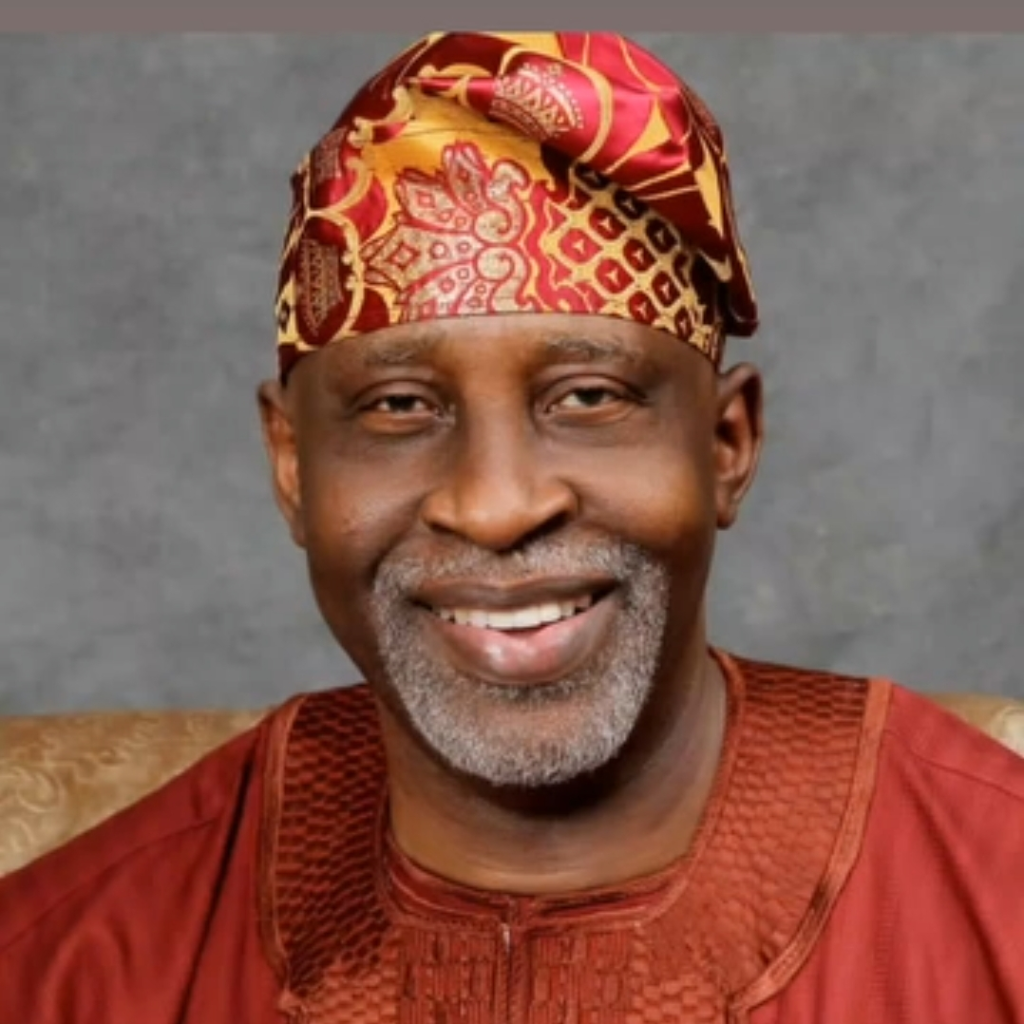
Queen Omo Ghandi-Olaoye is a true trailblazer who epitomizes virtuosity and dynamism. She stands as an exemplar of excellence, a visionary leader adorned with a servant’s heart and the Queen mother of the Ogbomoso people.
She served as the Special Assistant to the Continental Overseer and held the esteemed position of Executive Leader within the RCCG’s Women in Ministry. Furthermore, she graced the role of Senior Pastor, a devoted wife and mother, not only to Oba Afolabi Ghandi Olaoye; the Soun of Ogbomosoland, Feyintola and Toluni but also to the whole Ogbomoso populace.
Queen Omo Ghandi-Olaoye, is the illustrious Founder and Pastor-in-Charge of Jesus Women Ministries, a profound facet of Jesus House DC. This Women’s Ministry tackles the pivotal facets of womanhood, addressing every stage from birth to the golden years. Its mission, aligned with the divine Word, seeks to effect positive transformation in these domains.
By profession, Queen Omo Ghandi-Olaoye is a distinguished attorney. From the year 1992, she shares her life’s journey with her husband, Oba Afolabi Ghandi Olaoye, as they jointly fulfilled the roles of Senior Pastors at the RCCG Jesus House, DC parish, nestled in Silver Spring, Maryland until his ascension to the thrones of his forefathers as the Soun of Ogbomosoland.
In her capacity as Special Assistant to the Continental Overseer, she undertakes the mantle of SATCO – Welfare – The Americas. Her involvement extends to the Board of Executives for RCCGNA Women in Ministry (WIM), where she served as the Coordinator in Charge of Programs and Publicity. This vital role, initiated in 1998, has been ardently and triumphantly steered by her, resulting in an assembly of over a thousand women leaders and continuing to grow.
Within the RCCGNA Region 8, she took on the role of Provincial Pastor, supporting the Regional Pastor in executing regional responsibilities. Her profound visionary disposition drives her to share the good news of hope and deliverance with the underprivileged and the broken-hearted.
Additionally, she extended her ministry’s reach to encompass women of all ages within her local congregation, communities, and nations at large. Her vision is to empower them to embrace their full spiritual inheritance in Christ Jesus.
Queen Omo Ghandi-Olaoye is not just a spiritual leader; she is also an accomplished author and the CEO of Great Grace, a comprehensive publishing entity. She introduces the world to the GZUSWMN Brand, an elegant and contemporary women’s clothing line catering to diverse age groups.
Moreover, she also assumed the role of Founder and CEO of Summa Claude Initiative, a community-based youth leadership program dedicated to inspiring and producing high-achieving youth within the community.
Her involvement extends to the School Management Board of Edo State, Nigeria, Africa, where she collaborates with the state government, schools, and communities. This partnership aims to enhance educational development, planning, and decision-making at the school level, with the ultimate goal of improving learning outcomes.
Among her illustrious accomplishments is her visionary leadership of the 24-hour non-stop All Nations Praise-A-Thon, inaugurated in 2008 at Jesus House, DC. This event unites individuals from diverse nations, cultures, and languages, fostering praise and worship through instruments, songs, poetry, and dance. The impact of this gathering has been profound, resulting in salvation, healing, deliverance, breakthroughs, and divine restoration.
Queen Omo Ghandi-Olaoye, the visionary behind over 20 ministries operating under the Jesus Women Ministries, has left an indelible mark. Over 25 years, Jesus Women has touched the lives of over 10,000 women locally and internationally.
From ministering to married women through the HomeBuilders Ministry to supporting single mothers in the Daughters of Promise Ministry, she has created a vast network of ministries that cater to the diverse needs of women.
On her 50th birthday, she received accolades and greetings from prominent figures, including President Barack Obama of the White House, the Governor of the State of Maryland, and the Lieutenant Governor Anthony Brown. The County Executive, Mr. Isaiah “Ike” Leggett, also honoured her, as did a delegation from the Organization of African Union (OAU), marking 50 years of OAU’s existence.
Her exceptional leadership and contributions to the community have earned her numerous awards, a testament to her outstanding achievements. Queen Omo Ghandi-Olaoye’s life is a testament to her unwavering faith and continuous triumph as she lives out the Christian journey of victory.
To the glory of God, she is the joyful mother of Fehintolu and Toluni, the wonderful twin girls bestowed upon her as a divine blessing for her 40th birthday after 11 years of marriage.
On the 2nd day of September 2023, the esteemed Governor of Oyo State, Engr. Seyi Makinde, granted his approval for the anointment of a Pastor of the Redeemed Christian Church of God, Prince Afolabi Ghandi Olaoye, as the newly ordained Soun of Ogbomosoland.
This endorsement, however, has evoked a mélange of sentiments within the populace. While a substantial segment expresses jubilation over the accession of a man of such repute to the esteemed Sounship, others harbour a deep-seated resentment towards the notion of a clergyman ascending the throne of one of Yorubaland’s ancient cities.
Of particular note is the vociferous opposition emanating from certain members of the Olaoye lineage. They vehemently contest the selection of Oba Afolabi Ghandi Olaoye, perceiving it as an imposition, as he is not regarded as an active member of their family. These dissenting voices fervently advocate for the candidacy of Prince Mohammed Kabir Olaoye, one of the twenty-four other contenders, whom they deem more suitable for the exalted position of the Ogbomoso throne.
https://youtu.be/nb_HyzUC_Vo?si=cm-zFPXfWXMQ6Zd4
Initially, the Governor, Engr. Seyi Makinde, adopted a recalcitrant stance, withholding his approval for Oba Afolabi Ghandi Olaoye as the Soun of Ogbomosoland. He cited ongoing legal disputes and persistent opposition as the chief reasons for his reluctance. He firmly declared that he would only grant his assent once these contentious matters were amicably resolved, and the lawsuits were withdrawn. This impasse led to a perplexing and protracted deadlock.
The primary lawsuit filed by Prince Mohammed Kabir Olaoye, a fellow contender, had already been scheduled for judgment on the 3rd of October, prompting widespread anticipation for the court’s verdict. However, the situation took an unexpected turn on the 2nd day of September 2023, just 31 days before the judgment date. On this fateful day, the Oyo state government accorded its approval to Oba Afolabi Ghandi Olaoye, designating him as the Soun-in-waiting.
Oba Afolabi Ghandi Olaoye, a Pastor affiliated with the Redeemed Christian Church of God since 1992, previously served as the Pastor of the RCCG Jesus House in Washington DC. Besides his spiritual calling, he has demonstrated astute entrepreneurial acumen, having overseen three RCCG congregations in Nigeria before relocating to Germany to shepherd another RCCG Parish in Bonn.
Oba Afolabi Ghandi Olaoye openly declared his intention to retire from active pastoral duties at the age of 60, a vow he made when he turned 55. Fate intervened when Ogbomoso tragically lost its reigning Soun, Late Oba Jimoh Oyewumi Ajagungbade III.
Undeterred by whatever the outcome would be, Oba Afolabi Ghandi Olaoye joined the race for the throne, firmly believing that if it was God’s will, no mortal force could thwart his ascension.
In one of his candid interviews, he expressed a profound understanding of the intricate responsibilities associated with Yorubaland’s monarchy, particularly in Ogbomoso, affirming his readiness to embrace all indigenous sons and daughters, irrespective of the cultural and religious obligations inherent in his new role as King.
Impacts and Giant Strides Over the Years
Born on August 23rd, 1961, Oba Ghandi possesses a profound zest for exploring diverse cultures and regions. His wanderlust has led him to traverse the landscapes of over 65 countries spanning continents that include Europe, Asia, Australia, the Caribbean, North and South America, the Pacific Islands, and Africa—a testament to his cosmopolitan experiences.
Education forms a cornerstone of Ghandi’s background, as he graduated in 1982 from the illustrious Obafemi Awolowo University in Nigeria, previously known as the University of Ife. His academic pursuits led him to attain a Bachelor of Arts with Honors in English and Literary Studies.
Furthermore, he enriched his intellectual repertoire with a Master’s degree in Industrial and Labor Relations, emphasizing Human Resource Management, awarded by Nigeria’s esteemed institution, the University of Ibadan, in 1987. It is worth noting that Oba Ghandi Orumogege III’s academic aspirations transcend these accomplishments, reflecting his enduring commitment to knowledge.
Oba Afolabi Ghandi Olaoye is an individual of profound vision, and distinguished leadership acumen, a compelling motivational speaker, and a shrewd entrepreneur. He is celebrated for his unwavering commitment to the pursuit of excellence and the manifestation of exceptional leadership qualities.
In his professional capacity, Oba Afolabi Ghandi Olaoye Established Peculiar People Management (PPM) a Management and Human Resource Consulting Company of notable repute. Furthermore, his influence over the years has not only been felt in Nigeria but also across the board as a global research and management consultant renowned for his recognition by world-class workplaces in over 56 countries across the world. His prestigious organization Peculiar People Management (PPM) offers premier business advisory services to many.
Oba Ghandi Olaoye’s dedication to community development and mentorship is evident through his role as a member of the Board of Trustees for the Strategy for Mentoring Initiative & Leadership Empowerment (S.M.I.L.E). This non-profit entity focuses on nurturing budding entrepreneurship for the betterment of society. Additionally, he lends his support to the advocacy of A Smile on Their Faces Initiative, a non-profit initiative dedicated to serving individuals with disabilities.
His global outlook is further illustrated by his association with the International Third World Leaders Association (ITWLA), chaired by the late Dr. Myles Munroe—a forum that fosters the exchange of cross-cultural ideas on a global scale. In this capacity, Oba Ghandi Olaoye represents Myles Munroe International in Nigeria, contributing to the propagation of international perspectives and insights.
In the annals of his illustrious journey, Oba Afolabi Ghandi Olaoye’s expertise found resonance on an international stage when, in January 2009, he was invited to serve as an Advisor and Council Member on the Council for New Americans by the Maryland State Governor of the United States of America, Governor Martin O’Malley. During his four-year tenure on the council, he played an instrumental role in formulating policies aimed at facilitating the integration of immigrants into the state of Maryland, a testament to his influential contributions.
Moreover, Oba Afolabi Ghandi Olaoye’s leadership extended to the realm of real estate development, as he assumed the role of Chairman for a prominent project in Floyd, Texas, USA. Under his stewardship, this ambitious endeavour saw the transformation of over 700 acres into a multifaceted campus encompassing an educational institution, a residential estate, and a grand 20,000-seat Auditorium.
Throughout his remarkable journey, Oba Afolabi Ghandi Olaoye Orumogege III, the Soun of Ogbomosoland has garnered recognition as an influential community leader. His impact has been acknowledged both in Nigeria, where former Nigerian President Olusegun Obasanjo accorded him recognition in 2001, and in the United States of America, where President Barack Obama bestowed honour upon him in 2011. His distinguished journey has been punctuated by the reception of numerous awards, including the Youth Empowerment and Positive Mentoring of Africans in the Diaspora Award, a prestigious accolade conferred by the African Business Roundtable in December 2008.
Additionally, Oba Afolabi Ghandi Olaoye extended his influence by serving on the boards of several business conglomerates and owning thriving enterprises. His diverse experiences included previous roles within the Federal Government, where he contributed his expertise in various capacities, thereby consolidating his well-connected and influential stature.
Beyond his professional and academic endeavours, Oba Ghandi Olaoye Orumogege III derives joy from personal interests such as swimming and engaging in the cerebral challenge of playing Scrabble. He is also an ordained minister, sharing spiritual guidance within his faith community. His dedication to family life is evident in his marital union to Queen Omo Ghandi Olaoye and the blessing of two daughters, Feyintola and Toluni.
Ascension To The Throne
The emergence of Oba Afolabi Ghandi Olaoye Orumogege III as a prominent figure was not widely recognized until the commencement of the contest to fill the vacant throne of the Soun of Ogbomosoland. This event transpired following the passing of the last monarch, Oba Oladunni Oyewumi Ajagungbade III JP, CON, CFR, on December 12, 2021.
Prior to this pivotal juncture, Oba Afolabi Ghandi Olaoye had established himself in Washington DC, United States of America, where he diligently served as the pastor of the Redeemed Christian Church of God (RCCG) at Jesus House. This non-denominational, multi-racial, and multi-cultural international church attracts worshippers hailing from over twenty nations.
Oba Afolabi Ghandi Olaoye’s unforeseen entry into the contest for the Soun throne thrust him into the spotlight, owing to his lineage from the Olaoye Ruling House of the Soun Dynasty of Ogbomoso.
Initially disinterested in assuming the throne, external pressures, and what he believed to be a divine mandate eventually compelled him to partake in the rigorous selection process. After contending with twenty-four other contenders, he secured election by the kingmakers, and his nomination was subsequently submitted to the Oyo state government for ratification.
Predictably, opposition arose, originating from his rivals for the throne, family heads, and other dissenting parties. This opposition was grounded in various concerns, and petitions were forwarded to Governor Engr. Seyi Makinde. Subsequently, some discontented individuals initiated legal proceedings challenging Oba Afolabi Ghandi Olaoye’s nomination and petitioning the court to invalidate the process and instigate a fresh one.
Governor Makinde withheld approval, citing the ongoing court cases and persisting opposition. He emphasized that his assent would be contingent upon the amicable resolution of these issues and the removal of the matter from the judicial system. This stance led to a protracted impasse.
However, a transformative turn of events occurred on Saturday, September 2, 2023—just 31 days prior to the scheduled court judgment date of October 3—when the Oyo state government granted approval for Oba Afolabi Ghandi Olaoye to assume the mantle of the Soun-designate, effectively concluding the stalemate.
Coronation and Installation as Soun
The kingmakers in Ogbomoso, led by the Areago of Ogbomoso, High Chief Sobalaje Otolorin, on 8th September 2023, installed Olaoye as the new Soun of Ogbomoso at Abata.
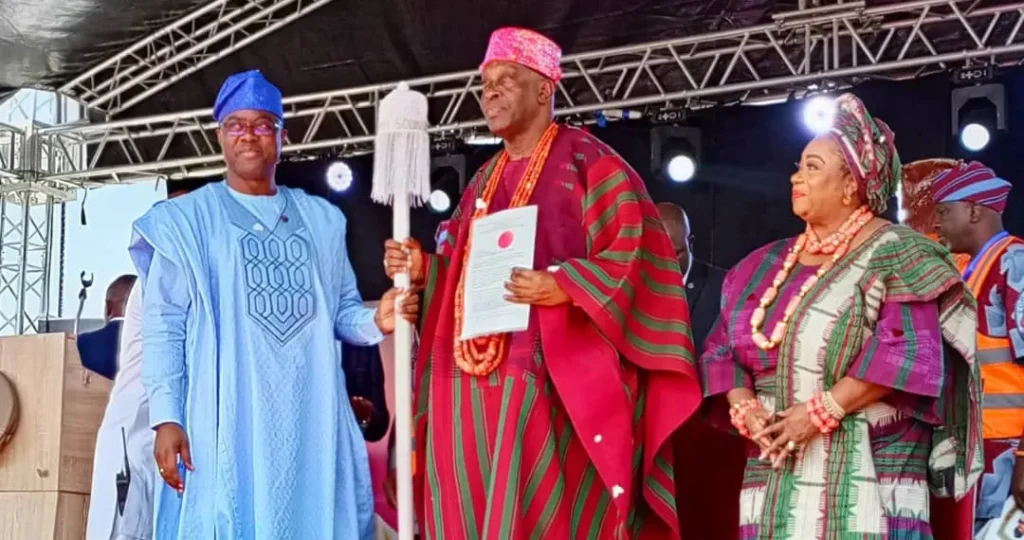
Governor Seyi Makinde of Oyo State officially installed Oba Ghandi Olaoye as the 21st Soun of Ogbomoso during a ceremony at Ogbomoso Township Stadium on 19th of December 2023.
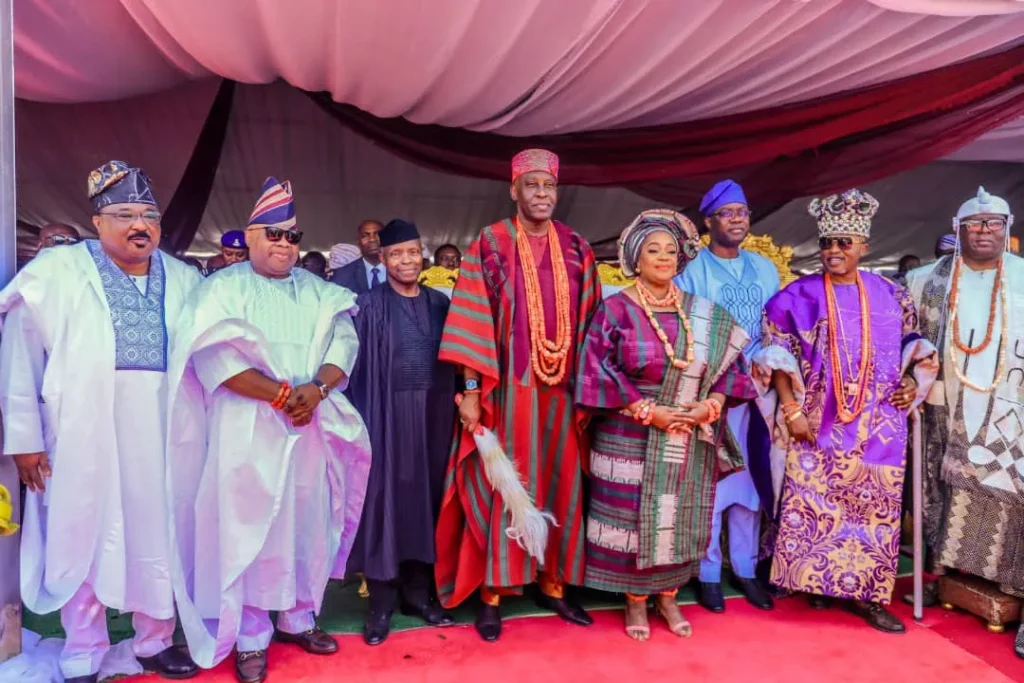
The coronation was attended by distinguished personalities nationwide. Gov Makinde emphasized unity and urged Olaoye to prioritize development initiatives. He pledged to revive the State Council of Traditional Rulers and rebuild the House of Chiefs for conducive meetings.
Oba Olaoye, in his address, called for collective efforts to unlock Ogbomoso’s potential, unveiling a 25-year development plan. Transitioning from pastor to monarch, he committed to serving all residents impartially, transcending religious and cultural boundaries.
Addressing the people of Ogbomoso, Oba Olaoye emphasized inclusivity and urged support for collective progress. He called on former contenders to join hands for Ogbomoso’s development, emphasizing the significance of unity and shared destiny.
The event attracted a lot of dignitaries to Ogbomoso, including former Vice President Yemi Osibajo and Governor Ademola Adeleke, symbolizing the significance of the occasion. Representing the federal government, Olusekun Adekunle attended on behalf of the Secretary to the Government of the Federation.
The Ancestral Lineage of Oba Afolabi Ghandi Olaoye Orumogege III
To trace the lineage of Oba Afolabi Ghandi Olaoye, we embark on a historical odyssey, commencing from his father and proceeding chronologically to his earliest known progenitor, Soun Ogundiran Ogunlola (Aisa Agbe).
Prince Samuel Oladunni Oyatoro Olaoye
The Father of Oba Ghandi Olaoye Orumogege III answers to the name of Prince Samuel Oladunni Oyatoro Olaoye. Simply referred to as Prince Oladunni, he was a man of substantial means who had the privilege of collaborating with the British colonialists, who at the time held sway over Nigeria. His sphere of influence encompassed the erstwhile Public Works Department (nowadays known as the Ministry of Works), and he discharged his duties in myriad locales throughout the Western Region of Nigeria. His ascent within the department’s ranks was nothing short of meteoric. He engaged in close discourse with numerous eminent personages within the country, a significant portion of whom counted him among their confidants.
Prince Oladunni, occupying a position of affluence within the elite stratum, emerged as a prominent member of the most influential socio-cultural organization in Ogbomoso during that era – the Ogbomoso Progressives Union (OPU), alongside illustrious compatriots such as Chief Samuel Ladoke Akintola (who would later become the second Premier of Western Nigeria), Chief J.K. Atanda, Professor N.D. Oyerinde, Rev’d Aisa Ige, and others. It was from this very organization that the formidable Ogbomoso Parapo later emerged.
In the annals of history, Prince Oladunni entered the fray for the throne’s stewardship in the year 1940, as it was the Olaoye family’s turn to anoint the Soun, following the demise of Baale Afolabi Oyewumi Ajagungbade II (the progenitor of the immediate past Soun). However, Prince Oladunni encountered defeat in this contest, thwarted by his uncles, based on the prevailing law at the time stipulating that “only direct descendants of a former Soun were eligible to ascend to the throne.” He was a direct grandson of the previous incumbent.
Prince Oladunni was a paragon of erudition, proficient in the literary arts; his discourse seamlessly interwove lines from William Shakespeare, Oliver Cromwell, and Yoruba proverbs, endowing him with the mantle of a consummate orator. Towering in stature, and resolute in demeanour, he concluded his earthly sojourn in 2004 at the ripe age of 93, having graced this world with his presence on October 9, 1911.
Prince Emmanuel Oladayo Olaoye
Prince Emmanuel Oladayo Olaoye was the progeny of Oba Olaoye Orumogege, who reigned over Ogbomoso during the latter part of the nineteenth century, up until January 1901. Prince Oladayo Olaoye, the father of Prince Oladunni, shared an early existence in Lagos, where he fostered associations with the white intelligentsia.
Tragically, his demise precipitated the arrival of Prince Oladunni, at the behest of his Caucasian superiors. Prince Oyekola was designated as the heir to the throne in 1940, destined to succeed Oba Afolabi Oyewumi. Elaborate preparations for his coronation were underway when, just days before the ceremony, he succumbed, allegedly to a fit of coughing.
Oblivious to the prevailing tradition, the British colonial authorities appointed Oyekola’s son, Amoo Oyetunde, as a sympathetic gesture. Nevertheless, this decision failed to resonate with a segment of the populace, who contended that the late Oyekola had surviving siblings deserving of consideration. With the assistance of the intellectual elite, a petition was lodged with the government, culminating in a legal battle that concluded in 1944 with a victory at the Judicial Committee of the Privy Council in London, United Kingdom.
Consequently, Amao Oyetunde Olaoye was deposed after a four-year reign, as per the court’s ruling, and Prince Oke Olaonipekun Olaoye, the brother of his father, ascended the throne in his stead as the Soun of Ogbomosoland, in April 1944. His reign endured until March 29, 1952, when he departed this earthly realm.
Baale Atanda Olaoye Orumogege I
Olaoye Orumogege, the progenitor of Oyekola, Oke Olaonipekun, and Oladayo (the father of Prince Oladunni), traced his lineage back to Bayewuwon, also known as Kelebe n’ija. Olaoye Orumogege succeeded Gbagun Ondugbe Ajagungabade I in 1871, presiding over the throne until 1901.
He stood as a formidable Oba and a valiant warrior. His reign bore witness to numerous conflicts, both internal and external, as he waged wars against marauders, arsonists, and murderers. His spirit of reciprocity endeared him to many. The era of his reign corresponded with the influx of Europeans into Yorubaland.
In point of fact, he was the monarch who extended a hospitable welcome to Governor Carter during the latter’s journey to Ilorin in 1893. His reign marked the inception of a new era, a wave of modernization that swept through the land.
The institution known today as the Nigerian Baptist Theological Seminary, Ogbomoso, found its genesis during his reign in 1898. Notably, he played host to Dr. George Green, the missionary responsible for founding the Baptist Hospital, which would subsequently evolve into the Bowen University Teaching Hospital.
Baale Jayeola Arolofin Bayewuwon
Bayewuwon Kelebe n’ija, as his appellation suggests, embodied the spirit of a formidable warrior, akin to his forebears – agile in battle. He was the third scion of Kumoyede to ascend to the Soun throne.
His reign was characterized by unceasing conflict, particularly with the Fulani Ilorin, who launched no less than 17 assaults on Ogbomoso during his rule. Remarkably, on all 17 occasions, the invaders were repelled! Bayewuwon rallied numerous warriors to fortify the town, a strategic response to the Fulani’s ambitions of subjugating the entirety of Yorubaland. Through sagacity, tolerance, strategy, patience, and unyielding bravery exhibited by Ogbomoso’s leaders during this precarious epoch, the imperialists’ advances were thwarted.
So as to fortify Ogbomoso and build a reliable spiritual defence for his town, Ogbomoso, Baale Jayeola Arolafin asked the most outstanding Ifa Priests and magicians of that era to create a kind of “monumental shrine” for the fortification of Ogbomoso from invaders now known as Ogun o jalu. It was said that of all the herbalists, Ajayi Inajokun an Offa man emerged as the greatest.
Bayewuwon was the father of Laoye, who in turn fathered Prince Oladayo, the progenitor of Oba Afolabi Ghandi Olaoye Orumogege III, the Soun of Ogbomosoland. His reign bore witness to pivotal wars, including the Osogbo conflict, which dealt a decisive blow to Ilorin’s audacious bid to conquer Yorubaland. Ogbomoso committed substantial resources, both in terms of manpower and materials, to this conflict.
It was a devious scheme aimed at outmanoeuvring the town. Ilorin initiated an attack on Osogbo, with the hope of enticing Ogbomoso’s warriors to its defence, leaving Ogbomoso vulnerable to an assault. Ogbomoso, astutely comprehending the stratagem, dispatched only a detachment to relieve Osogbo, while soliciting aid from Ibadan, a more distant ally.
Intriguingly, even the initial two battalions dispatched by Ibadan failed to compel a retreat by the Ilorin forces. Consequently, the brave generals of the Ibadan army, including Balogun Oderinlo (the Commander-in-Chief of the Ibadan army), had to personally intervene, marching upon Osogbo to engage the marauding invaders. This victory held immense significance in thwarting the imperialistic ambitions of the Fulani.
The Asofeyeje war transpired during Bayewuwon’s reign, characterized by a siege on Ogbomoso by the Ilorin and a contingent of Ibadan forces. The Baale Bayewuwon, in collaboration with the Ogbomoso war council, laboured relentlessly to devise a stratagem to break free from the asphyxiating blockade.
The war’s nomenclature, Asofeyeje war, stemmed from the circumstance wherein Ogbomoso’s denizens found themselves ensnared within the protective wall, encircled and unable to access their farmlands.
Consequently, many fruit-bearing trees remained unharvested, providing a feast for birds, hence the name Aso-fun-eye-je (fruiting for birds to feast upon)! Subsequently, following a war council deliberation, the war generals executed a swift and unexpected assault on the adversary, routing them in the process.
Leaders such as Areago Ori Oro, Abese Obiri Yeku, and Kuola spearheaded one division through the Apake front, while Ogunrunmbi and Bammeke struck via the Adunin route. Simultaneously, Baale Kelebe and Lalude descended upon the invaders along the Popo path, while Oluya Agbandugu and Lagbedu launched an onslaught via the Paku trail.
Their movements unfolded in synchronized fashion, characterized by stealth and surprise, catching the enemy unawares. Ogbomoso’s warriors descended upon the foe at various fronts with fervour and ferocity, inducing pandemonium within the enemy’s ranks. The Ilorins fled in disarray, with many perishing in the chaotic retreat. This episode showcased the indomitable spirit of Bayewuwon Kelebe n’ija. He passed away in 1901.
Baale Lasemi Kumoyede
Kumoyede stands as yet another illustrious monarch in Ogbomoso’s annals. He served as the direct progenitor of the five recognized ruling houses in present-day Ogbomoso. Kumoye’s father, Jogioro, was a renowned warrior.
Kumoye ascended to the throne in lieu of his elder brother, Oluopo, who, according to historical accounts in ‘Iwe Itan Ogbomoso’ by Prof. N.D. Oyerinde, nonchalantly declined the throne, instead urging his younger brother, Kumoyede, to assume the mantle of leadership.
Kumoyede begot five sons, each of whom ascended to the throne in succession. These scions were Toyeje Akanni Alebiosu, Aremu Oluwusi, Bayewuwon Kelebe, Idowu Bolanta, and Odunaro Apaebu.
Importantly, these five offspring hailed from different maternal lineages. Ologolo and Olukan subsequently succeeded to the throne following Kumoye’s reign, paving the way for his sons, commencing with Toyeje, the Are Ona Kakanfo, to assume leadership.
Kumoyede is the father of Bayewuwon, who in turn begot Olaoye Orumogege I, the father of Oladayo, the progenitor of Oladunni, who, in the course of time, sired Afolabi Ghandi.
Baale Jogioro
In the annals of Ogbomoso, the epithet associated with Souns of Ogbomoso today is “Omo Jogioro” (Offspring of Jogioro). Jogioro, a scion of Soun Ogunlola, a distinguished progenitor of the township; burgeoned in fame, strength, and valour.
He is the forefather of Kumoyede. His exploits conferred copious esteem, distinction, and reverence upon the Soun throne and, by extension, upon Ogbomoso itself. He engaged in numerous conflicts, and among his contemporaries were Langbin, reputed to be a former Kakanfo, and Kakanfo Oyabi, who vanquished the infamous Basorun Gaa.
Baale Jogioro occupied the position of the fifth Baale of Ogbomoso ruling after his three elder brothers, Baale Lakale, Baale Kekere Esuo and Baale Eiye Agannaganna. Consequently, Baale Jogioro stands as the patriarch of the ruling lineages of Ogbomoso. His reign spanned the midpoint to the latter part of the 18th century.
Soun Ogunlola
Soun Ogunlola, the patriarch of the Soun dynasty and a venerable forbearer of Oba Afolabi Ghandi Olaoye Orumogege III, the Soun of Ogbomosoland is of Ibariba descent and is the foundational figure in the saga of Ogbomoso. Soun Ogundiran Ogunlola emerged as one of the initial settlers in the region that would ultimately become Ogbomoso.
The narrative of Ogunlola enjoys widespread familiarity, thus obviating the need for its reiteration at this juncture. Soun Ogunlola Ogundiran fathered Lakale, Kekere Esuo, Eiye Agannaganna and Jogioro
Unfortunately, he was the last known ancestor of Oba Afolabi Ghandi OlaoyeOrumogege III, the Soun of Ogbomosoland and of course of the Soun dynasty. The Baribas’ native country is in today’s northeast Benin Republic and west-central Nigeria. They founded the Borgu kingdom.
About 30% of the Bariba people are found in Nigeria today in western Kwara and western Niger state while the larger 70% are domiciled in Benin, where they constitute 9.2% of Benin Republic’s population, and the fourth largest ethnic group, with their capital city being Nikki.
Their total population in Nigeria and Benin is about 1 million. Ogunlola is said to have arrived in the area now known as Oja’gbo in what became Ogbomoso in about 1650, on a hunting expedition. He permanently settled there to begin a new Yorubanized history.
In retrospect, we find the lineage of an Ibariba man known as Gborungunle, the progenitor of a lineage that traces its roots through Ogunola, thence to Jogioro, further to Kumoyede, continuing with Bayewuwon, followed by Olaoye, succeeding to Oladayo, and finally culminating in the birth of Oladunni, who in turn gave life to Oba Afolabi Ghandi Orumogege III, the Soun of Ogbomosoland. This ancestral tapestry weaves a tale of heritage, a continuum of life’s journey, each name in the line a testament to the perpetuity of existence.
Ogunlola – Jogioro – Kumoye – Bayewuwon – Olaoye – Oladayo – Oladunni – Oba Afolabi Ghandi Orumogege III, the Soun of Ogbomosoland
Reference
Ogbomoso In The Early Times, Modern Era And In Today’s Contemporary World – Written By Chief Oyebisi Okewuyi (JP)
Ogbomoso, The Journey So Far – Written By Ayo Adelowo
N.D Oyerinde, Ìwé Ìtàn Ògbómòsó [A History of Ogbomoso] – Written By Professor ND Oyerinde
Femi Ogunlana, Who are the ancestors of Soun-designate, Crown Prince Afolabi Ghandi Olaoye?, Ogbomoso Insight
Amora or Amwam sometimes spelled Amuam or Amwuam is prepared like yam porridge, this simple porridge is prepared from a starch plant, the starch plant, which resembles cocoyam corm, is usually peeled, sundried, and ground into powder.
Amwam is the Tarok name for this food. However, the Hausas called it Amora.
Amora is indeed a mouth-watering porridge that you can never get enough and it is one of the simplest dishes so far, if you have eaten Ikokore (water yam porridge) before, you will definitely love Amora because it has a similar taste and texture to it.
Amora or Amwam is prepared in a similar way to Tuwo or Native jollof rice, the process is always very simple but requires much carefulness because, without that, you are going to end up with a lumpy porridge which is not what want.
To prepare Amora, what you need to do is to combine all the ingredients in one pot and bring the stock to a boil, then add the dried starch to the boiling stock a little at a time and stir consistently in an anti-clockwise direction while you watch the content thickened into a yummy porridge-like.
Ingredients
3-cup starch
500g of Liver/heart
3 medium-sized dried fish
1 medium onion
3 scotch bonnets
2 tablespoons ground crayfish
2 stock cubes
cup green peas
3 medium carrots chopped
1/2 cup palm oil
Salt to taste
Ingredients for Amora or Amwan
How to Prepare Amora or Amwam
Rinse liver into a pot and season it with onion, pepper, stock cube, and salt, and place on heat to cook.
Diced the carrots, and onion, dress the dried fish and pound peppers and set all of these aside.
Once the liver has cooked, separate it from the broth, cut it into tiny pieces, and set aside.
Add one cup of water to the meat water and bring to a boil, add palm oil, chopped onion, pepper, and stock cube and let the oil dissolve.
Add the dried fish, liver, carrots, and peas, and cook the stock for 5 minutes so that the carrots become soft.
Reduce the heat to medium-low; use your hand to fetch the starch into the content while stirring with the other hand. A spatula is best for this process.
Keep adding the starch to the stock until it starts to thicken. Once it has thickened, stop adding the starch and keep mixing until the white starch is longer visible in the pot.
Leave the Amora to cook for five minutes with the lid closed, come back to it and stir, and take it off heat.
Amora (Amwam) is ready, serve it warm just as it is.
Amora (Amwam) is Ready
Have you ever heard of Amora (Amwuam) or prepared it before, what did it taste like?
Gote or Acha is a traditional delicacy of the Plateau people.
A great food, Gote Acha is widely enjoyed not only in Jos, Plateau State alone but the whole of Northern Nigeria.
This grain which is variously called Gote, Gwote, Gwete, Fonio, Acha, Pate Acha is underrated but it is packed full of nutrients.
Very Nutritious, Gote Acha is a simple meal born out of the marriage between Acha and some vegetables.
It is traditionally prepared without seasoning with beef brisket, sorrel leaves, garden egg leaves, tomatoes, pepper, and onions.
However, the beauty of cooking Gote is that recipes can be altered to suit our individual tastes.
This means that you can personalize the recipe by adding or subtracting any ingredient(s) of your choice.
You can also tweak the cooking method. From this recipe acquired by My Woven Words, we don’t have beef brisket but we have beef and smoked fish so we decided to use both.
We also didn’t use the garden egg leaves or sorrel leaves but we used Spinach, a little cabbage, tomatoes, two sticks of carrot, and green pepper.
We used them and the result was a lovely, delicious meal.
Ingredients
A Cup of Acha
Beef
Smoked Fish
Crayfish
Fresh Tomatoes
Onions
Pepper
Carrot
Cabbage
Green Pepper
Spring Onion
Stock cubes
Salt
How To Prepare
Rinse the meat thoroughly. Spice it with onions, seasoning cube, pepper and salt.
Cook on medium heat till it’s tender.
While the meat is boiling, prepare the rest of the ingredients.
Peel, rinse and dice the onion. Set it aside for later use.
Clean the smoked fish.
Rinse and dice the pepper, tomatoes, carrot, cabbage, green pepper and spring onion.
Pluck, rinse and slice the spinach.
Set the prepared ingredients aside for later use.
Pour the Acha into a sizeable bowl and rinse. Please note that Acha is usually very sandy; you should therefore rinse it thoroughly to get rid of the sand.
Check the meat. If it’s tender enough to suit you, take the pot off the heat and place a fresh pot on medium heat.
Add some oil to the pot and fry the meat till it’s brown on both sides.
Scoop them into a paper-lined sieve and set it aside for later use.
Decant some of the oil then pour in the diced onion; fry till translucent.
Add the tomatoes and pepper. Fry for two minutes.
Pour the meat, smoked fish and meat stock into the pot.
If the meat stock won’t be enough to cook the Acha, add two or three cups of water to the pot and bring it to a boil.
Now, pour the Acha into the pot.
Stir consistently and when the food starts thickening, add the carrot, green pepper, spring onions.
Stir again.
Allow the food to cook for another minute then turn off the heat.
Langtang is reputed to be the home of the army generals; the people are often referred to as the “Langtang Mafia“ in the heydays of the military. Those in that group include some of the most powerful and influential army generals and officers the Nigerian army has ever produced in history.
The Tarok People of Langtang in Plateau State are famous for producing senior military officers. The fact that the Tarok people are fond of military service is a topic that should be looked into closely and examined.
The Tarok tribe in Langtang North and South local government areas of Plateau State is said to be a tribe of warriors and known as the ethnic group with the highest number of military personnel in the North Central.
Every household/family (nuclear or extended) in Langtang has military personnel; it could be a senior or junior officer/other ranks, a fact that has been confirmed to be in fact true over the years.
The question remains, Why do Langtang men have so much interest in the military?
Many believe that the two local government areas stand out as the only communities with the highest number of retired military, officers, in the country. Some will argue that there are more Army Generals in the town than in any other single ethnic group not only in the entire North Central but in the nation.
Their momentous period and explosive awareness in the military date back to the regime of President Ibrahim Babangida, when they were referred to as the ‘Langtang Mafia’. Their military personnel, particularly the senior officers, held various positions during the military junta, while others announced military coups. By and large, the Langtang military personnel are dreaded.
Some of the greatest military men in the country from Langtang include the likes of Lt Gen Joshua Nimyel Dogonyaro (retired, deceased), Lt Gen Jeremiah Useni (retired), Lt Gen Domkat Bali (retired and deceased), and Brig Gen John Nanzip Shagaya (retired and former Senator, deceased), and Lt Gen Muhammad A. Najib (retired) among others. Although the above has retired from service, some of them have continued to remain in the limelight, albeit politically even after death.
By and large, whenever ‘Langtang’ is mentioned, the first thing that comes to mind (of those who know them properly) is a tough, fearless, and strong people, hence their military exploits and doggedness.
General Useni was very prominent in the All Nigeria Peoples’ Party (ANNP) as a member of the Board of Trustees, John Shagaya contested for the Upper house of the National Assembly under the ANPP, the late Joe Garba had aspired for the same slot in 1999 but lost while Domkat Bali remained a power broker of some sorts, Joshua Dogonyaro has preferred to remain at the background playing the role of an arbiter.
Among the great generals from Langtang are the Late General Domkat Bali, the Late Joseph Garba, Jeremiah Useni, Joshua Dogonyaro, Late John Shagaya, Jonathan Temlong, Musa Gambo, Yakubu Rimdam, and Ishaku Pennap. Others are Air Marshal Jonah D. Wuyep, Air Commodore Bernard Banfa, and General Muhammad A. Najib.
Just to mention a few:
Domkat Bali was the Chairman Joint Chiefs of Staff and Minister of Defence and was the Ponzhi Tarok before he died.
Yakubu Rimdan served in the Guards Brigade Dodan Barracks, Ikoyi Lagos, during General Yakubu Gowon’s regime.
Jon Temlong was a military strategist who served in many foreign peacekeeping missions.
Jeremiah Useni was the Minister of the Federal Capital Territory and has held several positions.
Late John Shagaya also held several positions in the military before retiring, and that applies to the others.
It was said that the fearless strength and cultural dynasty were almost exercised when Domkat Bali, the Ponzhi Tarok, passed on and they alleged that the military had taken over the burial without allowing them to perform their traditional burial rites for their traditional ruler.
But there were several interventions and the matter was settled amicably, thereby allowing a hitch-free burial, devoid of violence.
A native of Langtang, Gwamkat, said their fearless and warrior nature endears them to rugged professions like the military, and that they always wish that every household would produce military personnel.
Gwamkat said the Tarok people are determined to the extent that should the military be left for them to control, they can fit in and do it perfectly. She went on to hail the present military personnel, saying they are trying their best to tackle the insecurity and that more can still be done this year.
Another Langtang native, Golok Nanmwal, said a typical Langtang family teaches their children about bravery and all they should do to be strong and resilient in life.
And with such mentality, he said, a Tarok child grows up to be strong, fearless, and daring, adding that they have a defensive attitude and that is why they have been in the military for a while now and have been producing great military personnel till date.
According to him, the Tarok child is being taught from childhood that the world is a tough place and you have to live up to the toughness of the world, and so the children grow up with that mentality. He said if, given the opportunity, the Tarok people can tackle the insecurity in the nation.
Another Tarok lady, Anna Elizabeth Nancwat emphasised the disciplinarian nature of Tarok men and how it’s only appropriate to channel it into the military.
In her words, she said: “A Tarok man by nature is a no-nonsense man right from birth, he has principles he set out for himself and all the people in his household, what else would you have that kind of temperament channelled to than the military?”
Also, a Langtang native, Patience Dombin, said the people have always been striving hard to maintain the feat/historical perspective as the community with the highest number of soldiers and the ‘Home of Generals’ in the country.
She said most of the retired generals actually helped the others to get recruited then, adding that such gestures dwindled, but that the people are struggling to get into the military on their own now.
Sandra Manko Bindip on her own part said her father was a soldier and resigned in 1979, and that her elder brother was also a soldier and resigned this year.
She said they both resigned as Warrant Officers, adding that her family is related to Gen. Joshua Dogonyaro.
Bindip explained that her father encouraged her brothers to join the Nigerian Army because he believed in the military, and also because the military profession exudes the fearlessness and ruggedness that is synonymous with the Tarok man.
She said apart from the fact that the Tarok people have been in the military and still wish to continue assisting their wards to get recruited because of the characteristic bond between the military and the Tarok lifestyle, the military also serves as a source of employment for their people.
However, Jane Londir’s opinion on why we have lots of Tarok people in the military is a little bit different from others, she emphasized the fact that most Tarok people have high self-esteem, they see themselves as very important and deserve to be in control.
This yearning and proud understanding of who they are makes them want power and never want to be looked down upon, they seek to prove their strength, doggedness, agility, and domineering nature by maximizing it in the military,
Jane concluded by emphasising the fact that it’s a noble way of channelling one’s energy, at least it is not used for robbery or terrorism.
Aside from all this, in our article; The Tarok People of Plateau State, we emphasised how the Tarok people have a strong cultural lifestyle.
They remain arguably the tribe in North Central to have strongly upheld their cultural values and attendant ancestral manifestations.
It is common knowledge that the Tarok people (i.e. Langtang) have a running battle with the Hausa/Fulani-dominated areas of Shendam and Wase LGAs.
It’s quite difficult to actually pinpoint the genesis of the enmity between these peoples. What is certain is that the September 7, 2001 crisis which claimed thousands of lives and which was basically between the indigenes and the Hausa/Fulani settlers opened up a sore wound.
To some people, the ethnoreligious carnage was a keg of gunpowder, which exploded, and the dust still lingers even now.
The Fulani have always accused the Tarok of killing their cows and cattle while the Tarok have consistently maintained that they are being attacked by the Hausa/Fulani without being provoked.
Langtang is located in the southern part of Plateau State and is connected to Tunkus, Shendam, Kanam, and Wase through access roads.
The local government areas principally affected include Langtang North, Wase, Shendam, and at a few times Langtang South and Kanam councils.
Tarok is an agrarian society in the hills and on the plains southeast of Plateau State, Nigeria.
According to Tanchit Monica Binjin nee Wuyep Vongdoh in an interview with Bella Naija claims they’re the second largest ethnic group in the state.
The Tarok is an amalgamation of various peoples who now form a more or less ‘homogeneous’ group.
The constituents were of Pe, Ngas, Jukun, Boghom, Tel ( Montol ), and probably Tal origins, while others still remain obscure or unknown.
The Tarok people are found mainly in Langtang-North, Langtang-South, Wase, Mikang, and Kanke Local Government Areas (LGAs) of Plateau State in central Nigeria.
Their main town of Langtang is located about 180 kilometres southeast of Jos, the state capital.
They are found in large numbers in Shendam, Mikang, Qua’an-Pan, Kanam, Kanke, and Pankshin LGAs.
The Tarok people are also found in some parts of Tafawa Balewa LGA of Bauchi state the Sur (Tapshin.
Tarok farming communities are also scattered in Nasarawa and Taraba states.
Scattered in Nasarawa and Taraba states are Tarok farming communities.
The culture at a micro level portrays this admixture of peoples of the Tarok nation.
Tarok people believe that militarism naturally runs in their veins.
The Tarok people are remarkably successful in the Nigerian armed forces such that it is rumoured that there is one military General in every squared kilometre of Tarok land.
The adventures of their men in the military had made the land famous and the sons and daughters very proud.
The Tarok call themselves o’Tárók, their language iTárók, and their land ìTàrok.
Taroks are proud of their heritage and are determined to preserve it, and this is evident in the traditional architecture that remains to date.
The Name and Language “Tarok”
In the literature, other names have been used for Tarok as Appa, Yergam and its variants of Yergum and Yergem.
The name Tarok itself has been wrongly spelled by some as Taroh, some will go as fast as insisting that it is Taroh and not Tarok.
The name Appa on the other hand is used by the Jukun to refer to oTarok as a friendship term.
These fresh insights are pointing to the conclusion that Tarok was a nickname given to the Tal/Ngas immigrants. The name of the original group is lost and has been replaced by the nickname.
The term Pe-Tarok refers to the people who first spoke the original form of the language called Tarok today the mismatch notwithstanding.
The origins of the peoples may be a knotty topic, but it is clear that Proto-Tarok is the parent of the language which is known as Tarok today (whatever might have been their original name).
One of the books used while creating this article is “The Tarok Language: Its Basic Principles and Grammar”. The Author, Selbut Longtau described Tarok as one of the Benue–Congo languages almost completely submerged in a sea of Chadic languages.
These languages include Ngas, Tel, Boghom, Hausa, Fulfulde, and Yiwom. Its non-Chadic neighbours are Pe, Jukun-Wase, and Yangkam.
Tarok has spread considerably in the twentieth century and it now borders Wapan in the southeast. The Chadic languages belong to a different language family called Afroasiatic.
Selbut Longtau in his book further explained that Tarok had settled in their present abode long before the eastern and southward movements of Boghom and Ngas respectively.
The Origin of Tarok People
As is common with most African cultures, available data on the origin and the history of the people is hinged on oral tradition and its attendant controversies. The Tarok race is no exception to this dilemma.
The absence of any written record has thus left this subject open to the fertile imagination of historiographers who subsequently struggle to recreate or unravel the conundrum.
One tradition has it that the Tarok people originated from central and southern parts of the continent of Africa and are Bantoid. The other has even a Middle Eastern origin (Yemen/Egypt). As a result, western and eastern migration routes thus developed.
Further still, scholars have postulated linguistic evidence linking the Tarok to a western migration route and at the same time emphasizing a Niger-Benue confluence origin and a Benue Congo Language, thus challenging any Eastern and Chadic connections.
The Southern African, Niger-Benue confluence origins and migration routes might be controversial and intriguing but it is generally agreed, without any iota of doubt about the common rendezvous of the Tarok race at Tal in the present location in Langtang North and south.
Migration from Tal to Tarok Land
Oral tradition and anthropological notes indicate that by the middle of the 18th century, the Tarok race had already migrated from Tal to the present-day Tarok land.
The migration is said to be in three phases:
Zinni clan went to Dutse (Gazum)
Namurang went to what is now Kanam country and Gunnu brought Ce (Langtang)
Bwarat and Sa to the general area known today as plain Tarok. This Plain Tarok, later on, migrated to Wase.
Oral tradition and anthropological notes by Capt. T A Izard indicates that the Tarok of Sa, Dangal, Chuwi, and Singha had already spread to the plain before 1760.
When the Tarok left Tal and arrived at Langtang, Gunnu established himself at the South-west end of Langtang hill, while Bwarat went northeast and settled below.
As mentioned earlier, Tarok land is traditionally divided into hills and plains Tarok. The Hill Tarok (O’Tarok ga Barn) refers to the plains Tarok as O’Tarok ga Byan, but this nomenclature today refers to the Tarok in Langtang South and Wase generally.
Tarok mythology had earlier predicted the arrival of the white men (Ngol: gat Nyalang) and that they will not bring any harm but progress.
No wonder when the white men came and were rejected by neighboring communities, the Tarok accepted them wholeheartedly in an open embrace and assisted in building his accommodation and the first church in Plateau State.
Since then, the relationship between Tarok and western civilization has been growing from strength to strength.
Little wonder that the Tarok sons and daughters have made great exploits in the local, state, national, and international arena.
History of the Tarok People
A world-class Anthropologist and great lecturer at the prestigious University of Jos, Dr. Nankap Elias Lamle, stated that in the early twentieth century, people from other ethnic groups such as Tal, Ngas, Jukun, Tel (Montol/Dwal), and Yiwom (Gerkawa) migrated and settled together with the initial Timwat and Funyallang clans.
People from these ethnic groups came as migrant labour workers. The Timwat and Funyallang people gave them land to settle in Tarokland after they have served the former.
Colonialism and Christianity came into Tarokland by 1904. The initial inhabitants could not trust the missionaries and colonialists as such did not encourage their people to join them.
With the introduction of modernism, the later migrants to Tarokland used their connections to the missionaries and colonialists to acquire western education and join the army. Today these latter migrants are at the helm of affairs in Nigeria as such try to use their influence to change the history of the Tarok people.
Furthermore, the great scholar, Lamle asserted that the framework of Tarok migration supports the assertion above and is based on the fact that the Tarok language is part of the Benue–Congo language family.
However, other peoples of the Chadic language family, such as the Ngas, Boghom, Tel (Montol), and Yiwom, shifted to the Benue–Congo family and are given full status as Tarok.
Also, the Jukun, who speak the languages of the Benue–Congo family, joined the Tarok. What is called the Tarok people are actually a mixture of many ethnolinguistic groups.
Culture of the Tarok People
The Tarok people have an ancestral cult that retains considerable prestige and importance, despite major inroads of Christianity into the area.
One of the unique rites of the Tarok people is the cultural day festival which is known as Ilum Otarok which is an annual event that depicts the culture and tradition of the Tarok people of Plateau state. It has been a uniting force for the Tarok people to come together as one family.
The ancestors, Orìm, are represented by initiated males and post-menopausal women. The cult activities take place in sacred groves outside almost all Tarok settlements.
Orìm are mostly heard but emerge as masked figures under some circumstances, especially for the disciplining of ‘stubborn’ women and for making prophecies.
Orìm figures speak through voice disguisers in a language dotted with code words although framed in normal Tarok syntax and their utterances are interpreted by unmasked figures.
Each Tarok settlement of any size has a sacred grove outside it, which is conserved as the place of the Orim or ancestors.
The singular form, ùrìm, is applied to a dead person or an ancestor, while Orìm refers to the collective ancestors and the cult itself. Men above a certain age are allowed to enter the grove and engage with their ancestors.
These inhabit the land of the dead and are thus in contact with all those who have died, including young people and children who were not admitted to the Orìm.
On certain nights when the ‘Orìm are out’, women and children must stay in their houses. Orim can also be seen ‘dressed’, i.e., appearing as masquerades, when they engage with women through an interpreter.
Surprisingly, most Tarok are Christian and Langtang hosts some large churches, but the association of the Orìm with power ensures that these two systems continue to coexist.
Indeed, it is said that the Orìm take care to visit the houses of the retired generals and other influential figures at night to cement the bonds between two very different types of power.
Orìm society is graded, in the sense that there are members who are not fully initiated and so cannot be let into the inner secrets of the society.
Some of the Orìm vocabularies is therefore for internal concealment, that is, there are code-words among the elder members to conceal the meaning of what is being said from junior members.
The main function of the Orim from the external point of view is to maintain order, both spiritual and actual, within the society but also to prepare for warfare and other collective action.
In practice, maintaining order seems to be about disciplining women, who are forced to cook food as a punishment for being lazy or ‘stubborn’. This category of Orìm is called Orìm aga., literally ‘masquerade that gives trouble’ and its specialty is to fine women.
There is a special season, aga; ‘time of trouble’, for meting out fines to offenders.
The Orìm are also in contact with the dead and it is believed that the spirits of dead children require to be fed; hence they will request special meals from the mother of such children.
Orìm also has a marriage-broking function; for example, young women tell the Orìm the name of the young man they would like to marry, and they find ways of passing on the message.
Naming Ceremony and Styles
The coming of a newborn is a blessing to the parents and community.
For the community to benefit from a new child’s birth, he/she must be alive to adulthood.
As a result, children are initiated into the Orim cult to prevent them from dying.
Children are named based on the circumstances surrounding the birth.
Names like Nanmwa which means God has provided. usually given because the parents had given up on having a child.
Tarok Marriage Rites
Marriage is known as “ikam uchor” It is considered a social responsibility. Adults are expected to establish their homes.
Its significance is seen during the death of an unmarried adult, where the play partners referred to as “onim gha ijam” will mark his exit with a traditional drama.
Women of play partners referred to as “ocha ga ijam” accompany the footsteps of the corpse bearers, while pouring ashes and rolling a stone [igbongbar]
When a young man sees a young girl [uyenbyen] whom he likes, he uses body language to indicate interest.
Thereafter, he toasts her with a gift, which in the past was not very specific, but mostly things like soap and cream.
Once the toasting rights have been secured, multiple dating is allowed until an open ceremony is held to determine the lucky toaster; this is no longer accepted. However, there are still relics of these in some rural communities.
Gifts are presented to the mother. The man makes an offer for marriage known as “nvok igya”. He presents headgear, pants, underwear, and slippers. If these gifts are accepted by both the mother and the lady, dating is said to have taken effect.
Afterward, the bride price payment of clothes, a bag of rice, and one big basin of beniseed azhin ananjyol is given.
There is also a requirement to build a round hut guest room referred to as “ijini” which will be used by the couple to freely relax whenever the man visits, but without sexual activity.
The father of the bride is given a big gown with trousers, an inner shirt, and shoes. He is also expected to be farmed for by the supposed groom.
A “dir khaa godo” is given to maternal uncles and is considered important also. Without it, the children of that couple will be regarded as that of the maternal uncles, no matter how long they have been married.
An interesting fact about Tarok weddings is that there is no fixed date to take a man’s daughter away for marriage. Instead, they elope; then the groom’s family sends a message to the bride’s family informing them of their daughter’s whereabouts.
Ruling Class and Governance
The Tarok people consist of an autonomous community of over twenty sub-clans.
They reserve cultural rights over certain traditional rights that determine their status.
Every sub-clan has a spiritual leader known as ponzhi nbin.
Before the advent of colonialism, he was also the political leader of the people.
The ponzhi nbin institution represents the sovereign authority of the people.
Solomon Selkap Dalung: Nigerian Politician, Lawyer, and Academician. He was made the Minister of Youth and Sports by President Muhammadu Buhari in November 2015 and his tenure ended in May 2019 after which Sunday Dare of Ogbomoso Took Over.
Funerals and internment of Tarok People
Funeral rites in Tarok land are also unique.
The death and subsequent burial of an elderly man is followed by Ngaga which involves the beating of drums, chanting of incantations, and wielding of spears meant to drive away death.
This is followed by nken orim during which the spirit of the dead man is received and reunited with his ancestors and by extension, the people.
Tarok Food
Some of the foods consumed by the Tarok people are Amwam (amora), zogale (moringa) etc., and soups like Agbantar (groundnut soup) and Izhin.
Tarok Native Proverb
Ina’va ya ka’swal kat te, uponzhinan yi ya ‘ichinchin ana.
It Literally translates: [You do not have any human help. You can only depend on God]
Apostle Joshua Selman donate to Tarok
Economic Activities of the Tarok People
The Tarok people are mainly farmers producing both food and cash crops such as guinea corn, maize, millet, yams, rice, cassava, beans, groundnuts, cotton, benniseed, etc.
Other economic activities of the Tarok people include blacksmithing, carving, fishing, hunting, and mining local salt using indigenous technologies.
The traditional pomade known as Miko, produced from the mahogany tree also abounds in Tarok land.
Local textile is also popular with the Tarok man such as Le. Gba, nyante, agodo etc
Some Prominent Tarok People
Dr Elias Nankap Lamle: (University of Jos a graduate of Katholieke Universiteit Leuven Belgium, under the Institute for Anthropology research in Africa, with emphasis on Conflict Management and peace studies
Daniel Lamda Bongtur: (HRH Madakin Langtang), Monarch
Solomon Selkap Dalung: Nigerian Politician, Lawyer, and Academician. He was made the Minister of Youth and Sports by President Muhammadu Buhari in November 2015 and his tenure ended in May 2019.
Hon. Beni Lar: a present member of the House of Representatives,
Brig. Gen Rimtip,
Chief Solomon D. Lar (Deceased),
Professor Mary Lar: former Nigerian Ambassador to The Hague, Netherlands,
Air Marshal Jonah Domfa Wuyep: Former Chief of the Air Staff of the Nigerian Air Force,
Prof. J.F. Jemkur: Dean of Arts & Professor of Archeology, University of Jos
Dindam D. Killi, Esq: Activist, lawyer, and former student leader
Joshua Nimyel: Ministry of Works and Housing, Plateau State Government
RTD Col. Dauda Nimyel: Ponzhi Gani of the Pil-gani community
Brig. Gen Joseph Nimmyel: Defense HQTRS Abuja
Prince Goselle Obed Nanjul: International Student Ambassador, Bangor University, United Kingdom
Mr. Mark Kparmak: a Research Administrator, Office of Research and Development and Project Manager of the World Bank-Africa Centre of Excellence in Phytomedicine Research and Development, University of Jos
HRH Mr. Stanley Selchak Sambo: the Ponzhi Bwarat, the paramount ruler of Bwarat in Langtang North LGA.
Chief Nanzing Nden: Dan Madamin Langtang
Senator Victor Lar: Former Senator, representing Plateau South Senatorial District of Plateau State Nigeria from 2011 – 2015
Mr. N Nimfel: Director of Human Resources Management, Federal Ministry of Justice Headquarters, Abuja
Chief Dan Dul: Barayan Langtang and Chairman, Langtang North Local Government, Plateau State
Major Gen. Shidafa Nandul (Rtd): Former Intelligence Chief at Defence Headquarters Abuja
Major Gen. Pennap (rtd)
Prof. Stephen Banfa: University of Jos)
Air Commodore Banfa (rtd)
Mr. Timkat Nanmak Peter: 21st Century Entrepreneur
Mr. Nancwat Garba: A Great Entrepreneur
Generals JN Tyemlong,
NW Rimtip,
Colonels BP Salmwang (rtd),
BW Gbonglap
Group Captain SD Fadip-Miri: State Manager Defence Health Maintenance Ltd Plateau/Nasarawa States
Apostle Joshua Selman Nimmak: Nigerian Gospel minister, instrumentalist, Chemical Engineer, conference speaker, and televangelist.
Amongst numerous other prominent Tarok people who are not mentioned here.
List of 56 Ethnic Groups/Tribes in Plateau State
Afizere – Jos North / Jos East
Amo – Bassa
Anaguta – Jos North
Attakar -Riyom
Atten – Riyom
Bache – Bassa
Bashar – Wase
Berom – Jos South, Barking – ladi, Riyom, Jos North.
Bijim -Mangu/Pankshin
Bogghom – Kanam
Buji – Bassa
Bwall -Quanpan
Bwarak – Pankshin
Chakfem – Mangu
Chokobo – Bassa
Doemak – Quanpan
Duguza – Bassa
Fier – Pankshin
Firan – Jos East
Gamai – Shendam
Gus – Bassa
Ibaas – Barkin-Ladi
Irigwe – Bassa
Jere – Bassa
Janji – Bassa
Jipal – Mangu
Jahr – Kanam
Jukun – Wase
Kadung – Mangu / Pankshin
Koenoem – Shendam
Kulere – Bokkos
Kurama – Bassa
Kwagalak – Quanpan
Lemoro – Bassa
Mhiship – Pankshin/ Kanke
Merniang – Quanpan
Mupun – Pankshin
Mushere – Bokkos
Mwaghavul – Mangu
Ngas – pankshin / Kanke
Nteng – Quanpan
Piapung – Mikang
Piti – Riyom
Pyem – Mangu
Ribina – Bassa
Ron – Bokkos
Pai – Pankshin / Shendam
Runzu -Bassa
Sigdi – Mangu
Takkas – Pankshin
Tal – Pankshin
Tambes – Pankshin
Tarok – Langtang North/ South, Kanke & Wase
Tarya – Bassa
Tehl Tao –
Youm – Mikang
Reference
AN INTERVIEW WITH TANCHIT; Discovery Journey of the Tarok People from Langtang, Bella Naija, August 14, 2018
Facebook Page VISIONED TAROK; January 16, 2016
TAROK PEOPLE; Wikipedia, November 2013
NEWS TOWER MAGAZINE; Brief History of Tarok People, Published on October 2, 2010
; The Tarok Language: Its Basic Principles and Grammar, 2009
Facebook Page of PALANG FAITH MALLO; Know The Tribes In Plateau State, January 28, 2022
John Nanzip Shagaya was a Nigerian senator and former senior military officer who was elected in April 2007 to represent the People’s Democratic Party (PDP) in Plateau State as a member of the Nigerian Senate for Plateau South.
John Nanzip Shagaya ran for reelection in April 2011 on the Labour Party (LP) platform but was defeated by Victor Lar of the PDP. As a non-commissioned officer (NCO) with the 2nd Reconnaissance Squadron in Abeokuta, he participated in the Nigerian counter-coup of 1966.
Early Life and Education
John Nanzip Shagaya was Born on 2nd September 1942 at Danburam Langtang II to MalIam Sikji Miri-Wazhi alias Shagaya and Mrs Maryamu Zwancit.
He attended his primary school at Nyer and later SUM Primary School, Langtang between 1952-1959, and later the Nigerian Military School (NMS) Zaria in 1960-1964.
After graduation from the Nigerian Military School, Zaria, he was posted to the Nigerian Army Armoured Corps then (Recce Squadron).
Between 1964 and 1966 when John Nanzip Shagaya rose to the enviable rank of a corporal and an instructor in the squadron in Communications, Gunnery, and D & M.
Shagaya, then a Corporal with the 2nd Reconnaissance Squadron in Abeokuta, was one of the many soldiers of northern Nigerian origin (including 2nd Lieutenant Sani Abacha, Lieutenant Muhammadu Buhari, Lieutenant Ibrahim Bako, Major Theophilus Danjuma, Lieutenant Colonel Murtala Muhammed, and Lieutenant Ibrahim Babangida among others), who staged what became known as the Nigerian counter-coup of 1966 because of grievances they felt towards the administration of General Aguiyi Ironsi’s government which quelled the January 15, 1966 coup
In 1967, Shagaya attended the first short service combatant course in NDA Kaduna and was posted to 3 Marine Commandos upon commissioning in the rank of second lieutenant where he participated in the Nigerian civil war 1967-1970
Career and Achievements
After the civil war, John Nanzip Shagaya started a long and successful march to command a West Africa Multi-National Force (ECOMOG) in 1993 in the field rank of a Major General, having commanded 1st Mechanized Division of the Nigerian Army between 1992-1993 and all lower commands in the Nigerian army including platoon, company, battalion, and brigade.
To date, he is the country’s longest-serving Federal Minister of Internal Affairs and a member Armed Forces Ruling Council. Member of the Police Council, all between August 1988-December, 1989.
Shagaya served as Chairman of the controversial Organization of Islamic Conference (OIC) committee at the time this country would have been torn to pieces because of religious crises in 1987 allegedly associated with Nigeria’s Permanent Membership of OIC.
Between this same period as Minister of Internal Affairs, he served as the Chairman of the Ministers of Internal Affairs of the ECOWAS sub-region to draft ECOWAS PROTOCOLS l, ll & III.
Because of his interest in military history, in 1984-1986, he was made the Chairman of the National War Museum and a member of the National Commission for Museum and Monuments.
His efforts resulted in the historic Umuahia complex of the National War Museum and the National Museum of Colonial History at Aba in Abia State.
Other important military appointments he held include:
The Military Secretary Army, Army Headquarters.
Directing Staff Command and Staff College-Jaji,
Director of Cadets-Nigerian Defence Academy Grade lIl,
Staff Officer, Nigeria School of Infantry-Jaji.
He was described throughout his career by his superiors and assessors as the soldiers
John Nanzip Shagaya was one of the few Nigerian Military Officers who between 2nd Lieutenant and Brig. General attended every professional course commensurate to that age and rank.
His performances at military institutions in the USA earned him the Honorary citizenship of six states.
At the Royal College of Defense Studies (1990), he became the Second Nigerian to earn an academic prize for his research work, the first being the late General l.D. Bissalla in 1974.
On November 17, 1993, General Sani Abacha became head of state after a military coup. Abacha distrusted Brigadier John Shagaya and other “IBB boys” loyal to Babangida. Within a few days, Shagaya was recalled from Liberia, demoted from Major General to Brigadier General and then retired from the army.
On 16th November 2000, John Nanzip Shagaya was conferred with a National Honour of the Officer of the Order of the Federal Republic (OFR) by the President, Commander-ln-Chief of the Armed Forces of Nigeria, Chief Olusegun Obasanjo.
In addition to being an active politician, Brig. General Shagaya was Director of Lion Bank (Nig) Plc From 1998 to 2003
Shagaya was a founding member of the United Nigeria People’s Party (UNPP), running unsuccessfully for the Senatorial seat of Plateau South in the 1999 elections.
Before the 2003 elections, he joined the All Nigeria People’s Party (ANPP) but was defeated again.
As of 2003, he was working on a book, “The Tarok History“ having published in 1990 “The Ministry of Internal Affairs, an Overview.“
John Nanzip Shagaya has participated in many international seminars on “Peace Keeping “The ECOMOG Experience and Conflict Resolutions.”
Some of the traditional titles he held include:
Danburam Langtang II,
Akaraka I of Ibeku and
Otun-Akogun I of Ikosi – Kosofeland, Lagos.
Shagaya had converted from a military officer to a politician, earned the title of a moderate, and was elected as Senator for Plateau South in April 2007, running on the platform of PDP.
His election was challenged, and nullified by the elections petition tribunal, but in December 2008 a Court of Appeal in Jos overthrew this decision and ordered the Independent National Electoral Commission (INEC) to immediately issue a Certificate of Return to Shagaya.
In June 2009, Shagaya warned that offering an amnesty to the Niger Delta militants might not end the violence. The militants might hide their best weapons, and return only disused and damaged ones.
In an interview in October 2009, he defended the various military interventions since Nigeria gained independence, and stated that the influence of generals in politics since 1999 simply reflected their training and discipline.
John Nanzip Shagaya was involved in a car accident on the 11th of February 2018 while returning to Jos from Langtang, at a time when he was involved in reconciling the quarrelling North of Nigeria.
He was succeeded by John Nanzip Shagaya Jnr.
MAY HIS SOUL REST IN PEACE!
Interview and Talks about “The Langtang Mafia” and “IBB Boys”
The Military historian and former West African peacekeeping force, ECOMOG Commander, Brig-General John Nanzip Shagaya (rtd). In this encounter with Louis Achi in Jos on March 8, 2003, the former internal affairs minister under General Ibrahim Babangida reveals why he was summarily withdrawn from Liberia as ECOMOG Commander, demotion and unceremonious retirement by Late General Sani Abacha. He also talks on several persistent naughty labels like ‘IBB Boy’, ‘Langtang Mafiosi’, as well as gives some insight into his life’s momentous journey…
“What might qualify as the very low point of my military career would be that unfortunate incident of General Sani Abacha announcing my retirement on the CNN and BBC”, Brig. Gen John. Shagaya continues: “Simply because he (Abacha) had called me on December 19, 1993, to seek my co-operation and support for the coup against Shonekan and I told him I was not going to do that.”
Providing more insight to his role, or lack of one, in the murky intrigues that preceded the ouster of the interim presidency of Chief Ernest Shonekan, Shagaya talked about how the late Military Supremo General Abacha told him he would proceed with the upstaging of Shonekan all the same.
“I said if he did I was going to quit the service. I was not ready to subordinate myself under an armed forces we all had taken a vow to allow a democratic system to exist. Quite a few officers have acknowledged this position in their write-ups”, he further disclosed.
As it turned out seven days after the Abacha palace putsch sacked Shonekan on December 26, 1993, Shagaya was unceremoniously retired from an army he had served for over three decades. Before this move, the Kano-born goggled general withdrew Shagaya from the Liberian civil war theatre where he commanded the ECOMOG peace force and demoted him from a Major-General to Brig-General.
Observes the one-time internal affairs minister under General Ibrahim Babangida, “I was not surprised at my retirement. I knew the implications of the position I had expressed. My surprise was more at the information medium that was used to communicate that decision. This lowest point of my career all the same never killed my morale.”
Having shared the lowest point of his career with THISDAY, it was only natural that the Langtang general recall his happiest moment: “My happiest moment in life was that day, that hour, I was being decorated Major-General to go and head ECOMOG forces which later became an enlarged Continental force under OAU, now African Union, AU.”
Shagaya’s scholarly mien, insight, and articulation could make him easily pass for an academician. But the steely glint in his eyes and barely concealed vibrations of command give him away as a soldier.
In attempting to deconstruct one of the Nigerian army’s most brilliant combatant soldiers and something of a military historian, a writer would first need to rescue him from some popular stereotypes: an IBB boy’ and a member of the shadowy Langtang mafia’. In grappling with this bracing task, Shagaya himself provides some assistance.
Ensconced in his Spartan Jos office as CEO of Viewpoint Communications Ltd, he shares some insights into these somewhat naughty labels which have found fashionable perches on the necks of several Babangida military loyalists on one hand, and ex-military top shots of Langtang extraction in Plateau State, on the other.
“There is nothing wrong in friendship or to my mind, to be loyal to a friend and superior. If it is what has attracted to me and several other colleagues the label of IBB boys’, then I take it very kindly because I see it as very complimentary,” Shagaya reveals.
And more… “I was asked this same question when I returned from Liberia in December 1993. My reaction to the media was that I was proud to be associated with a government to the extent that I was being called IBB boy’, knowing fully well he is not my father. That label is a compliment to the fact that we were loyal to ourselves.”
Stating that if it was providence that made IBB and himself master and boy, then it was all well and good. Shagaya further reveals that following Abacha’s sacking of the Shonekan interim government and retirement of himself and some of his colleagues at the excuse of their being called IBB Boys, he had offered prayers for the new Commander-in-Chief. “I prayed that he enjoys the level of loyalty that IBB enjoyed from both his military colleagues and civilian subordinates who served under him that would warrant them being called IBB boys.”
But alas, regrets Shagaya, “He (Abacha) was not that fortunate to have had the likes of us to be called his boys. So I believe once you have friends they should be loyal to each other.
Once in authority, subordinates should be very loyal to bosses. If that is the interpretation Nigeria would run very well.” Expressing his sympathies to the then President Olusegun Obasanjo because “in all his subordinates I have not seen one who is loyal to him because he believes in what he is doing or because they believe in getting Nigeria out of the woods,” Shagaya restated that he was proud to be called an IBB boy.
“I belonged to his administration. I am happy I enjoyed the confidence of IBB throughout my service as minister of internal affairs. The resultant effect of that level of confidence and related support could be seen in the difference from when I left the ministry of internal affairs and what has become of the same ministry.”
In decades of successful march through the Machiavelian jungle of the Nigerian army, Shagaya has rightly, or wrongly garnered his own share of fables woven around this martial career. One is that he is a member of the shadowy Langtang Mafia. Langtang is a patch of real estate inhabited by the Taroks of Southern Plateau State in the Middle Belt.
More importantly, the area is top-heavy with retired and serving brass of the Nigerian army. A quick check-list-Air Marshall Wuyep (CAS), Lt-Gen. Jeremiah Useni (rtd), Lt-Gen Domkat Bali (rtd), Air Cmdr Bernard Banfa (rtd), Lt-Gen. Joshua Dogonyaro (rtd), Brig-Gen. Yakubu Rindam (rtd), Late Major-Gen. Joe Garba (rtd) and many others.
The impact this crop of soldiers has made on the nation’s socio-political history is hardly debatable. Perhaps, it was only natural that a matching mystique evolve to appropriately position them in the geo-political pantheon of forces that shape the country’s future.
What really is the Langtang mafia and is Shagaya a member? “That’s a very difficult question, but I will attempt an answer,” responds the mafiosi
According to Shagaya, “When the accident of progress and promotions made them meet at certain points and times in their career, it was not a deliberate plan. So he (IBB) defended his position in having a lot of Christians, if not the majority as members of his cabinet. He also had a lot of the so-called Middle- belters enjoying the commands of the formations of the Nigerian army.”
The ‘IBB boy’ then delivers his punchline: “And so if Langtang belongs to the sub-region called Middle belt, the detractors of IBB were then supposed to see it differently, because they thought and believed at the time that exclusive enjoyment of power or the control of power was in the hands of some particular group.
If that is what is being referred to as the Langtang mafia then one is happy that I belonged to a certain group and grade of officers at a certain time that run this country. It was fortunate or unfortunate that a majority happened to come from a particular sub-region (Langtang/Middle Belt) where I come from.”
Having delved into the origin of that enduring construct, ‘Langtang Mafia’, Shagaya went further to clarify what he felt were some misperceptions about IBB’s tenure and unfair flak from the Middle Belt itself. “Having spoken at length on the so-called Langtang Mafia and the way some Northern Moslem citizens saw IBB at the time, I would also say that in as much as I have admitted we have enjoyed the name Langtang Mafia, you will be surprised to also know that even in the Middle Belt itself, IBB was not spared.” And more…
“Difficult in the sense that IBB (General Ibrahim Badamosi Babangida rtd) being a Muslim stood being accused by the core Islamic North for surrounding himself with Southerners and of course Middle belters. His explanation at the time was that people joined the service at different times.
“He was being accused and I think till today some political leaders in the Middle Belt are still accusing him to the effect that the Middle Belt were his boys. They served and he used and dumped them. I want to say here that it is false. False, because at the time the man exited the seat of power almost all the formations of the Nigerian army were commanded by Middle Belters.”
Deploying statistics to shore up his contention Shagaya recalls, “I was in 1 Division, Major-Gen. Chris Garuba was in 82 Division, Late Major-Gen. John Inienger was in 2 Div. Major-Gen. Ishaya Bamaiyi was in Lagos. They were all Christians. And so, if the man left this crop of officers to run the formations, he couldn’t have also been responsible for using them to overthrow Shonekan.”
At this point, Nigeria’s longest-serving Minister of Internal Affairs has a word of advice to anybody who wants to become the country’s president “So what one will say here is that one common central feature to all this is that a large portion of Nigerians recognise that IBB had certain loyalists.
That he had a very strong hold in the Middle Belt sub-region and especially his friends in the South and South-South which I will advocate is desirable for anybody who wants to become the President of the Federal Republic of Nigeria.”
With a faraway look in his eyes, Shagaya recalls the philosophy that has guided his life this far. “One thing my upbringing dictates for me to do is to be upright, be truthful in whatever I do. In my relationship with other beings and lesser mortals. one has to do so with fairness.”
“And in carrying out the challenges of duty and responsibilities one should do so as a good ambassador. This has been all I have tried to do hard work, truthfulness, honesty-some-times to a fault. I also set very high standards and expect that subordinates and colleagues would take on and achieve results.”
“I am one of those who believe that we have seen enough deceit from 1959 till date and that some of us should come in and add value and quality. One decided to join politics to be able to contribute qualitatively to the way the game of politics is being played. Especially in my sub-region and my community, Langtang.”
A foundation member of the United Nigeria Peoples Party (UNPP), Shagaya makes it clear he did not join politics because of certain immediate needs like seeking political office or appointment- “Far from it.
I would continue to participate, represent the little community I belong to and above all give advice nationally and within the state level where I believe this would be useful to advance the polity. For now, I have not taken a decision to seek elective office.”
In a parting message to the Nigerian youths who represent the future of the soldier, he said:
“Young Nigerians are too much in a hurry to acquire material wealth. A meaningful future should be rooted in honesty, sincerity, and hard work.”
Sir Joseph Ntung Ari was born on the 21st of December, 1960. He is a prominent Nigerian who has facilitated a lot of positive outcomes in the Nigerian Nation as a whole and more importantly for the younger generation.
He is a holder of the West African School Certificate, Diploma in Broadcast Journalism, Post Graduate Diploma in Journalism and Post Graduate Diploma in Management.
Sir Joseph Ntung Ari also holds a degree in Law (LL B (Hons.), a Masters Degree in Law LLM, and Masters Degree in Business Administration (MBA).
His working career spans a period of over two decades, covering different spheres of disciplines and human endeavour.
Sir Ari started broadcasting from the scratch at the Plateau Broadcasting Corporation as a News Reporter/Presenter; had a stint with the Federal Radio Corporation of Nigeria Lagos as a Newscaster and subsequently moved over to the Nigerian Television Authority (NTA) as a News Editor/Caster.
His working career took him to the National Insurance Corporation of Nigeria,(NICON) where he was the Public Relations Manager, North.
Sir Joseph Ari was also the Director of Press and Public Affairs to two Governors of Plateau State before his appointment as the Sole Administrator and later General Manager of the Plateau Publishing Company, (PPC) Jos.
Thereafter, he was reassigned to the Plateau Radio Television Corporation, (PRTVC), as General Manager. To date, he remains the first Plateau citizen to have headed the two-state media outfits at different times.
Sir Ari completed the cycle of his public service at the state level when he was appointed Permanent Secretary in charge of the Government House Administration; a position he held until his appointment by the Federal Government as a Director in the Department of Public Relations, External Affairs and Publicity of the Industrial Training Fund, ITF, a grade ‘A’ Federal Government Parastatal under the aegis of the Federal Ministry of Industry, Trade and Investment.
As the Director of Public Relations, Sir Joseph Ntung Ari introduced the re-branding philosophy which saw members of staff re-oriented to provide quality service to Clients of the Fund.
The policy also engaged external stakeholders, thus paving the way for increased support and collaboration for the smooth implementation of the ITF Act. Sir Joseph Ntung Ari was also at different times the Director of the Administration and Human Resource Department, Corporate Planning Department and the Director of Business Training Development Department at the ITF Headquarters.
Sir Joseph Ntung Ari is a member of the Nigeria Union of Journalists, NUJ, a member of the Nigerian Institute of Management, a member of the Advertising Practitioners Council of Nigeria, APCON, a Fellow of the Corporate Administration Institute and a Fellow of the Nigerian Institute of Public Relations, NIPR.
Recently, he concluded two terms as a member of the Institute’s Governing Council. He has attended various management and professional courses both within and outside the country. He has also bagged many awards of professional excellence from different Agencies, bodies, and organisations.
Sir Joseph Ntung Ari is with no doubt a philanthropist, he has donated so much to charity and he doesn’t care what it takes from him. He puts his other people first before himself.
These good deeds of his and numerous more have so elevated him in status that he is being recommended by the nation Nigeria as the man of the year.
Asides that, Sir Joseph Ari has received numerous awards in all ramifications of life one of the recent awards is AUPCTRE which he collected along sides Governor Lalong and 5 other prominent Nigerian leaders.
Recently, it was rumoured that he is also running for the office of Plateau state governor until he came out to debunk the news as untrue and baseless.
A devout Christian, Sir Ari, is a Knight of the Catholic Church of the Order of St.Mulumba (KSM), where he has held positions as Chancellor and Grand Knight of the Order.
His works of charity are numerous, but he prefers to engage in such activities quietly and with little publicity.
Married to Lady Victoria Ari with five boys, his watchword is humility, while his motto is “This too shall pass away”’ drawn from a biblical verse.